
The Factory Reset Gino Yu, Jeffrey Epstein, and the fifty-year project to replace the human being
Wed 10:31 am +00:00, 29 Apr 2026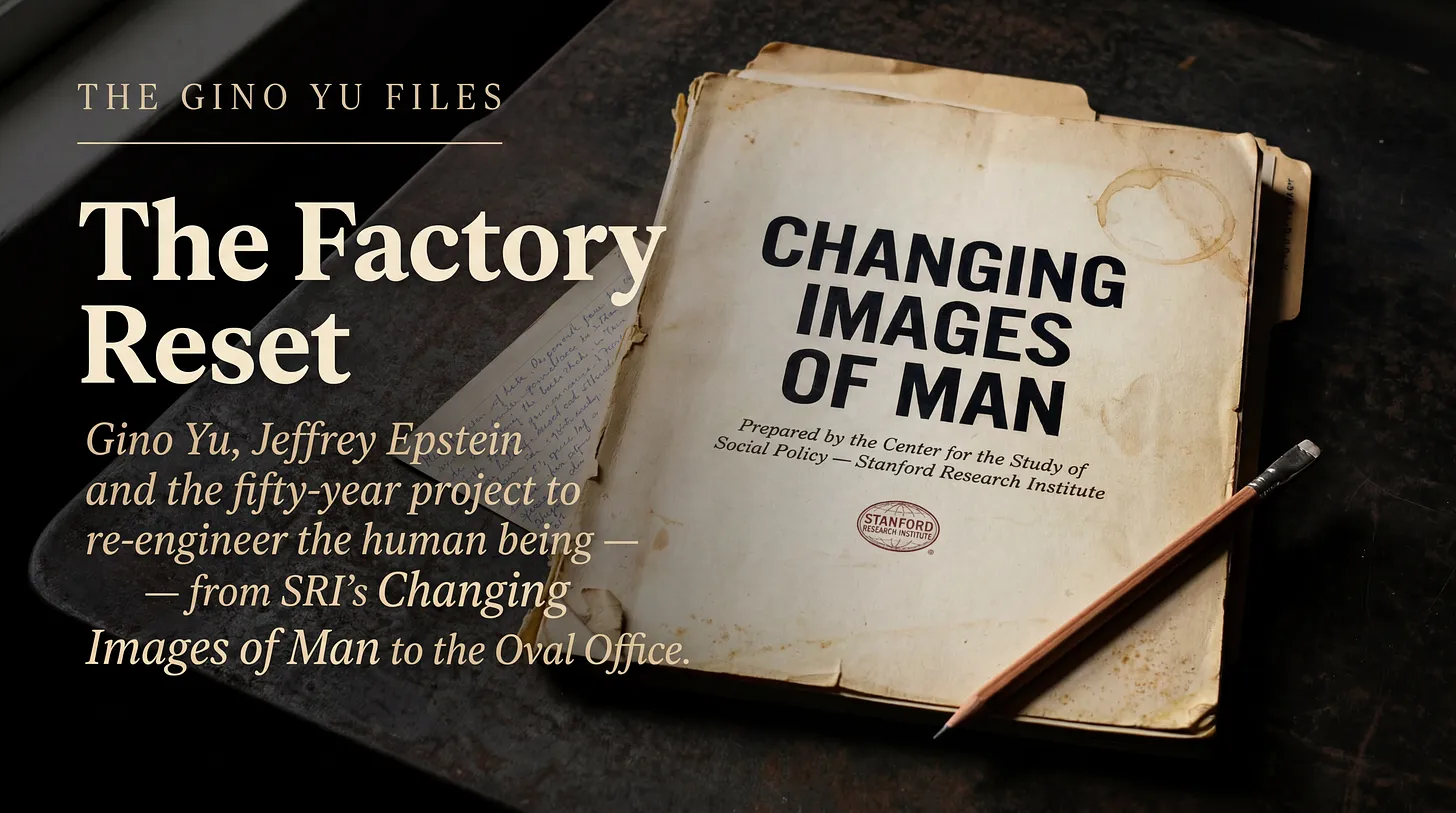
Source: https://courtenayturner.substack.com/p/the-factory-reset
A very long article
I’ve posted the first section only
For the full monty take the link above
“David started to explain to me world politics. So David would say, Jeffrey, money is going to be sort of the most important things.” — Jeffrey Epstein to Steve Bannon, 2019 (DOJ release, January 2026)
“The aim of the study is to change the image of mankind.” — Willis Harman et al., Changing Images of Man (SRI, 1974)
A note to the reader: This essay combines primary-source documentation, published reporting, and my own synthesis and analysis. Where I am drawing inferences or making interpretive claims, I have tried to say so explicitly. Named living persons are discussed only on the basis of their own published statements, their own documented correspondence, or reporting in identified outlets. Nothing in this piece alleges criminal conduct by any individual not already convicted of it.
A note on access and support. I’ve chosen to publish this essay free rather than behind the paywall, because in many ways it is a capstone of the prior work in this series — the synthesis the earlier pieces have been building toward — and I want it to reach as widely as possible. That said, my work is entirely reader-supported. If you are in a position to contribute financially and you value what I do here, please consider a paid subscription or a one-time contribution; it is what makes the research, the time, and the independence of this writing possible. For those who cannot contribute financially, sharing this essay and subscribing (free or paid) are themselves meaningful forms of support — they help the work reach past algorithmic suppression and into the hands of the people who most need to see it. Thank you for reading.
Contents
I. Opening: What the Epstein Files Reveal About Gino Yu
II. The Deeper Question: What Is a Human? The philosophical spine — Being vs. Becoming, perennialism, what Changing Images of Man actually says vs. what its lineage delivers.
III. Who Is Gino Yu? Berkeley, USC, PolyU — the Goertzel–OpenCog–Epstein funding chain.
IV. The 1974 Blueprint SRI’s Changing Images of Man.
V. The Operational Arm: Stargate And the scaling problem SRI never solved.
VI. Complexity as Cover: The Santa Fe Institute Including the 2005 identification of SFI in Project Russia.
VII. The Patron Epstein as funder-node.
VIII. The Monetary Leg: Cybernetics as Currency The Bannon interview, Rockefeller, Lynn Forester, CBDC, and purpose-bound money.
IX. The Yu Offer: Ego Death as Product Buddhism without the container.
X. The Inner-Technology Pipeline: From Huxley to the Oval Office The fifty-year civilizational arc from The Perennial Philosophy to Trump’s April 2026 psychedelic executive order.
XI. Game B and the Meta-Crisis With the ecosystem’s own vocabulary: meta-crisis, Liminal Web, integral community, metamodernism, psychotechnology.
XII. Two Paths to the Post-Human: Mechanical Rupture and Erotic Unity Two marketing departments, one social world. The dialogos circuit, ARC 2025, and the Lifeboat Foundation as three documented venues of the same convergence.
XIII. The Cybernetic Organism Personal, societal, machine, economic, and metaphysical layers.
XIV. Naming It What the architecture wants to replace — and what defending the human creature actually requires.
A note on the kind of claim this essay is making. The argument is not that a single conspiracy with one master plan has run continuously since the Macy Conferences. The argument is that a specific civilizational-engineering project — born in the cybernetic moment of the 1940s, articulated openly in 1974 in Changing Images of Man, and continuously elaborated since — has been carried forward across decades by an ecosystem characterized by four overlapping properties: shared metaphysical assumptions about the malleability of human nature; overlapping institutional and donor networks; inherited personnel across generational handoffs; and self-conscious rhetorical lineage in which later actors explicitly position themselves as continuations of earlier ones. Where I claim documented coordination, I document it. Where I claim ecosystem inheritance — networks, vocabulary, metaphysics, self-naming — I document the inheritance and let the reader weigh whether it constitutes coordination or convergence. Some passages rest on documented institutional pipelines (the LANL-to-SFI personnel transfer; the Maxwell-Pergamon-SFI-Epstein donor thread; the Yu-Goertzel-Epstein triangle). Some rest on rhetorical lineage explicitly named by the actors themselves (Eric Weinstein’s 2009 “Economic Manhattan Project” branding, the 2025 OpenAI-Oracle Stargate naming). And some rest on inferential reading that I have done my best to name as inferential where I make it. Both documentary and inferential evidence count in this essay, but they count differently, and a careful reader should be able to see which is which throughout.
What this essay argues, in one paragraph
A retired Hong Kong Polytechnic University professor named Gino Yu exchanged at least 548 emails with Jeffrey Epstein between 2015 and 2019, proposing that the two of them build a university “base” where Epstein-selected thinkers could be “developed and studied” using Yu’s five-stage model of consciousness transformation. That offer was not a private eccentricity. It was the scaling technology a fifty-year civilizational-engineering project had been waiting for — a project whose founding document is SRI’s 1974 report Changing Images of Man, whose operational pilot was the CIA-DIA remote-viewing program Stargate, whose respectable institutional rebrand was the Santa Fe Institute, whose patronage node was Epstein himself, and whose present-day custodians market the same program under the names conscious evolution, Game B, the meta-crisis, CosmoErotic Humanism, effective accelerationism, inclusive capitalism, purpose-bound money, and Homo Amor. This essay traces that fifty-year arc in documented detail and names what the architecture is trying to replace: the sovereign ensouled human being of the imago Dei tradition — the anthropology on which the American Founders built a constitutional republic ordered to protect rights that are anterior to the state because they are features of what the human creature is, and the anthropology without which no functioning limited government, due-process tradition, or inalienable-rights settlement can stand.
This essay uses several kinds of evidence, and they should not be weighed identically.
Documented fact means released correspondence, primary-source texts, public institutional records, legislative documents, corporate filings, published papers, and official biographies.
Published reporting means claims reported by identified outlets such as HK01, Dimsum Daily, Hong Kong Free Press, the New York Times, and others cited in context.
First-person testimony means accounts published or stated by the people involved, including Lydia Laurenson’s published essays, Ben Goertzel’s own accounting of Epstein funding, public interviews, and deposition material.
Source-based or inferential claims are marked as rumor, inference, “if true,” “in my reading,” or similar language. These are not treated as identical to documentary proof.
My synthesis is the interpretive argument connecting the documented nodes: the claim that these institutions, donors, vocabularies, and metaphysical assumptions form a recognizable civilizational-engineering ecosystem.
With that evidentiary distinction in place, the story begins in the Epstein files.
Why this matters now: This is not an archive exercise. The same architecture is now moving into policy, medicine, education, AI governance, digital identity, and money. The names have changed. The anthropology has not.
When the Justice Department dropped the final tranche of Epstein files in February 2026 —roughly three million pages, around 180,000 images, approximately two thousand videos — most of the headlines chased the obvious: the flight logs, the socialites, the politicians who suddenly remembered they had never actually been friends with Jeffrey. What got less attention, because it requires more patience to read, was the quieter story underneath.
Inside the cache was a retired Hong Kong Polytechnic University professor named Gino Yu.
A search for Yu’s name on the DOJ’s Epstein Library portal returns more than a thousand results. At least 548 of those, per HK01 and Dimsum Daily‘s review, are direct emails between Yu and Epstein, spanning from their first contact in 2015 through Epstein’s July 2019 arrest. Four years. An email every two to three days, on average. The two frequently met in person and attended parties together, and — per HK01’s review of the released correspondence, as summarized by Hong Kong Free Press — Yu referred to Epstein in the emails as his “benefactor.” In October 2017, Yu emailed Epstein to ask, “Is your island out of commission?” Epstein replied that the island was “destroyed” and added that “the US will not allow travel … so it’s a no go.”
And according to Dimsum Daily‘s February 3, 2026 review of the DOJ-released correspondence, Yu was the go-between who introduced at least one American writer to Jeffrey Epstein: the journalist and media strategist Lydia Laurenson, founder and executive editor of The New Modality. Laurenson has written publicly about her two meetings with Epstein, which took place in October 2017 at his Manhattan mansion, in a viral November 14, 2025 Substack essay titled “’It’s Just Politics’: The Time I Met Jeffrey Epstein, Twice.” In her own account she refers to the person who introduced her as “a mutual acquaintance” who dismissed Epstein’s reputation as “politics”; it was Dimsum Daily‘s review of the DOJ-released correspondence that identified the introducer as Gino Yu, reporting that “after cross-checking details, that go-between corresponds to Yu in the released correspondence.” Laurenson’s own first-person testimony about what happened in those meetings is published under her own byline and can be quoted directly. She describes Epstein steering their conversation to “New York City’s sexual history” and to what sex parties “were like before the AIDS crisis,” writing that “as the conversation intensified, something about his energy became intensely uncomfortable for me, even though I am accustomed to navigating such topics.” At the second meeting, she writes, Epstein took a phone call during which he said something like “Oh yeah, give the girl an internship,” named “several large amounts of money,” hung up, turned to her and told her that it was “the easiest thing in the world… to make it look like the money hadn’t come from him.” Soon after, Epstein “rang a bell and a group of young women entered the room. Really pretty women. Who looked like teenagers.” She watched him “pull one into his lap,” describing the girl as having “perfect features bored, as only a teenager can look bored.” Then, in her words, “Jeffrey immediately prompted me to start talking about the sexuality workshops I used to teach in my twenties. Then he encouraged the girls to ask me questions.” She also records the fresh-funding-after-introduction pattern in her own words: “Later, I got CCed on an email between Jeffrey and the person who introduced us. The email notified our mutual acquaintance that Jeffrey would send them a new grant of money.” In a March 16, 2026 update to the same essay, Laurenson wrote that she now believed Epstein was “essentially trying to get me sexually involved with both him and the girls during our meeting” and that she suspects “he hoped this would ultimately lead to a procuress-type role, similar to the one Ghislaine Maxwell allegedly played.” That is Laurenson’s own first-person published account of the recruitment pattern Gino Yu, per Dimsum Daily‘s identification, facilitated.
There is a separate, and in my reading still more consequential, piece of her story, which she published under her own byline in August 2022 on her Substack Solar Light, in a piece titled “What It’s Like To Suddenly Start Completely Believing In God.” In it, Laurenson recounts a 2016 business meeting with a man she calls “Jason” — “a hyper man in his fifties” working in “an emerging tech field” — who, during what she expected to be a routine digital-strategy conversation, induced what she describes as a sudden shift in consciousness. She describes him holding her gaze, noticing when her attention slipped, pulling it back with gestures and sensory cues, and then saying to her: “From here, I could totally mess with you.” As the session continued, her “consciousness shifted,” her “awareness opened outwards and expanded,” and Jason told her: “The world around you is a language. Forces are moving that we don’t understand. Reality is the mind of God.” Laurenson writes that the experience “outclassed every drug experience” she had ever had, that Jason had “not dosed” her, and that she emerged from the meeting a convinced believer in God — a transformation that subsequently reshaped her personal life and career. It is rumored that “Jason,” in Laurenson’s piece, is Gino Yu. If that identification is correct, then the chronology matters: the 2016 consciousness-induction meeting preceded by roughly a year the October 2017 meetings Yu arranged for Laurenson with Epstein. In that light, Laurenson’s 2022 account would become one of the most important first-person descriptions in the public record of what this consciousness work looked like when applied to a named adult professional in a private meeting, without drugs. That is precisely the scaling problem Section V will argue SRI’s Stargate program never solved: not merely finding rare gifted subjects, but inducing altered states in ordinary people in real time. It appears he was selling that capacity to Jeffrey Epstein.
Read Yu’s 2018 email to Epstein — “We’re not crazy. We are … geniuses” — alongside Epstein’s documented stated ambition, reported by the New York Times, to “seed the human race” with his DNA by impregnating twenty women at a time at his New Mexico ranch. This is not two separate fragments of elite weirdness. This is the same cultural operating system articulating itself through different mouths inside an overlapping network.
There is the October 2017 email in which Yu asked Epstein, “Is your island out of commission?” — to which Epstein replied that the island was “destroyed” and later added that “the US will not allow travel … so it’s a no go.” The correspondence does not specify which island was being discussed, though Little Saint James is the obvious candidate. There is the pattern of the Laurenson introduction discussed above — Yu bringing her to meetings at Epstein’s residence, and being copied on correspondence indicating that he received a fresh grant of money following the introduction — as noted in Dimsum Daily and HK01‘s review of the files. There is the context, well documented in Hong Kong press coverage, that Yu’s wife — Hong Kong business figure Lily Chiang Lai-lei, daughter of industrialist Chiang Chen and the first woman to chair the Hong Kong General Chamber of Commerce — had been convicted in 2011 of conspiracy to defraud, fraud, and authorizing a prospectus containing an untrue statement, sentenced to three and a half years’ imprisonment in connection with a HK$3 million share-option scam, and released on parole in March 2013 after serving twenty-one months. There is Yu offering to bring people with “interesting abilities” to meet Epstein for an hour at a time. There is Yu offering VR equipment “for you and your girls to play with,” with the cost framed as “ideally funded” out of “the 100K.” And there is, in 2018, a confessional email Yu sent to Epstein about his own neurology — ruminating on what he framed as Asperger’s — in which he wrote, “We’re not crazy. We are … geniuses.” Epstein’s reply was curt. He wanted to know what had prompted it.
But the thing Yu was really bringing Epstein was not social access, VR equipment, or introductions. It was a developmental model — a five-stage theory of human consciousness that Yu had been refining in public for more than a decade, paired with a proposal that the two of them build a “base” at a university where Epstein-backed thinkers could “thrive, develop new stuff, and also be studied” if willing. The correspondence names Joscha Bach, the German AI theorist, as one of the “people like Joscha” Yu proposed to test within the developmental program.
Develop. And be studied.
That phrase should stop you. It is not the language of ordinary academic collaboration. It is the language of a research program with human subjects — a program to shape and observe the consciousness of a selected cadre. And once you understand what Yu was actually offering, the entire Epstein science network comes into focus. The neuroscientists were mapping the substrate of the human. The geneticists were identifying the levers. The AI researchers were building the successor. Yu was offering something the others could not: the psycho-technology — the inner protocol, the stages, the interactive media, the contemplative scaffolding — by which an ordinary human being could be moved through an engineered transformation.
In 1974 the Stanford Research Institute argued that such a transformation had to happen if Western civilization was to navigate what the report itself called “the world macro-problem” — the interconnected web of population, resource, ecological, and institutional crises it identified as converging on the century ahead. Beginning two years earlier, in 1972, and for the twenty-three years that followed, SRI ran a classified program — jointly sponsored initially by the CIA and later by the Defense Intelligence Agency, consolidated under the umbrella name Stargate in 1991, and terminated in 1995 — that tried to operationalize altered states of consciousness for intelligence purposes: remote viewing of Soviet military installations, psychic surveillance of hostage situations, the induction of trance states in trainees who had never meditated. Stargate was, in other words, the classified attempt to engineer the very transformation Changing Images of Man called for publicly. The public report and the classified program shared an institutional home, an era, and an ambition. Gino Yu, fifty years on, was selling Jeffrey Epstein the working prototype.
This essay is an attempt to draw that line.