
Peace between US and Russia or Iran lies a long way off
Wed 11:09 am +00:00, 29 Apr 2026 1Why the US is at War with Iran and Why the War Might Pause but Won’t End
While much discussion of the US war of aggression against Iran has focused on region-specific factors, including the myth that the US is fighting Iran on “behalf of Israel,” there are far more realistic and important global factors that have led to the war and will unfold because of it.
This includes most recently Venezuela in Latin America. The early 2026 US war of aggression against the Venezuelan state, kidnapping of the Venezuelan president, and taking hostage of the remaining Venezuelan government led to the almost immediate cutting of Venezuelan oil exports to China and the distribution of Venezuelan oil wealth to US corporations.
A similar war of aggression by the US against Russia through Ukraine is also quickly expanding into a war directly against Russian energy production, storage, and export infrastructure through the use of drones that — while attributed to Ukraine — the New York Times has revealed are actually overseen by the US Central Intelligence Agency (CIA) and the US military.
Likewise, the US is encouraging its European proxies under a “division of labor” to expand maritime tracking, interdiction, and seizure of tankers carrying Russian energy exports, as well as a US campaign using maritime drones to attack the tankers. Again, the NYT has identified the US CIA and US military as having “supercharged” what are nominally claimed to be “Ukrainian” operations.
Together with the war on Iran, a clear, global pattern emerges of what is the deliberate US disruption, destruction, and even shutting down of energy exports to Asia in general, but to China specifically.
While the US was likely also attempting to quickly topple the Iranian government to enhance its control over the region and further isolate both Russia and China, a much wider and more global-focused objective was to cut off energy not just from Iran to Asia and specifically China, but from the entire Middle East to Asia and China.
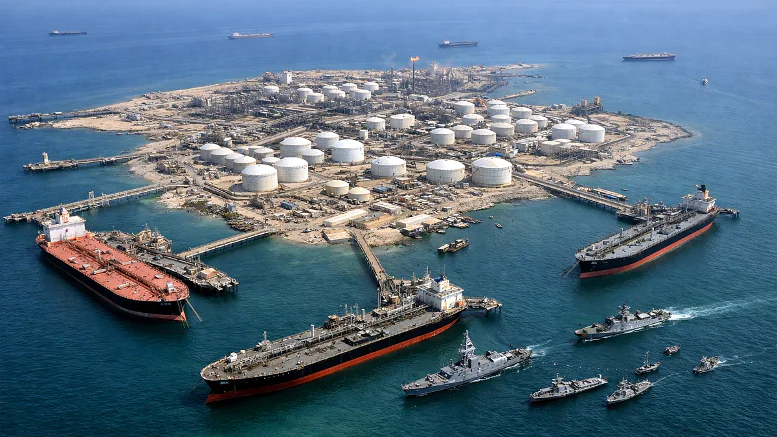
The most recent phase of US aggression against Iran — beginning in late February and as a continuation of violence launched against Iran in both 2025 under the Trump administration and even 2024 at the end of the Biden administration — involved targeting Iranian energy production as well as strikes on Kharg Island, Iran’s key energy export facility.
US strikes on Iranian energy production led to retaliatory strikes by Iran on America’s Persian Gulf Arab state proxies, including Kuwait, Qatar, the UAE, and Saudi Arabia.
Collectively, this violence led to reduced production across the entire region, subsequently leading to lower energy exports of gas and oil from the entire Middle East to China when compared with pre-war levels.
From the late-February start of hostilities to the recent ceasefire agreement, energy exports from the entire region to China dropped from approximately 52% of China’s total imported needs to around 30%, according to Reuters.
A March 2026 Politico article makes it clear that beyond just China’s dependence on the region for energy, Asia as a whole depends on energy imports from the Middle East for between 70% and 90%+ of their total energy import needs — especially US proxies like Japan, South Korea, the Philippines, and the island province of Taiwan.
Isolating China, Controlling Asia
Just as the US had previously done to Europe through its instigation of war with Russia in Ukraine, the destruction of the Nord Stream pipelines, and the implementation of sanctions on all other energy imports from Russia — and now including the striking of Russian energy production, storage, export facilities, and actual tankers carrying Russian energy exports — all of this forcing Europe into energy dependence on US exports — the US is now pursuing a similar policy targeting China and the rest of Asia by deliberately disrupting access to Middle East energy exports.
The war on Iran has led to the close regulation of maritime traffic through the Strait of Hormuz by Iran, followed by a US-imposed blockade primarily targeting ships exporting energy from Iran to China. While US claims of completely controlling maritime traffic to and from Iran are false, the US blockade has turned back or seized at least half of all maritime traffic attempting to leave Iran onward, mainly to China, the Financial Times reported.
This means that the total energy exports from the region to China have dropped yet again — with many other options held by the US in reserve to decrease regional exports to Asia and specifically China even further.
One option is the threat of resumed US military aggression against Iran, which could see both the deliberate targeting and wider destruction of Iranian energy production and export infrastructure and further Iranian retaliatory strikes on energy production across the US’ Persian Gulf Arab proxies.
The emerging consequences of the US war on Iran and the regional impact it is having are analogous to the US-destruction of the Nord Stream pipelines and the incremental targeting, sanctioning, and restriction of Russian energy flows to Europe, leaving only US energy exports as an option — an option that was not economically viable until the US eliminated existing, cheaper, and reliable alternatives.
With the US war open-ended — having continued from late 2024 to today — with only months of relative calm between US campaigns of military aggression, the prospects of accessing affordable and reliable energy from the Middle East for China and the rest of Asia are steadily fading.
“Serendipitously,” the US has already begun the expansion of an already massive energy production and export industry targeting Asia specifically.
In 2025, US-based energy corporation Glenfarne and its CEO Brendan Duval repeatedly mentioned the fact that their new LNG project under construction in Alaska could export energy to Asia “through uncontested and safe shipping lanes.”
No mention was made at the time that it would be the US itself contesting shipping lanes and making them unsafe and thus enhancing the viability of both Glenfarne’s Alaska LNG project as well as the expansion of US energy export capacity in general.
It should be noted that Glenfarne had honed its expertise in exporting/importing LNG through a project in Colombia made possible only by the US sanctioning of neighboring Venezuela and the closure of pipelines that would have otherwise supplied Colombia with gas. Only because of the US-imposed pipeline closure in Venezuela did the importing of Texas LNG to Colombia by Glenfarne make any economic sense.
Similarly, only through US threats of conflict and actual conflict endangering vital maritime chokepoints around the globe does the exporting of LNG to Asia and beyond make any economic sense — just like exporting US LNG to Europe only made sense after Nord Stream was destroyed and sanctions were placed on much cheaper and more readily available Russian energy.
The Cart Before the Horse, But for a Reason
By the early 2030s, the US is expected to double its LNG export capacity, making it capable of meeting the demands of key Asian proxies, including South Korea and Japan, as well as the island province of Taiwan — but again, only if cheaper and more reliable alternatives remain off the market.
This means that while the US is essentially placing the cart before the horse, it is ensuring that when the horse finally arrives, conditions are ideal for the US and the US alone to benefit.
Just like with Europe and the elimination of their access to cheap Russian energy imports, complete energy dependence on the US of America’s Asian proxies will transform them further and fully into extensions of US geopolitical ambitions in the region and around the globe.
Just like with Europe, serving US interests will come at the cost of each US proxy in Asia as well as at the cost of peace and stability for the entire region, and specifically at the expense of China’s continued rise, just as Europe has been used to target Russia at the expense of both Russia and the rest of Europe.
In addition to the US political capture of these Asian proxies, the presence of US military forces on their territory, and now the imposition of energy dependence upon them, a recent US Senate hearing has made it clear nations like Japan, South Korea, and the Philippines will be shaped into military industrial outposts of US power in the region, helping minimize the “tyranny of distance” the US is faced with when provoking war with China on the other side of the planet from where the US is actually located.
The creation of factories making US weapons in Asia and port facilities in the region for implementing repairs on US ships is already underway, with Japan having manufactured and, in some cases, even sending back to America Patriot missile interceptors and South Korea securing deals to maintain US naval cargo vessels.
All of these preparations are taking place ahead of what the US sees as an inevitable confrontation with China itself – which is ultimately the priority driving US conflict against Russia, Iran, Venezuela, and many other nations in the first place, all as a means of first isolating and containing China before confronting it directly.
Considering the costs Europe and Persian Gulf Arab states are paying for their subordination to the US and their role in hosting and facilitating US wars of aggression in their respective regions of the world, Japan, South Korea, and the Philippines are likewise painting targets on themselves ahead of any confrontation with China.
What the US often refers to as “security guarantees” for its “allies” is merely a euphemism for US military occupation, political capture, and control of what are actually proxies — not allies. The purpose of maintaining a global network of proxies from Europe to the Middle East to the Asia-Pacific is specifically to have other nations pay all the costs for US foreign policy, allowing the US to assume any and all benefits solely for itself.
The prospect of US war around the globe continuously escalating in the near to intermediate future is inevitable because the wars taking place now are being fought specifically to prepare for a future confrontation with China itself. For this reason, the prospects of the US arriving at any sort of “peace” deal with Russia or Iran are near zero.
Until the interests driving US foreign policy — including the arms industry, big oil and gas, big tech, the automotive industry, and many others — are displaced around the globe by the alternatives offered by multipolarism, and until the multipolar world can create sufficient deterrence against not only US military aggression but also the economic coercion, political interference, and capture that lead to that aggression, the US will continue to hold global peace, prosperity, and stability hostage to its demands for continued unipolar hegemony over the planet.
Brian Berletic is a Bangkok-based geopolitical researcher and writer.
Why the US is at War with Iran and Why the War Might Pause but Won’t End










Interesting analysis. But it is missing the top layers of the pyramid, the unknown, unknowns, the global owners if you like
Countries and sovereign states mean nothing to them. They have no loyalty, maybe other than their own class, and even then….
They are satanic, anything goes
Has to be that way in such an analysis I suppose, given that they are largely unknown. But it’s very relevant