
“The censorship remains absolute. I can barely find footage of any of it”
Fri 11:48 am +00:00, 13 Mar 2026 1If Hormuz really is being mined that spells long term trouble
Source: https://www.theburningplatform.com/2026/03/13/march-12-fafo/#more-399336
The cardboard cutout spoke.
The Strait of Hormuz will remain closed. All US bases in the region must be shut down immediately. Iran demands reparations, or property belonging to the aggressors will be seized or destroyed. Studies have been conducted on opening additional fronts “where the enemy has minimal experience and would be highly vulnerable”. And vengeance for Minab will not be forgiven.
While these words were being read, the IRGC launched Wave 42 of True Promise 4. Simultaneously. Codenamed “At Your Service, O Khamenei” – the first military operation formally dedicated to the new Supreme Leader. Emad and Qhadr multi-warhead missiles at Tel Aviv, Jerusalem, and US bases.
750kg payload fireworks.
Trump, the same day, told reporters the war had “already been won”. That the straits were “in very good shape”. That America had “knocked out most of their boats”.
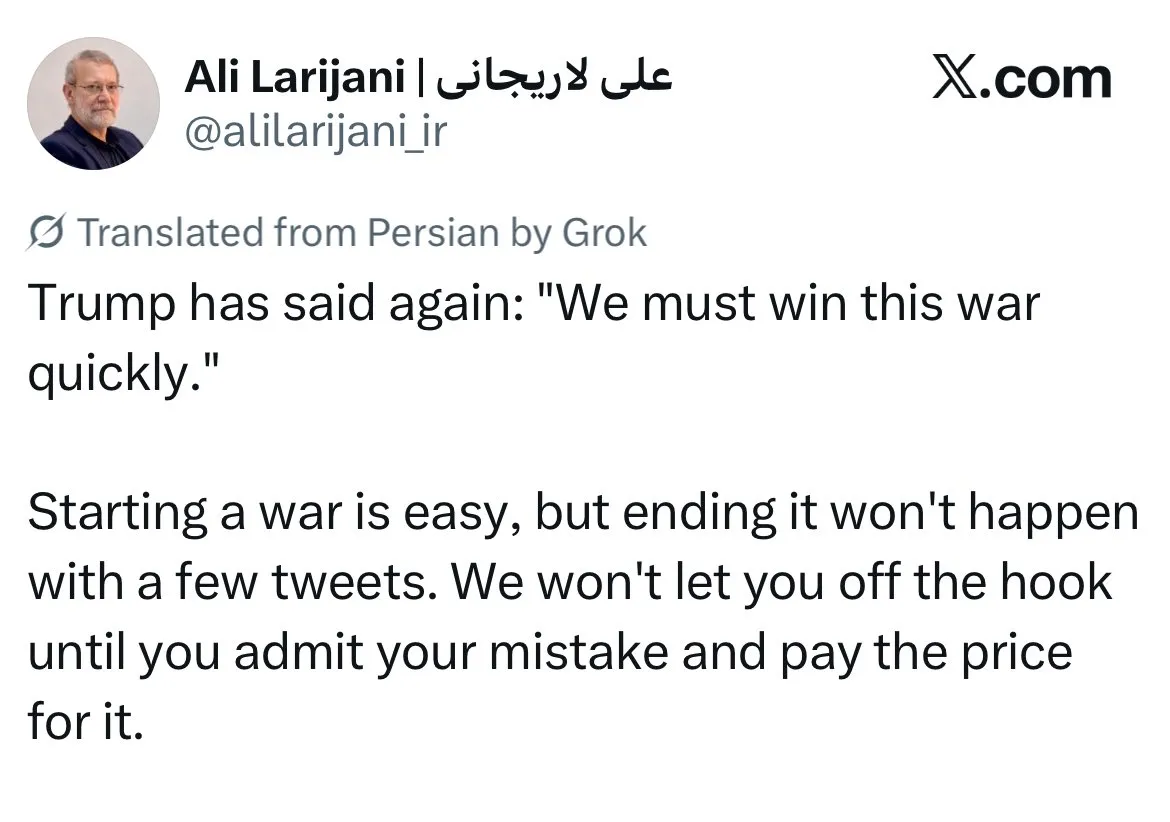
Larijani’s response: “Wars cannot be won with a few tweets, Trump”.

Tehran is being carpet-bombed. That is not hyperbole.

Iran’s Red Crescent put numbers on it: over 20,000 non-military buildings hit since day one. Of those, 17,353 were residential. The rest: hospitals, schools, commercial buildings, infrastructure.
CENTCOM released strike footage of transport aircraft – a C-130 Hercules, a P-3F Orion, an Il-76. Real planes this time. Not paintings.

Iran’s Foreign Minister went further: “Israel is bombing Iranian historical monuments dating as far back as the 14th century. Multiple UNESCO World Heritage Sites have been struck”. His line was surgical: “It’s natural that a regime that won’t last a century hates nations with ancient pasts. But where’s UNESCO?” Good question. Silence, apparently, is UNESCO’s mother tongue.

And then there’s Parchin. Satellite imagery from Maxar and Planet Labs shows significant damage at the Taleghan-2 facility inside Iran’s Parchin military complex. The weapon used is said to be the GBU-57 Massive Ordnance Penetrator – the largest non-nuclear bomb in America’s inventory. Whether it reached anything important under 80 metres of rock is a different question. The enriched uranium moved long ago. Even JD Vance admitted it.
Over Israel, 717 Home Front Command alerts triggered by midday – and that’s without counting the previous night’s barrage. Alerts, not impacts. But 717 sirens in half a day tells you everything about the state of what’s left of the early warning network.
Iranian cluster munitions reportedly struck outside Jerusalem’s Old City, near Al-Aqsa Mosque and the Church of the Holy Sepulchre. The three holiest sites of three religions, give or take, in one blast radius. Symbolism aside, the targeting accuracy on display is the story. These aren’t random launches hoping to land somewhere useful. They’re arriving precisely where someone chose to put them.
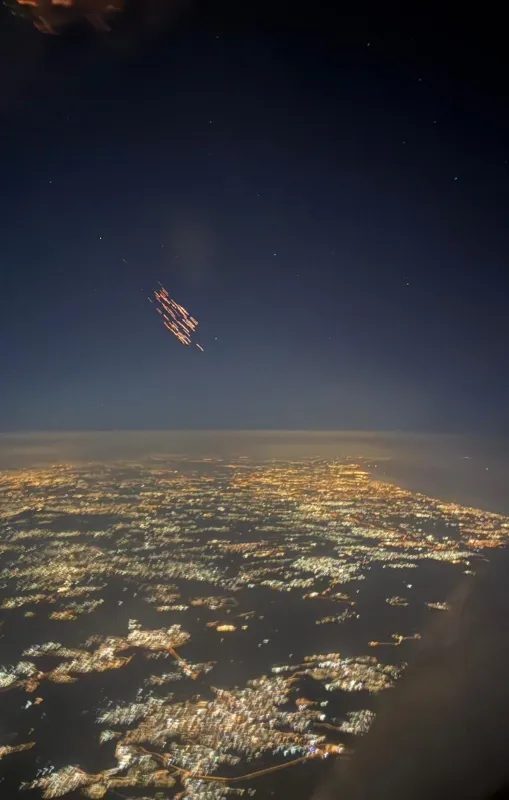
The censorship remains absolute. I can barely find footage of any of it. An Israeli Air Force pilot filmed ballistic missiles raining down on Israel at night. Mesmerising footage, if you can ignore what it means. But that’s about all that leaked. The BBC’s own reporter called the blackout “unprecedented” last week. It hasn’t improved.
Thirteen Israeli dead. Officially. Day fourteen of continuous bombardment from two axes. Thirteen.
The absence of data is itself data.
Beirut is being Gazified.
Al Jazeera captured the moment the IDF struck a building in Bachoura, central Beirut. Live. On air. The southern suburbs took another overnight pounding. Dahiyeh, the Hezbollah heartland, where command centres share walls with bakeries.
Hezbollah launched a named campaign for the first time in this war: “Operation Severe Storm”. Forty-three operations in a single day. A hundred-plus rockets in one barrage at Haifa, Galilee, and the Golan. Israeli Channel 14 admitted Hezbollah had “shifted from defence to offence, carrying out preemptive strikes with tremendous firepower”. When a military organisation names its operations, it’s not defending anymore. It’s advertising.
Then Ramlet al-Bayda. A drone double-tap on displaced families sleeping in tents on Beirut’s seafront. “Targeting a very specific person”, the IDF claimed. What they hit were displaced children sleeping on the sand. They picked up pieces of their bodies.


Israel’s Defence Minister Katz ordered the IDF to “prepare to expand the activity in Lebanon and restore peace to northern communities”. The expansion is already underway. Displacement orders now extend north of the Litani River to the Zahrani River – pushing the evacuation zone deeper than anything seen since 2006.
Hezbollah answered by hitting Unit 8200’s headquarters at the Glilot base, suburban Tel Aviv. 110 kilometres from the Lebanese border. Guided rockets. Plus salvos at the Misgav base, Yodfat military industries, Haifa naval base, and Tirat Carmel. The range of what’s coming out of Lebanon keeps stretching.
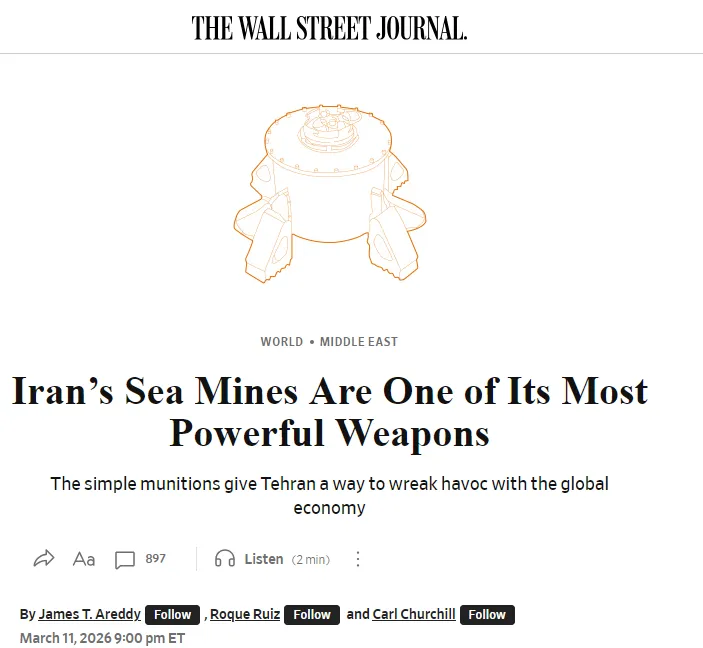
The Strait of Hormuz is apparently mined. Or so says the Wall Street Journal, citing US officials and “the Institute for the Study of War”. Ten mines, allegedly. The UK’s Healey added that “evidence mounts”.
Iran’s deputy foreign minister denied it. No mines.
I believe Iran on this one.
Mines don’t check passports. A naval mine detonates on magnetic signature, pressure change, or acoustic detection. It does not care whose flag flies above the hull. Chinese tankers are transiting freely every single day, confirmed on MarineTraffic. If the strait were mined, they’d be hitting those too.
So why float the story?
Because “we can’t escort tankers through a mined strait” sounds considerably better than “we can’t escort tankers because we’d get hit”. The world’s most powerful navy has been unable to open a 33-kilometre waterway for two weeks. That’s embarrassing. Mines provide a technical excuse that avoids the simpler, more damaging explanation: Iran’s coastal defences work, and the US Navy doesn’t want to test them. The mines are cover. For impotence.
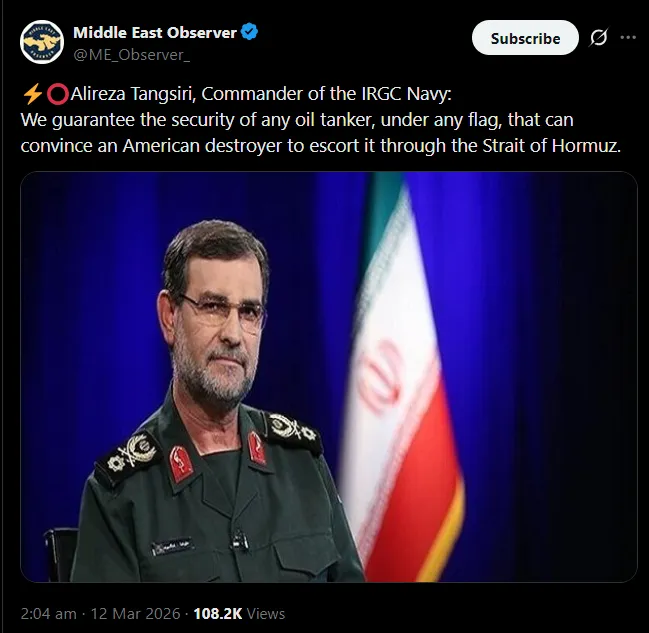
The IRGC Navy commander Tangsiri: “We guarantee the security of any oil tanker, under any flag, that can convince an American destroyer to escort it through the Strait of Hormuz”.
What isn’t fiction is the tollbooth.

India’s Foreign Minister called Iran’s Foreign Minister and asked permission to transit an international waterway. The world’s fifth-largest economy, nuclear-armed, with the fourth most powerful military on Earth, called Tehran and requested a waiver. And got one. The tanker Shenlong arrived in Mumbai loaded with Saudi crude, having sailed straight through Hormuz. Two more Indian tankers – the Pushpak and Parimal – also passed.

Bangladesh secured the same deal.
China already had it. The strait isn’t closed. It’s a members-only club. And the membership criteria is: not being allied with the people who started the war. Although India?? Note to self: worth keeping an eye on that.
For more economical background: Strait to Brrrr
The Safe Sia was not very safe at sea (sorry, couldn’t help myself). It was struck in the northern Persian Gulf near Basra. Marshall Islands-flagged, US-owned. One Indian crew member killed. Thirty-eight rescued. First confirmed fatality among tanker crews in this war.
Two more fuel tankers were attacked in Iraqi waters overnight. Explosive-laden Iranian boats. Reuters confirmed both were set ablaze. That brings the total to at least eighteen commercial vessels struck since day one. Brent nearly touched $100 again before settling near $98.5. The IEA, in a moment of unusual candour, called this “the largest supply disruption in the history of the global oil market”. 7.5% of global crude supply offline. Eight million barrels a day lost in March alone.
The Energy Secretary said $200 a barrel is “unlikely”. The IRGC said “not a single litre of oil”. One of these statements will age better than the other.

Trump, asked about oil prices: “We make a lot of money when oil prices go up”.
Making money while schoolgirls get massacred. Another great statement from the President of the United States.

The USS Gerald R. Ford – the most expensive warship ever built, $13.3 billion – caught fire. In the laundry. While operating in the Red Sea off the Saudi coast. CENTCOM says: not combat-related, contained, two sailors treated for non-life-threatening injuries. The previous night, an E-2D early warning aircraft from the Ford squawked 7700 emergency and diverted to an Israeli airbase.
A laundry fire on a $13.3 billion aircraft carrier during an active war. The same ship that was -for lack of a better term- full of shit not too long ago. They make it way too easy for me.
The FBI distributed an intelligence bulletin to California police departments warning that Iran “aspired to conduct a drone attack from an unidentified vessel off the US West Coast”. Same week, the Army announced a reward for four military drones stolen from Fort Campbell – reportedly taken months ago, but publicised now. Convenient timing for a missing-drones story to surface alongside a missing-threat story. If something happens in California, the narrative is pre-built.
Iraq is burning again. As if it ever stopped.
US A-10s struck PMF positions in Mosul. A-10 Warthogs it seems. On the way out, I thought. Apparently they got the call back like the rest of the Cold War inventory. Airstrikes hit three sites belonging to the 19th Brigade of the Popular Mobilisation Forces in the Akashat area of Anbar province – the medical headquarters, a battalion headquarters, and a support base. Reportedly thirty dead, fifty wounded.
Iraqi Resistance launched Shahed drones at US bases in Erbil and Victory Camp in Baghdad.

Iran warned Syria directly: any attempt to interfere in Lebanon’s battlefield will be treated as a direct act of aggression. The Iraqi Resistance Coordination issued the same warning to al-Julani: if he wants to relive his glory days chopping heads in Lebanon, the entire Axis of Resistance treats it as a declaration of war. The Syria front that everybody thought was settled is being reactivated.

A US intelligence assessment – not from Twitter, not from Iranian state media, but from the intelligence community’s own reports shared with Reuters – concluded that Iran’s leadership “remains largely intact” and is “not at risk of collapse any time soon”. The regime “retains control of the Iranian public”. Israeli officials in closed discussions acknowledged there is “no certainty” the war will lead to the government’s downfall.
On day one, the stated objective was regime change. On day fourteen, the regime is intact, has a new Supreme Leader who hasn’t even shown his face and is already launching offensives named after himself, and America’s own intelligence says it isn’t working.
The war costs $11.3 billion for the first six days of operations alone. Not counting munitions. Pentagon briefed a closed Senate session with the number. The NYT and NBC both confirmed it. That’s before interceptors, before infrastructure repair, before the long-term costs that haven’t even started accruing. At a billion-plus per day on top of a $3 trillion annual deficit, this is the most expensive failure of real estate due diligence in human history.

Saudi Aramco is negotiating to buy drone interceptors from Ukraine. That sentence is the 21st century in a single transaction. The world’s largest oil company buying weapons from the country Russia has been bombing for four years, to defend against the country America has been bombing for two weeks. The WSJ reported that a Saudi intermediary is in advanced talks with Ukrainian manufacturers SkyFall and Wild Hornets.
I need a murderboard to track who’s selling weapons to whom.
The United Nations Security Council passed a resolution condemning Iran. Russia and China abstained. Both delivered rebukes. Russia’s Zakharova said Iran has “the right to self-defence”. China condemned the US-Israeli strikes within hours of day one. Thirteen days later, Beijing has not once named Iran as the attacker of any Gulf state. Not the UAE. Not Bahrain. Not Kuwait. Not Qatar. Not Oman. Not Saudi Arabia.
Read that silence carefully. It’s the most expensive non-statement in geopolitics.

Poland’s Prime Minister stated plainly: “Polish and American interests overlap significantly, but they are not entirely identical”. That’s diplomatic speak for “you’re on your own, mate”.


Italy’s public agrees. New polling: 69.5% of Italians want to follow Spain’s lead and deny US military bases. Only 15.9% disagree. NATO’s southern tier is turning.
An Iran-linked hacker group called Handala claimed responsibility for a cyberattack on Stryker Corporation – the American medical technology company whose surgical robots and joint replacements operate in hospitals across 79 countries. Claimed 200,000 systems wiped and 50 terabytes extracted. WSJ and ABC confirmed the attack. The war just entered the operating room.
The cyber front has a symmetry to it. USrael struck Bank Sepah’s data infrastructure. Iran’s proxies hit a surgical equipment manufacturer used by hospitals globally. An eye for an eye. A server for a server.
South Korea lost all six THAAD launcher vehicles to redeployment in the Gulf. The radar and fire-control units are “expected to follow”. Expected. Not confirmed. Without the radar, the launchers are spectacularly expensive lawn ornaments. Seoul, which also has very little LNG left and a stock market that triggers circuit breakers every day that ends in a y, is left with either incomplete missile defence or none at all.

Kim Jong Un visited a munitions factory with his daughter the same day. Test-fired some guns together. More bonding.

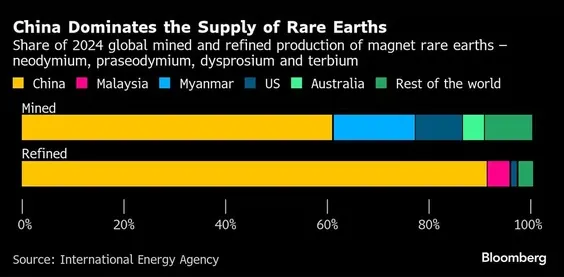
The US has two months of rare earth materials remaining. Two months. The radars being destroyed across the Gulf require yttrium. China holds 98% of global production and banned exports (link). The destruction is, in practical terms, permanent.
And a detail that’s buried in the supply chain news: Qatar’s LNG shutdown has also taken out roughly a third of global helium supply. Helium is irreplaceable in chip fabrication. No alternative exists at Qatar’s volume. The AI boom that was supposed to save the economy needs chips that need helium that comes from a country currently telling its entire population to stay indoors.
The Houthis went off-grid. No launches. No statements. I noted it yesterday. Today: still nothing. Whatever they’re preparing, the planning phase involves radio silence.
And Israel’s casualty count remains thirteen. After fourteen days. Two simultaneous fronts of continuous bombardment. 717 alert activations in a single half-day. Cluster munitions over Tel Aviv. Ballistic missiles arriving without sirens.
Thirteen dead.
The Israeli military censorship that the BBC called unprecedented is doing its job perfectly. What I can’t see, I can’t verify. What I can’t verify, officially didn’t happen. The absence of data is doing more to foment speculation than I ever could.
Iran’s air force, meanwhile, still hasn’t shown itself. The jets that were hidden underground before day one – the ones I’ve been asking about since the paintings were being bombed instead of planes – remain invisible. I didn’t notice that anyone had engaged an Iranian fighter since the Yak-130 training jet on day five. The real aircraft are somewhere. Waiting for something. Or they’re gone and nobody wants to admit it. Either way, it’s a question mark that keeps getting larger.

Diesel in Europe has surged 55% in ten days, past $1,100 per ton. Base fuel for freight, agriculture, and mining.
The cardboard spoke today.
The cardboard said FAFO.
Still devolving…










Great post Pete, thanks.