
National Heroes – A TV presenter? Really?
Sun 6:01 pm +00:00, 10 May 2026 9
Source: https://jupplandia.substack.com/p/100-years-of-condescension
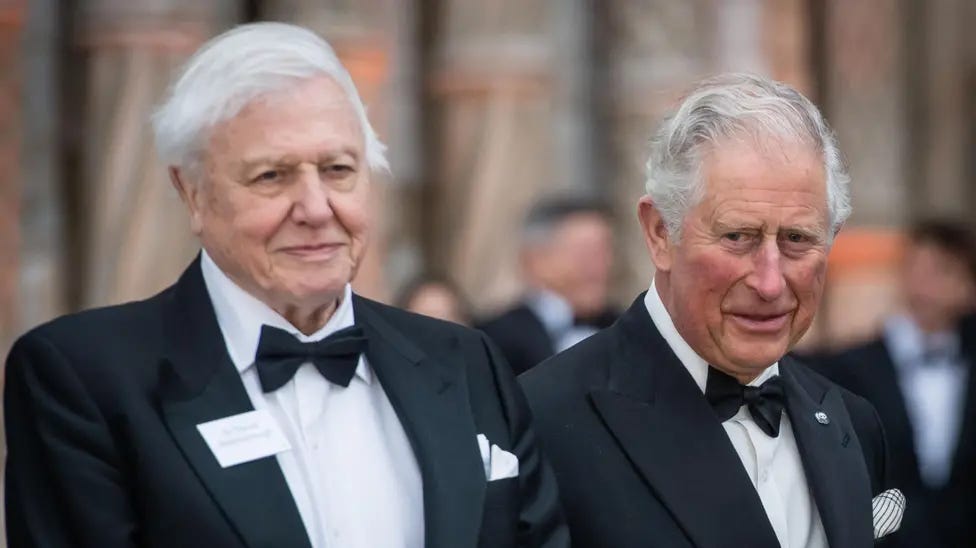
Above: upper class warriors for The Planet with impeccably Globalist credentials.
National heroes are, in my view, a very good thing. A nation should celebrate its greatest men and women, and teach its children to do so as well. In modern times, and in some ways perhaps for an entire century, Britain under the guidance of Fabian and Marxist distortion of our history, has refused to do so. Victorian and Edwardian children read adventure book stories of English courage, gallantry and resolve. Their lessons were filled with Nelson, and Drake, with explorers and warriors, with kings and queens, and with an unashamed casting of such as heroes or villains based on loyalty to their nation, success and achievement, or (in the case of villains), betrayal of the same, failure and disaster.
From Captain Cook to Scott of the Antarctic, and from Boudicca to Queen Elizabeth I, the qualities that formed our national character-perseverance, endurance, self-assurance, loyalty, wit and flashes of brilliance-were given real examples.
Nations need history, and history needs heroes. That’s what brings it alive. That’s what makes it real. That’s what teaches younger generations to care about who they are, to value their own country and people, and to feel a responsibility to preserve an inheritance and to themselves meet high standards of courage and behaviour.
At first the Left tried to entirely destroy this instinct, this love of heroes. They removed all the heroes from the curriculum, or if they mentioned them, they turned them into villains. They sneered at every achievement, especially those linked to Empire. They removed the adventure books from school libraries. They broke the consistent narratives of self identity by leaving huge gaps in the history curriculum, and they had Marxists write the textbooks and exam papers. Today of course they ‘decolonise the curriculum’, deliberately removing as many native British voices as they can. The true theme of a people who invented Liberty and fought again and again for their own freedom, was replaced by the self hating narratives of white guilt and perpetual apologia.
The Fabian Society was formed in 1884. Eminent Victorians, Lytton Strachey’s elite sneer at the heroic concept inculcating the idea that all heroes have feet of clay or are secret perverts, was published in 1918. The ‘lions led by donkeys’ interpretation of World War One speeded the leftist task of deconstructing and demeaning old heroes and the ideals they represented. All this (modern tearing down of statues and modern obscenities like the raising of the Banksy statue alongside a Crimean War memorial in deliberate contemptuous mockery of our past) has been a long time coming.
But the interesting thing is they just couldn’t erase the persistent and human need for other people to admire. It diverted into celebrity. It focused on actors and football players instead. A few real examples simply could never be tarnished enough, or their greatness was too recent to be easily forgotten (Churchill, for instance). And even the Left grew to understand the heroic impulse, artificially inflating their own ‘heroes’ to serve anti-national agendas.
In film, a curious dying gasp occurred. At the moment of leftist capture of all social rules, the 1960s, films like Lawrence of Arabia (1962), Zulu (1964) and Khartoum (1966) provided a reminder of all that had been lost, with the deliberate elements of self-undermining smuggled into the scripts utterly overwhelmed by the powerful facts of courage underlying the true events and despite any intentions to the contrary making this triptych deeply nostalgic and patriotic. Slightly earlier WWII set pieces like Ice Cold in Alex (1958) still showed a firm understanding of what British heroism looks like.
In the TV era though, we experienced the curious phenomenon of the ‘National treasure’, a person who by ubiquity on our TV screens accessed a diluted, rather pathetic version of the affection in which real heroes were once held. Longevity in TV became the equivalent and substitute for real world achievements. We were no longer allowed to cherish those who won battles or invented things or made Britain more powerful. But we were allowed to obsess over vapid celebrities, subsume all national feeling into the fortunes of a football team, and think that somebody had achieved a worthwhile task by being on our TV screens for 20 or 30 years.
And nobody has been on our TV screens longer than David Attenborough.
Attenborough is a perfect ‘hero’ for our times. He’s not actually done anything other than present TV shows. He comes from a privileged background, and has reassuring good manners (still important to the elite, even while national loyalty isn’t). On the surface, his animal documentaries represent an area that should be non political. They should encompass love of animal life, awe at natural beauty, and respect for the ecosystems we also inhabit. There is much of that which all of us can share. But in reality these things have been heavily politicised, and like general leftist claims of altruism mask an increasingly hectoring demand for policies that actually hurt ordinary British people. Attenborough is a ‘national treasure’ with no national component in that at all. He is a world traveller, the ultimate global citizen, more concerned with the fate of coral reefs than the fate of the British voter, all his care invested in animals and The Planet, with apparently very little left for humans and his country.
Back in 2019 Spiked published an article of mine on Attenborough:
(https://www.spiked-online.com/2019/07/17/david-attenborough-upper-class-warrior/)
I offered that when his politics became clear. I repeat it below as a final comment on why the media and Establishment are so excited by Attenborough’s 100th birthday:
“If you are British and have watched television at any point in the past 50 years, you know who David Attenborough is and you know what David Attenborough does. Many people find it impossible to imagine a nature documentary without hearing his slightly urgent, curiously authoritative whisper – always expected, always reassuring. When you think of David Attenborough, you think of blue whales bursting out of the waves, gazelles being tackled in slow motion by a lioness, or huddled penguins moodily enduring a blizzard. For more decades than I have been breathing, Attenborough has been educating and enthralling us in equal measure with the wonders of nature and the precariousness and beauty of life.
But even as his constant presence on our screens turned him into a national treasure, few of us knew who Sir David was, or what he thought about anything (besides his devotion to the great outdoors). Like many others, I always thought he was a cuddly, genial figure with a nice mellow voice, who liked sitting next to gorillas. I am less in awe than other people about his televisual longevity. I think that making essentially the same nature documentary roughly 10,000 times is not an automatic qualification for sainthood. But I’m as ready as the next man to sit down for a relaxing bit of lion watching. So I’m grateful for Sir David’s efforts.
But the sad truth is that, in his twilight years, a new figure has emerged, a new light has been cast on the Attenborough legacy. He recently made a Corbynesque appearance at Glastonbury, tottering out from backstage to deliver a short, sharp lecture on climate change, the sad fate of polar bears, and the naughtiness of plastic. The Glastonbury audience listened carefully, of course. Sir David lavished praise on the audience for not buying any of the plastic that was not available to buy this year, and the audience roared with approval. It was an ecologically conscious version of ‘what a great crowd you are’, including a tactful failure to mention the several hundred tonnes of discarded trash that the Glasto crowd leaves behind each year.
Like Jeremy Corbyn or Channel 4’s scrupulously impartial Jon ‘fuck the Tories’ Snow, Attenborough has shown himself to be another elderly, middle-class man suffering under the delusion that he is an 18-year-old student radical. And Glastonbury was not an isolated incident, either. Anything a 16-year-old Swedish girl can do, Sir David has obviously decided, he can do, too. Forget the splendours of nature, huddling down close to a termite mound in South Africa, or watching a crocodile barrel roll its next meal in the Zambezi – Attenborough’s attention is now fixed firmly on the human zoo of politics.
In a recent appearance before parliament’s Business, Energy and Industrial Strategy Committee, he compared changing attitudes to plastic to changing attitudes to slavery. He also complained that air travel was ‘extraordinarily cheap’. He called for prices to be hiked, conceding that this would hit the poor hardest. At the same time, he admitted that he himself travels by air ‘frequently’. The best way to ‘restrict’ air travel would be ‘economically’, he argued. So a man who has clocked up more air miles than the average African dictator is deeply concerned that your once-a-year package holiday to Spain is destroying the planet. If Attenborough had his way, a certain class of people (by coincidence, his class) would be allowed to jet around the world enjoying themselves, while others would be restricted from doing so.
Attenborough also seems to think that the British people must bear the greatest cost of green policies because our ancestors developed, discovered and invented more rapidly than those in other parts of the world. Britain ‘started the problem’, said Sir David, to parliament. ‘It was the Industrial Revolution that started here, based on burning coal.’ For Attenborough, the Industrial Revolution was a crime for which people who were not alive at the time must be condemned.
While Sir David observes lions, whales and penguins with a certain geniality, he doesn’t seem to extend the same warmth to his fellow man, especially the poor and working class. Like much of the liberal elite, he sees us as a species to be studied, guided, ruled, prodded and nannied.
And isn’t it revealing, when we consider the class Sir David represents compared with the class that will bear the burden of environmentalist measures? The rich will not struggle to pay more expensive airfares. They will not lose their weeks in the sun. They will not lose the industrial or manufacturing jobs that will be sacrificed to climate-change activism. They will not suffer. But we will.”










Read the book Propaganda by Jacques Ellul (French in original – English version by Vintage ISBN 978-0-394-71874-3). It explains how the system is and has to be all as one. These two are co-workers in the mind programming units. Propaganda is total or it is nothing. No places of quiet can be left or your mind has a space to work out the games being played. Turn off and avoid all media. Head for silence and see what your mind is saying to you. Otherwise you will never know.
Was Churchill so great? I have read that sometimes he was so drunk that someone else had to write and make his speeches for him.
Norman Shelley recorded all Churchill’s speeches. I knew Norman and his son Anthony. They were very proud that Norman was the WW2 Churchill – not denied until later by the media. It was a well known fact at that time – 1960s. Churchill was known to be of low ability at school. So why would he become a genius later? He was a puppet of Victor Rothschild who managed the character for the purposes of conning the public. Listen to a Churchill recorded pulic speech and you will be shocked by how boring and bad he was. Churchill was not a Churchill btw but the son of Edward 7th, and the grandson of Queen Victoria, which is why the royal family always called him Winnie and were close to him. QV was the daughter of Nathan Mayer Rothschild making Churchill a Rothschild cousin. Both of Charles’ parents were great grandchildren of Queen Victoria.
Wiki – According to Shelley’s great friend, former BBC radio and TV producer and presenter, Trevor Hill, Shelley did stand in for Churchill on at least three occasions, specifically when Churchill was ill or out of the country. That would never have been divulged at the time. Shelley’s party piece, apparently often requested, was for everyone to close their eyes while he impersonated Churchill, and on those occasions, according to Hill, it was impossible to tell the difference.
“He was a puppet of Victor Rothschild who managed the character for the purposes of conning the public”. Sounds familiar, same old same old right up to the present day
“QV was the daughter of Nathan Mayer Rothschild”. So all our “royals” are Rothschild bloodline then. Sounds right, fakes the lot of them
Hitler Was a British Agent
Greg Hallett
3.87
23 ratings7 reviews
Hitler was a British Agent covers Hitler’s psychological training in Britain during his missing year (1912) and how this was activated throughout WWII to steer him as a puppet of British intelligence, carrying out their plan to destroy the European powers, particularly France, Germany and Russia (TAP -and of Britain’s Empire – world government requires all powerful nations to be crushed) . For the first time Operation WINNIE THE POOH is Hitler’s escape out of Berlin on 2 May 1945 with the help of Ian Fleming of James Bond fame. It gives the time and circumstance of Hitler’s real death. Rudolf Hess’ flight to Britain is solved, as is the Duke of Kent’s crash and apparent death. Both died in different countries and different decades from the official versions. Many history books are difficult and unpleasant to read. This one is an exception. As you turn the pages, you get to know the people who pulled the strings. Some people say, it is like the “Who’s who” of the 20th century. This book created a new ‘Historical Crime Solving Non-Fiction’.
I will have a look at that, thanks Tap
I will compare and contrast with McGregor and O’Dowd’s 2025 book:
“Two World Wars and Hitler
Who was responsible?
Anglo-American money, Foreign agents and Geopolitics”
This book shows clearly who the British and US handlers were for agent Hitler. They managed him all through his rise to power in 1930’s and into WW2
Hallett’s book is £56 at Amazon
All other bookfinders drew a blank
But I found it an the internet archive:
https://dn721606.ca.archive.org/0/items/hitler-was-a-british-agent-by-greg-hallett/Hitler%20Was%20a%20British%20Agent%20-%20by%20Greg%20Hallett.pdf
And I downloaded the pdf. Only 55 pages
Don’t spend £56 unless you’re very determined to. It’s fairly basic, but the narrative of who was who in English history seemed very believable to me, and explains how we are where we are.