
Keir Starmer’s policy on the Iran war is a recipe for catastrophe
Wed 9:09 pm +00:00, 25 Mar 2026 4The British government has learned no lessons from the disaster that the US-UK invasion of Iraq was.
In March 2003, a million people took to the streets of London to oppose the illegal invasion of Iraq. Seeing straight through the lie that Iraq possessed weapons of mass destruction, protesters warned the British government in no uncertain terms: This action would trigger a spiral of misery, hatred and death.
More than 20 years on, most people now recognise the Iraq war for what it was: a catastrophic mistake that fuelled a string of subsequent conflicts and instability. The United Kingdom had followed the United States into an illegal war – and more than a million Iraqi men, women and children paid the price.
Unfortunately, not everybody has learned the lessons from the past. It has been almost a month since the US and Israel launched their attacks on Iran. More than 1,400 Iranians and more than 1,000 Lebanese people have been killed.
In seeking to justify the bombing, US President Donald Trump spoke of the need to eliminate “imminent threats from the Iranian regime”, whose “menacing activities directly endanger the United States, our troops, our bases overseas and our allies throughout the world”. He said the goal was to make sure Iran “will never have a nuclear weapon”. Sound familiar?
The first casualty of war is the truth, so let us get the facts straight: These are lies that have been peddled to justify an illegal and unprovoked war. As the National Counterterrorism Center Director, Joe Kent, said in his resignation letter last week, Iran “posed no imminent threat to our nation” and that it was “clear that [the US] started this war due to pressure from Israel and its powerful American lobby”.
There is only one nuclear-armed state in the Middle East: Israel. Next month’s UN Conference of the Parties to the Treaty on the Non-Proliferation of Nuclear Weapons would have been the perfect place to call for an end to the nuclear arms race. A diplomatic solution was possible, but the US and Israel chose war instead. In doing so, they have jeopardised the safety of humankind around the world. So, too, have those nations that have decided to lend support to their war of aggression.
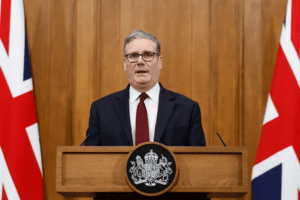
Shortly after the attacks on Iran began, British Prime Minister Keir Starmer gave the US permission to use British military bases for strikes on Iranian missile sites. Last week, his government agreed to let the US use British bases to strike Iranian sites targeting the Strait of Hormuz.
The UK could have followed in the footsteps of Spain and said, “No way, absolutely not. We will not be involved in this illegal war in any way whatsoever.” Instead, it has dragged itself into another catastrophic conflict.
Astonishingly, the prime minister still maintains that the British government is not involved – a line that has been regurgitated by many across our media. He says the UK is allowing its sites to be used only for “defensive” strikes. What nonsense.
The reality is, if a bomber takes off from Royal Air Force base Fairford and bombs targets in Iran, we are involved in that act of aggression. If civilians die, will their families stop mourning when they are told that they were bombed for “defensive purposes”? No matter how Starmer dresses it up, he cannot change the truth: The UK is directly involved in this war.
Mark my words: This is a historic mistake that jeopardises the safety of us all. That’s why, earlier this month, I tabled a bill in the House of Commons that would require parliamentary approval for any British involvement in military action. That includes the use of British bases by other nations.
So far, the prime minister has refused to pass this legislation. With no debate, no discussion and no vote, he is dragging Britain into another disastrous illegal war.
Just like with the invasion of Iraq in 2003, today, those of us who oppose the war on Iran are accused of giving succour to authoritarian regimes and leaders. Whatever one thinks of the governments of various places, there is no basis in law for an attack to bring about regime change. There is no basis in history that bombing from the sky would bring about human rights either.
Trump couldn’t care less about people’s human rights. Whether it’s in Iran, Venezuela or Cuba, he is interested in one thing and one thing only: seizing resources and political control around the world.
If the UK cares about international law, it would be standing up to Trump, not bending over backwards to appease him.
The story of US-led foreign interventions is a story of chaos, instability and misery. How many more of these catastrophic failures do we need before we learn the lesson? And what will it take for the UK to finally defend a consistent, ethical foreign policy based on international law, sovereignty and peace?
The views expressed in this article are the author’s own and do not necessarily reflect Al Jazeera’s editorial stance.










One of the few politicians who tells the truth. Jeremy Corbyn is an honourable man, but being honourable doesn’t cut the mustard in politics today.
Corbyn joined the royal Privy Council as soon as he became opposition leader. Make of that what you will
This is the oath that they all swear when they join. Note the secrecy words which, to my mind, are a direct repudiation of their duty to Parliament and the people:
““You do swear by Almighty God to be a true and faithful Servant unto The King’s
Majesty as one of His Majesty’s Privy Council. You will not know or understand of
any manner of thing to be attempted, done or spoken against His Majesty’s Person,
Honour, Crown or Dignity Royal, but you will lett and withstand the same to the
uttermost of your power, and either cause it to be revealed to His Majesty Himself, or
to such of His Privy Council as shall advertise His Majesty of the same. You will in all
things to be moved, treated and debated in Council, faithfully and truly declare your
Mind and Opinion, according to your Heart and Conscience; and will keep secret all
matters committed and revealed unto you, or that shall be treated of secretly in
Council. And if any of the said Treaties or Counsels shall touch any of the
Counsellors you will not reveal it unto them but will keep the same until such time as,
by the consent of His Majesty or of the Council, Publication shall be made thereof.
You will to your uttermost bear Faith and Allegiance unto the King’s Majesty; and will
assist and defend all Jurisdictions, Pre-eminences, and Authorities, granted to His
Majesty and annexed to the Crown by Acts of Parliament, or otherwise, against all
Foreign Princes, Persons, Prelates, States, or Potentates. And generally in all things
you will do as a faithful and true Servant ought to do to His Majesty. So help you
God.”
https://privycouncil.independent.gov.uk/wp-content/uploads/2025/02/2025-02-04-Wording-of-the-Privy-Council-Oath.pdf
You can’t just join the Privy Council; you have to be elected and I imagine that as Leader of the Opposition, he would have automatically have had a place there. Norman Baker explains all this in his fascinating book ‘And What Do You Do?’
Correct Belyi. But he joined the royal club didn’t he? And thus placed his duty to the monarch, including the royal secrets, above his duty to the people. They all do
They tell us that it’s all purely ceremonial and non political. But that isn’t true. Mathew Ehret has previously posted some good articles about the Privy Council’s role in running Canada
https://matthewehret.substack.com/
How would we know it’s role in the UK anyway? It’s all in secret. Maybe I’m too cynical but I think that it’s a pretty obvious way of keeping all the senior pols in line. Lots of civil servants, clergy and lots of judges are members too…
https://en.wikipedia.org/wiki/List_of_current_members_of_the_British_Privy_Council