
Cybernetics and the human mind – Solaris and the Reign of the Cybernetic Tyrants
Sun 10:26 am +00:00, 11 Oct 2026
Source: https://www.unz.com/article/i-solaris-and-the-reign-of-the-cybernetic-tyrants/

We’ve spoken about how Tarkovsky’s Stalker was a film predicting the KGB-Chabad plot to detonate Chernobyl before.
His other great masterpiece was Solaris an it is much harder to understand. On its own, the film is pretentious arthouse nonsense, like all of Tarkovsky’s other films. But, when you understand the hidden subtext, or rather, the internal debate among the elites that the film is exploring, the nonsense starts making perfect sense and a hidden plot emerges. All of a sudden, you also come to understand why Tarkovsky had such a hard time due to censorship and political persecution as wel.
I assume that some of you watched Solaris and greeted the end credits with a confused shrug. That is what happened when I saw it for the first time, but, in the years since, I became aware of the important role the Cybernetics played in the internal debate of the ruling elite of Britain and the USSR.
What is Cybernetics though? It sounds like an outdated term used by a Boomer trying to explain the internet or memes and computers generally.

But that is not what Cybernetics, or “the Cyber” is.
Like all things of note, the root word Cyber is Greek and refers to Kybernetes, the steersman on the river Styx in the underworld. This is an important hint to keep in mind as our investigation continues, so do make a note of it now.

What does this have to do with computers then?
Well, basically, the mainstream story is that the British came up with a theory right around WWII based on anti-aircraft targeting, that the human mind, and all life processes in general, are governed by “feedback loops”. Basically, something happens, you react, you adjust … something happens, you react, you adjust … something happens … Hardly very insightful or groundbreaking.
Hell, it sounds too banal to even mention, let alone make an entire theory out of.
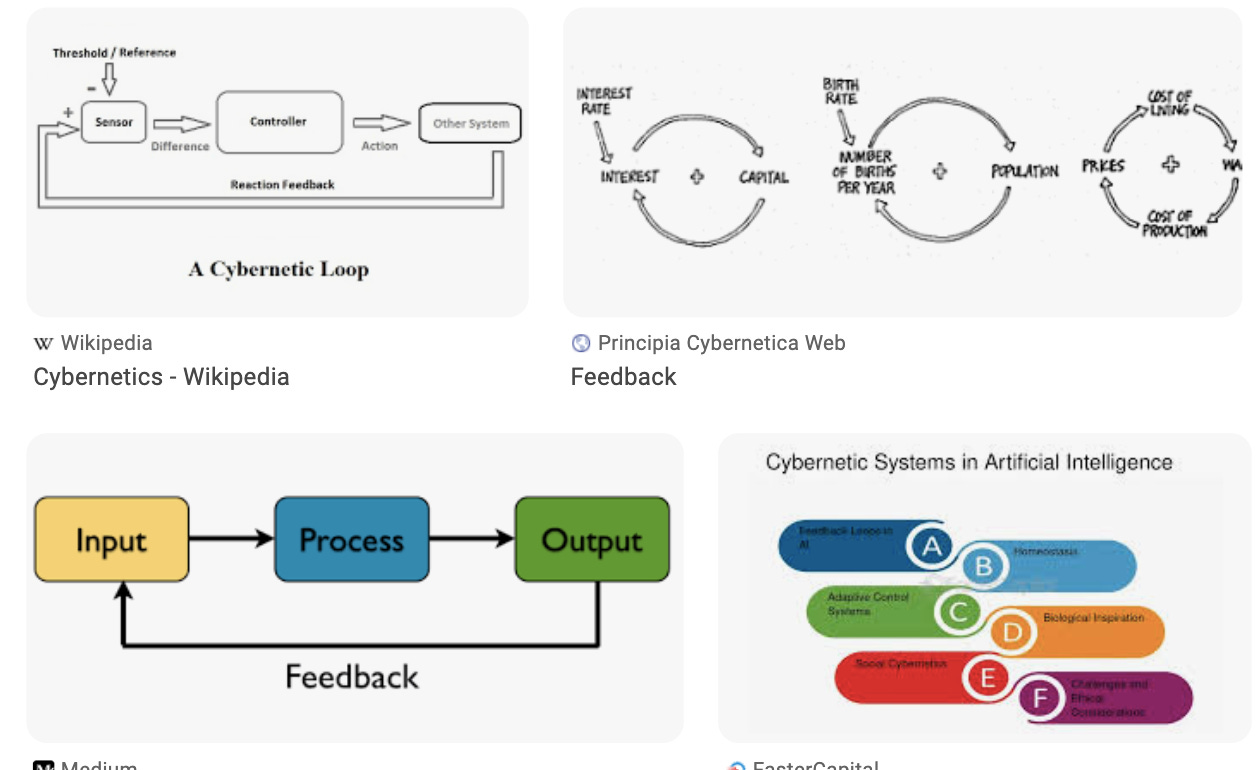
But, what makes Cybernetics noteworthy is not its supposed discovery of feedback loops, which were known already, but its misapplication to, well, everything — to literally every single field of studies.
Cybernetics believes that literally everything can be explained by feedback loops, the process of Action ==> Reaction ==> Synthesis ==> Action …
That life itself is just this never-ending feedback loop.
Boring egghead stuff so far, I know.
My theory for why they make their public facing material so dry and boring is to dissuade any public interest in the matters that they discuss. So, let’s foil their plots by spicing the discussion up a bit.
Solaris and the Power of the Human Mind
Now, the book/movie Solaris is about a deep space expedition to some planet coated in a sentient, living, moving sea of plasma named Solaris. I don’t have the time or the patience to draw out the big reveal that the author/director were being so coy about, so I’ll just get right to it — the planet Solaris is an analogy for the human mind. At least, that’s the role that it plays for 80% of the story. Later, it gets weirder still.
The probes being sent to Solaris and the experiments being done on it by the scientists on the space station are just the real world efforts of scientists in the 20th century to research the human mind. After centuries of work studying “Solaris/the mind”, these efforts have all largely failed before the start of the film/novel and the scientist protagonist Kelvin is sent in to do some damage control and a kind of postmortem of the project.
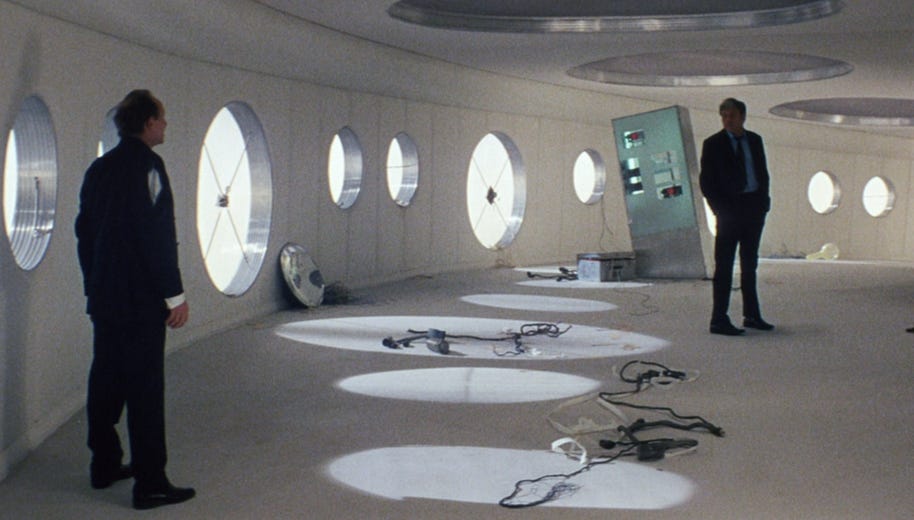
The book on which the movie was based was written by a Soviet-Polish author, who was deep into the Cybernetics material, named Stanislaw Lem. Yes, he was Jewish and he was friends with the top Jewish cybernetics theorists in the UK.
Again: once you know about the internal debate being had among the ruling elite about Cybernetics, you understand what both the author of the book Solaris and the film director Tarkovsky were engaged in a debate about.
I am certainly not the first person to notice that Solaris is clearly a critique and status report on the state of the Cybernetics project wrapped into one. There are research papers on the hidden real subject being discussed in the book. Here:
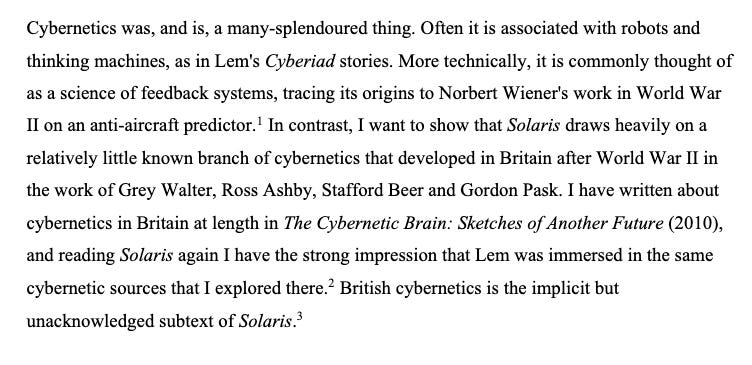
Like all bad British ideas, Cybernetics eventually made its way into the highest levels of power in Russia, where a faction of the elites picked up on it, after the Stalin era ban on Cybernetics (derided for being capitalist, bourgeois, subversive) was lifted.
Lem, despite being Polish, is very plugged into the British writings, and Solaris, again, is a story about science’s failed efforts to understand the human mind using Cybernetics principles.
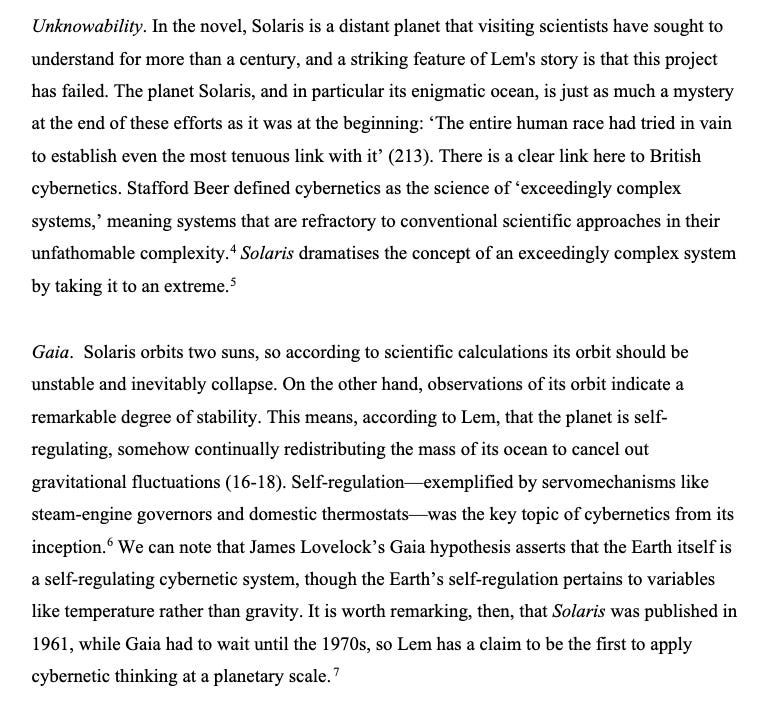
In the book, he provides us with some interesting theories about what Solaris/the human mind is and how it functions.
Lem explores the possibility that the consciousness generated by the mind, like a field of awareness, is itself alive. And the fact that he made the ocean generated by Solaris a plasma-based super life form is worth noting as well, seeing as alt-scientists believe that plasma is capable of attaining sentience.

The most fleshed out explanation given is that the ocean of plasma has skipped evolution and instead developed semi-sentience through never-ending “feedback loops” expressed through the undulation of its waves and the strange cityscapes and formations that the planet raises up out of the waves, only to sink them back down.
The ocean is essentially a psychic super-organism.
If, on our planet, life developed on an individual level, with differentiation, then here it developed without differentiation, thereby skipping the Darwinian “competition” process entirely. But the abilities of Solaris/the human mind extended into the supernatural, with the ability to manipulate and interact with space-time.
This gets into Itzak Bentov’s work on the human mind, claiming that supernatural powers of prescience were attainable through brainwave manipulation techniques. The theory was that the brain was an organ capable of piercing through space-time itself.
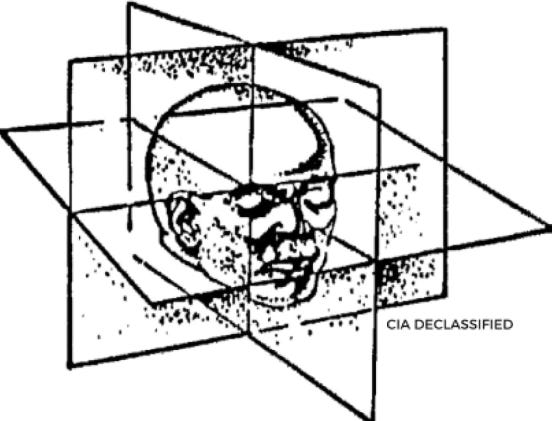
As someone who studied and “practiced” this particular school of the “occult”, I am very familiar with Bentov’s theories, as well as the actual source material he cribbed his notes from, and the subsequent Monroe Institute programs (the Gateway Tapes) that were developed to capitalize on this theory and make it actionable.
The results are … mixed, to say the least, and I have my critiques of the methodology and assumptions that I keep to myself mostly because people think that this is looney talk already. But, Bentov, and many of the other Cyberneticists, are either Anglos or Jews, and so they have this baggage of centuries of materialist atheism behind them. When they try to explain these occult spirit phenomenon, they are held back by the terms and concepts that they have to rely on. They are forced to use the materialistic language of Judaism, Christianity, Anglo Empiricism to make their arguments and points.
This language limits them in a way that someone who simply speaks and “thinks” in, say, Sanskrit and Vedism would not be limited. The only use for this kind of language and science is in its established familiarity among others, who might be guided into a new form of thinking if this language is used, at least initially.
Put another way, Cybernetics is essentially a long and convoluted process by which at least a portion of our intellectual overlords have rediscovered “animism” or “demonology” from totally atheistic priors. But I have skipped too far ahead and I apologize. This sounds like gibberish until you walk through the entire process of thought and discovery that these people did.
The Daimon in the Machine and the Realm of the Cyber-Omnissiah
Occulted cybernetic principles undergird most of our computer science, which is based on the terminology and theoretical concepts of Cybernetics.
The most striking examples are to be found in the curious naming practices of computer scientists. So, take Daemons for example. A “daemon” is a feedback-driven sub-system or autonomous process in a computer system.
Zoomers and Boomers and women don’t know this, but you used to have to set up and run a separate daemon to play a game that you had pirated off of Limewire or Pirate Bay back in the day. This was the introduction that most of us had to the term, and even then, all the way back in high school, I remember thinking to myself, “what a curious name,” when the daemon icon popped up.

Depicted: the vajra of daemonic intelligence.
So, why did they name them Daemons i.e., Daimons i.e., Demons?
To name them as such implies that computer scientists/wizards had a working theory of what pagan spirits actually were, and how they operated. That means that they took an interest in such topics, otherwise they would not have been able to construct this naming analogy, right? Even the “Cyber” naming reference to the ancient realm of shades and spirits starts to take on more meaning now, does it not?
Here is a question for you: what/where do you think “Cyber-space” or the “Realm of Cyber” really is?
Just think of it this way — we are describing a realm of incorporeal bits of information and intelligences floating around. An immaterial realm that we enter into to consult “oracles” and speak with “artificial intelligences” and to access the past through ephemeral archives and to communicate with others across vast distances …
The connection being drawn here should be making sense now, no?

Like, Neuromancer, the great artistic achievement of the “Cyber” genre, is a portmanteau term that refers to “necromancers”, those who spoke to the spirits of the dead, much like Case speaks to the spirits of dead “cowboys” stuck on floppy disks and in the Cyber space.
Point being: Cybernetics is tied at the hip with occultism, mysticism … and with discussion of spirit summoning if you really know where to look.
You would never understand any of that from the Wikipedia entry into the topic, but, if I had to summarize the situation, Cybernetics is essentially a bunch of atheist nerds with materialist assumptions about the world trying to grapple with the problems usually assigned to the fields of metaphysics and mysticism.
Many of the ideas of Cybernetics have also found their way into sci-fi more generally, not just into Solaris.
The Mechanicum or the Adeptus Mechanicus of Warhammer 40K, a franchise steeped in the British occult revival associated with Alesteir Crowley’s time onwards, is a direct embodiment of Cybernetic principles. The sci-fi cult believes that the machine is divine and that there are spirits in the machines that they use, and that there is a god of machines, called the Omnissiah. Praise be!
The priests of the machine practice extensive augmentation to become more machine-like, the process of becoming less human and more machine-like is itself a process of worship to them. When people on the interwebs start railing against “Transhumanism” I think that they basically have the creed of the machine priests of Mars in their mind’s eye as the object of their fear and loathing, even if they’ve never consumed even a tiny bit of sci-fi.
This is also the source of many humorous memes on the subject:

But I have a dedicated follow up essay on “Machine Spirits” and the Ship of Theseus paradox in the works that will address all of this in a deeper, more methodical way. The famous Hellenic identity puzzle is actually an animist/shintoism ontology, as you will see.
…
Back to Solaris.

That Solaris Has to Be a Woman
Recall that Solaris is a planet-sized ocean with no discrete form, that is constantly shifting and that reacts and alters the inputs of the human mind. That’s not just random weird alien life — that’s just cybernetic system illustrated on a planetary scale. Or, at least that is how the scientists conceptualize the human mind, as a knowable cybernetic loop system, and they then extend it to the planet, only to be baffled and rebuffed.
Solaris also doesn’t communicate with the male scientists on the station directly, instead it communicates passively and in riddles and through emotionally taxing antics … just like a woman would.
Specifically, Solaris generates “Guests” from “memory-feedback constructs”. These guests are the clones or the hallucination or the projections that it creates out of the tortured guilt-racked memories of the scientists on the station. For example, Kelvin is tortured by the appearance of his dead wife, who nags him incessantly for the entire movie over some vague fucking nonsense that I never did quite understand. Basically, he left her over a career promotion or something, and now Solaris is generating her on the station and driving Kelvin insane with her suicide ideation antics.

About 60% of the film is about a dumb broad whining about something or other and driving Kelvin to the brink of insanity with her bullshit. Very realistic depiction of modern relations, admittedly, but totally uninteresting as a sci-fi plot. That she’s the embodied avatar of Solaris trying to communicate with the scientists in some way is funny though, if you think about it.
The writer/director basically wondered aloud:
how can I depict an illogical, capricious, frustrating, unknowable and alien semi-intelligence?
Ah yes, why not make it a woman?
…
In contrast, the book is mostly about the scientists talking amongst themselves trying to understand the true nature of Solaris. The scientists conclude, in the book, that Solaris is a living feedback field, a plasma-based information processor, a formless non-corporeal intelligence — or, in folkspeak, something like a primordial spirit on a planetary scale.
This is the most roundabout “Science-speak” way possible to essentially describe Rhea or Gaia, the primordial Earth/Terra deity.
Solaris is essentially a sentient entity, but not human and not part of some Darwinian evolutionary chain. The mystery that the scientists try endlessly to pontificate about in their psychobabble nonsense-speak is how, essentially, does a spirit/god/deity/non-corporeal plasma intelligence like Solaris manifest in the world?
As for its relationship with the human mind, well, the “guests” are proof that Solaris can see into their thoughts and seeks to interact with them, but that communication and understanding through the use of the Cybernetic methods that the scientists employ, is impossible. But, sadly, it doesn’t seem like our Tech Overlords got the memo.
**
That’s enough for a primer into the Cybernetics material, I think.
Next, we have to talk about how/why Silicon Valley tech-elites got into this stuff and how they apply it to their plans to seize political power, reform society through “(Cybernetic) Accelerationism” and what that means for the social, human systems of control and manipulation that they are building now. If you look past the obfuscating language and TheorySpeak, Cybernetics is essentially nothing more than the project to create a kind of “Digital Gulag” for all sentient life.