
Yookay
Mon 8:54 am +00:00, 23 Jun 2025 10


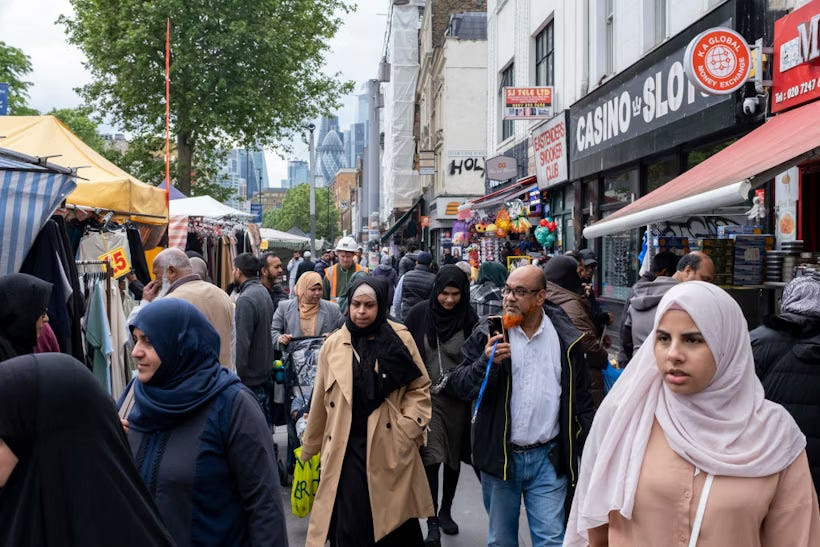 |
When I took out my phone and fired off a tweet about my experiences in London, I didn’t expect it go viral and be read by 10 million people around the world.
But that’s exactly what happened this weekend when I shared a few observations on the way home after a day out in our capital city.
What did I say?
“All these things happened to me in London today.
I paid nearly £30 for a train ticket to take me into London from a town just 30 miles away —on a Saturday.
The first person I sat next to, I think from India, decided to have a FaceTime conversation with his friend on speakerphone so we all had to listen to it.
The train was late by 40 minutes due to unexplained “signalling issues”. It was also filthy.
I paid nearly £8 for a pint.
I offered a woman my seat on the tube without realising she was with a man who intervened and said, “no man”. He was not from the UK. I think he took my gesture as an insult.
I was asked for money by homeless people three times in one day.
I noticed several people who are paid to give information to taxpayers and tourists over the tannoy on London’s Tube cannot speak English properly.
A cabbie told me “London is dead most nights”, unless you are among the global high net worth set and the top 1%.
Restaurants are visibly struggling and often hideously overpriced.
I had dinner in a neighbourhood where the average rent is £3,663 per month while half of all local social housing has gone to people who were not even born in the UK.
I was constantly aware I should not get my phone out on the street as 80,000 were stolen last year.
I also discovered while checking that statistic that there were 90,000 shoplifting offences in London last year, up 54%.
My train back —delayed—was suddenly changed at the last minute with all passengers on board. They were told it would no longer be stopping at all stops.
I bought a tin of instant coffee on the way home and it had a security tag on it.
Maybe I’m in a bad mood and perhaps it’s amusing to think how somebody of my political outlook is “triggered” but to me there is a deeper point here.
London is over —it’s so over.
It’s a city that is now in visible decline, with deteriorating standards and no real sense of identity or belonging.
Going in and out of our once great capital city is a truly miserable experience.
Infrastructure is falling apart, as is the social contract.
I’ve been coming in and out of London since 1981.
I simply cannot remember a time when it’s been this visibly dire and when so many things just do not work as they should”.
While the tweet inevitably irritated London liberals who are unable to accept any criticism of their beloved urban paradise, it struck a chord with a larger audience.
At the time of writing, the tweet’s been shared 19 thousand times and has been liked, endorsed, by 100 thousand people, many of whom can clearly relate to what I said.
 |
Funnily enough, one scene I had in my mind when I was writing the tweet was from the once-upon-a-time but no longer entertaining show, Sex and the City.
Filmed in 2004, the main character, Carrie Bradshaw, bumps into an old friend and prominent NYC socialite, Lexi Featherston, at a party for New York’s ultra elite.
Looking out at a crowd of upper-class, status-obsessed, high-achieving liberals who the American writer David Brooks once dubbed the ‘BoBos’ —Bourgeois Bohemians— Lexi Featherston, stunned the elite gathering by interrupting their bland party and delivering a damning indictment of their cosmopolitan paradise.
“This city”, she proclaimed to the elite class, the members of which were all as boring and predictable as one another, “used to be the most exciting city in the world. [But] New York is over. O.V.E.R. Over”.

While her complaint about New York had more to do with how a stuffy, health-conscious, fitness-obsessed and utterly boring elite was sucking all the fun and spontaneity out of a city that once had this in droves —a trend that can now be seen in most Western cities today—my complaint about London is shaped by other factors.
Particularly over the last decade, I’ve watched a toxic cocktail of rapid demographic change, mass immigration, and economic stagnation push our once great city into managed decline and make it completely unrecognisable.
And I’m not the only one.
Last week, writer David Goodhart referenced many of the same things that have been on my mind in a compelling and insightful essay for London’s Evening Standard.
A quarter-century ago, writes Goodhart, London was a booming metropolitan centre that for much of the political, media, and creative class was seen as a beacon of openness and opportunity for the rest of the country. He goes on:
“How times change. When it was recently estimated, in a report by Professor Matt Goodwin, that the white British population will become a minority in the UK in 2060, I heard nobody saying, “rapid demographic change is nothing to worry about, just look at London”.
He has a point, and not only because he cites my recent work.
Consider some of the truly eye-opening and sobering statistics in Goodhart’s piece.
White Britons now represent less than one-third of London. Only one in five children in Greater London’s schools are white British. Four in ten Londoners were born overseas. Close to one in five are Muslim. Nearly one-quarter do not speak English as their main language. Almost half of all social housing in London is now headed by somebody who was not born in Britain. And those homes enjoy a rental subsidy, from the British taxpayer, of more than £4 billion every year.
While London’s liberal set will respond to this by repeating, in robotic fashion, “diversity is our strength”, Goodhart asks the more troubling question that is clearly, based on the reaction to my tweet, on a lot of people’s minds.
Yes, immigration has long been a central feature of London’s life. But is all this demographic change actually improving the quality of life for Londoners? Really?
Just look around.
Shoplifting in London is soaring, up 54 per cent in the last year, compared to 15 per cent across the country. Housing is now beyond reach for most Londoners as demand has pushed property prices and rents sky-high.
Home ownership, since the early 1990s, has crashed by 20 per cent. London rents over the last fifteen years have surged 83 per cent, while earnings increased by only 21 per cent —a housing crisis undoubtedly exacerbated by mass migration.
And if London really is the future, if it inspires such confidence and optimism, then why does it have, by far, one of the lowest fertility rates in the country? People not wanting to have babies is a pretty good indicator of not just a cost-of-living crisis but, at a deeper level, how they feel about the surrounding social contract.
To Goodhart’s list we can add some other facts.
Violence against women and girls in London has increased sharply and remains “endemic”. Homelessness and rough sleeping are up. Violent offences in London are up 35 per cent on a decade ago. Knife-crime surged by over 20% in the last year alone, as gang violence has become a depressing, everyday feature of London life.
While ‘theft from the person’ fell across England last year, by 14 per cent, in London it rocketed by 41 per cent. Robberies are also up 10 per cent. ‘Moped-enabled crimes’ are booming. Pickpocketing is up 38 per cent in a year.
And if London is so great then why do more than one quarter of Londoners now say they feel unsafe walking alone at night in their own neighbourhood, which rises to nearly 40% for women?
The story of diversity in London, beloved by liberals who talk about today’s migration into London as if it’s similar to what they witnessed in the 1990s and the 2000s, has also changed in profound and, I would argue, negative ways.
The European bankers, asset managers, and Polish plumbers of two decades ago, as Goodhart points out, have now largely been replaced by low-wage, low-skill migrant workers from across the Middle East and Northern Africa.
Coming as part of the post-2019 ‘Boriswave’, this more recent immigration, as several studies have made clear, is taking more out of the economy than it’s putting in, exacerbating not just the housing crisis but the glaring lack of growth.
While London’s Mayor Sadiq Khan continues to mislead people about the effects of this migration, there is now no doubt it’s making the country, including its capital city, poorer. Everybody can sense it; and now the evidence backs them up.
This is not to criticise the migrants themselves; it’s merely to point out the reality Londoners are now living in. Like much of the rest of the country, London’s energy, productivity, and prosperity is being drained by a model of low-skill, low-wage, non-European immigration that simply does not make sense for Western nations.
While 30,000 millionaires and taxpayers fled London over the last decade, they’ve been replaced not only by these low-skill workers but roughly 500,000 illegal migrants, who are now also being joined by many of the more recent arrivals on the small boats.
How do you sustain a social contract in a major city like London when it’s estimated that roughly one in every twelve people is an illegal immigrant, and when a significant share of the population are breaking our laws and not contributing at all?
London’s immigration story is also having many other unintended effects that are stripping the city of its former charm and recognisable identity, which many ordinary Londoners will be able to relate to.
The iconic black cab with a driver who possesses a deep and historic knowledge of our capital city is now being replaced by the Uber driver from Somalia who mutters in a different language into his phone, can barely speak English, and drives you around while relying heavily on Google Maps.
And while the idea, head around the dinner tables of liberals like Fraser Nelson, that London is a remarkable success story when it comes to integrating this demographic change, no serious observer from outside the elite class would agree.
Watch the pro-Hamas hate marches, mingle in Tower Hamlets, look at the data concerning the shocking number of people in London who neither speak English nor identify as British or English, or read about the 286 per cent increase in antisemitic hate crimes in London and then tell me London is an integration success story.
Indeed, one fact I left out of my viral tweet is had I walked around London for a little longer at the weekend then I would most likely have bumped into pro-Iran, pro-Hamas, and pro-Hezbollah protests on the streets of our capital city.
Rather than build a dynamic, integrated, and unified capital city with a clear sense of history and identity, what all this is pushing us toward, as Lord (David) Frost pointed out in another insightful essay last week, is the ongoing ‘Yookayfication’ of our capital city and, indeed, our country.
Increasingly, after passing through the stages of “Great Britain” and then the “United Kingdom”, the label “Yookay” is now being used to refer to the aesthetic quality of the country today —a jarring mix of cultures, languages, and identities that are being imposed on what we once recognised as England and Britain.
Examples include the American candy store next to the kebab shop, the Deliveroo bags and Uber Toyota Prius that have come to symbolise this new, migration-fuelled low-skill, sluggish economy, the proliferation of Palestine flags and obvious signs of sectarianism in migrant communities, the spread of multicultural “English” with its global slang, the mainstreaming of gang culture in everything from fashion to advertising, the loud drill music and speakerphone conversations in the train carriage on the way home, the constant smell of weed, and so on, and so on.
 |
As Lord Frost points out, the term “Yookay” is no longer just about what we see on the surface; it suggests we are quite literally becoming a new country, a successor state to Great Britain and the UK, with an entirely new and very distinctive identity, character, culture, set of values, and way of life, emerging among a population that has no real connection to what came before.
As the young and promising writer Luca Watson notes, the promise made by Tony Blair et al. in the late 1990s was that multiculturalism would deliver exciting new experimental fusions not “the reality of actually-existing-
“Instead of high streets full of exotic shops selling Persian rugs or Moroccan spices or French delicatessens, we get an incomprehensible number of vape shops and Turkish barber shops of dubious legality. Once mysterious religions that enthralled Anglo-orientalists have been thoroughly demystified, reduced to rackety dawah stands obnoxiously blasting nasheeds amidst backdrops of decaying commercial centres.”
Shaped by past and ongoing mass migration, this cultural process of “Yookayfication” now looks set to accelerate and spread rapidly, not only because 81 per cent of all all migration into the Yookay now comes from outside Europe but because of how the foreign-born and their immediate descendants are forecast to become a majority of the entire country by the year 2079 —only 54 years from now.
All this raises profound questions for future of the country and its capital city, as David Goodhart asks in his essay:
“What happens when London’s white British population falls below 20 per cent in 10 years’ time, as it appears on track to do? Is there some minimum number of natives that a capital requires before it ceases to be the capital?”
While I’m not sure of the answer I am certain that unless there is a radical change of direction then I’m unlikely to be one those natives living in a London that will from hereon look a lot more like the “Yookay” than the country I once knew.
In fact, the question Goodhart asks took my mind to a thought experiment that raises a much deeper point about not only London and Britain but the West more generally.
Known as the Ship of Theseus, it goes like this. If you gradually replace every part of a ship so that its parts no longer have any real connection to the past —if you replace, say, the physical parts, the people on board, the language they speak, the historic connections—then is it really the same ship or has it become something else entirely?
It’s a question I would encourage you all to ponder, perhaps the next time you pass through our once great capital city and take a look around.
Matt Goodwin’s newsletter goes to 80,000 subscribers










I haven’t been back to London for 10 years, although I really miss the fish and chips at the North Sea restaurant near Tavistock Square and the bookshops selling the kind of books you never see here.
I understand that many people don’t speak English (in Geneva where I live, many people don’t speak French or speak it badly), but it has been my experience that many UK-born whites are illiterate in speaking and writing English too and the Internet is full of examples.
If you want the best fish and chips Belyi then, come to Yorkshire, God’s own country, no poncey southern vegetable oil, cooked in beef dripping…
It is still largely white English too. The comfortable, middle class, rural village, area, where I live is an oasis of Englishness. With a few cosmopolitans thrown in for good measure
My local, Yorkshire born, mate is acutely aware of all this. He’s very awake and he observes the madness and the national demographic trends, for himself. Like the rest of us here, he wants to preserve what is good. He sometimes says to me, with a large chunk of tongue in cheek:
“What we need to do is put an ‘effin big electric fence round Yorkshire to keep the buggers OUT. And another ‘effin big electric fence round Bradford to keep the buggers IN”
A couple of years ago my daughter left London after a decade living there. She moved back to Leeds, my closest city, and where she had previously lived for a decade. She lives central too, a beautiful regenerated area 5 minutes from the city centre. She says that everything is half the cost of London and that it’s so safe in comparison. And that, on a Saturday night, it is full of merry Yorkshire folk. She says it’s difficult to walk any distance with her dog on a Saturday night because she keeps getting stopped by merry locals who want to cuddle her dog
“Hi love, can I cuddle your dog?”
“Hi love, I’ve got a dog like that, does yours know what you are thinking too? Please come over ‘ere for a bit”
That sort of thing….
So, don’t expect the King’s English. But do note the word “love”. Most folk here start a conversation with a stranger with “love” it’s a great start….
I’ve lived here 15 years now. So, despite my faint scouse accent, I’m almost accepted as a local. I’ve even picked up local speech habits when chatting to locals “Aw reet love, how are you doin’?”
Sounds good. A friend, often on business in Aberdeen swore they were the best fish and chips. Don’t think I’d fancy them cooked in beef dripping though.
For a short while I lived in Totnes and Exeter back in the 1990s, but I found it too slow although perhaps with a family I would have settled; I just loved escaping to London now and then.
Incidentally, my Mum was a Londoner and she used the word ‘duck’ or ‘ducks’ as a term of endearment. Dialect is fine, it’s just when we get a things like ‘I was fed up of…’ or ‘I was sat…’ That’s just bad grammar.
I do think it’s good to live in a multi-cultural city and for children to mix with all races and types and here, over half the population is from elsewhere.
Fair enough Belyi, each to their own
I’ve visited Geneva a couple of times, it’s a beautiful cosmopolitan place and it struck me as very safe and comfortable, a very gilded place to be. At least back then…
First time was when I was bumming round Europe, post-uni summer, in the early ’70’sas a 21 year old. With a tiny backpack and a sleeping bag. I had no idea where I was going, zero plans, go with the flow, I bought a train ticket to Paris and took it from there. And I spent 2 months roaming around, France and Paris, Switzerland and Geneva, Italy and Genoa, Rome, Naples, Florence and Venice, Germany, Munich [the beer, oh the beer!] and the Rhine valley, Belgium and Brussels with more excellent beer, last stop being Amsterdam, nudge, nudge, wink, wink. Before back to reality back in Blighty
Sleeping outdoors, mainly in local parks and the like. I racked up in Geneva and had a good look around. That night I ended up sleeping in a park next to the Lake, big mistake. It was freezing and I barely slept a wink!
Early next day I met a young bloke and told him about my night. He said “there’s a hippy house in the diplomatic area, why not try there?” He gave me the address and I went there before dark. It was a mansion in lovely gardens but it was semi derelict, although the roof was sound. Full of young folk all staying there for free. So I spent a few nights there and had a whale of a time too before moving on
Happy days, long gone, different world now, hard to see how that would be possible for a modern youngster
That’s the way to see the world I did a bit of hitching myself and had a nasty fright on a Sardinian beach in the middle of the night. I wasn’t alone, but if the person or the people you’re with is/are just as scared, it doesn’t help a lot.
Nice memories of easier times which I too recall. Travel was still cheap and borders open in the early 1970s. War seemed like an impossibility and the economy only improved. Bright futures awaited us all. Fence in and out seems like a good angle to take. Nice to hear Yorkshire carries on. Shropshire is not far behind although the fence off area here is Telford, where the Council attack the Police Commissioner for running the worst policing area in the country. Robin TIlbrook’s action for a judicial review of the rape gangs has forced Starmer’s hand into granting a full national enquiry.
Yes Tap, the world was mainly open, travel was easy and the globalists were only just starting their Marxist shenanigans
Kudos to Robin too! He forced the demons to change policy and come out into the open. Quite an achievement. Particularly after all the bleating with zero impact, actions speak louder…
I think ya’ll like these! A bit of practicality and reminiscence.
https://www.youtube.com/watch?v=H3tSkfai8bU
https://www.youtube.com/watch?v=qmQ7Uu3RKCs&list=PLK2s1qtdGAuc-s5EFFdVi4LwT-__JcEJ3&index=8
Thanks Gordon, some very good advice in that first vid. Particularly for later generations than mine, who seem somehow more driven by the system than we ever did
I was lucky to be born, and spend the first 40 odd years of my life in the analogue age, pre digital. We were able to be parents in the old fashioned way too. Didn’t need a double income to be able to buy a house. I earned the money, my wife looked after the home and subsequent family. Apart for some cash in hand part time jobs for “pin money” in the old vernacular
And we didn’t want perfection, make do and mend was the order of the day. We moved into our first home with a second hand bed with a new mattress, a new gas cooker, my mums old kitchen table and chairs, and a top notch hi-fi, by far the most important item to us! We didn’t even have a television or a settee, just a few cushions, £5 each from Habitat, on the lounge floor hippy style. Which we sometimes slept on too. I will leave the reason for that to your imagination
Neither of us were over driven, we always made time with family and friends, and were happy with the more simple pleasure of life. Particularly the free outdoor pleasures that she mentions, and were very very happy too
The second link shows just how Britain has visibly changed over our lives. London seemed so civilised and British back then, different world indeed to the present multicultural madhouse as above. Of course it is easy to look back wearing rose tinted for an older Brit like me. But there were plenty of hard aspects then that had to be dealt with. But still, it made me feel that we’ve lost a lot that we should have retained….
Not just in the UK, but everywhere children seem to expect things that didn’t exist for us and we were so much happier.
A friend’s 11 year-old went to a party recently. It was on an industrial estate and it lasted two hours before the next group arrived. They had all sorts of climbing frames and suchlike and were served slices of pizza and given a bag of toxic jelly sweets to take home.
Our parties meant party clothes, food we didn’t eat every day such as jellies and cake, games and little prizes. Nobody can tell me my friend’s son had more fun that we did.