
America – Still Using Egyptian Measurements – The Great Pyramid
Fri 1:33 pm +00:00, 10 Jan 2025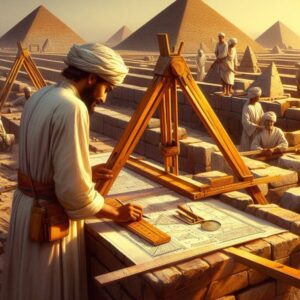
Source: https://x.com/ralfellis/status/1874460154726609304
Have you ever wondered why Imperial Measures have such stupid-looking units? Things like 22 yards in a chain, and 5.5 yards in a rod? What simpleton would devise and use a fractional unit of measure?
The answer is that this system of measures is very ancient. It came from the Great Pyramid, and in turn the pyramid got them from the mathematical function of Pi. Because the Great Pyramid is a Pi pyramid. The simple Pi fractional is 22 / 7. 40x this becomes 880 / 280. Multiply the numerator by two gives 1,760 / 280
Which are the dimensions of the Great Pyramid (GP). As measured in royal or Thoth cubits (tc) GP perimeter = 1,760 tc. GP height = 280 tc. Note: The numerator is doubled, because the GP is an image of a circle, and the formula for a circle is 2 x Pi x r.
So just like the Dahshur pyramids in my previous TwiX, the Great Pyramid is a mathematical pyramid. It embodies math, presumably to declare to any future investigator that the designer was extremely educated and knowledgeable. It is also an invitation
The designer is saying to us: “you have seen the mysteries on the outside, so come and see the many mysteries that lie within…” .
Astoundingly, America is still using this same ancient metrological system to this very day, which is why the Imperial mile measures 1,760 yards. This is not a coincidence, and it is why Imperial measures have such strange looking units: Mile = 1,760 or Perimeter of Great Pyramid. Mile = 1,760 or Pi numerator x 40 x 2. Furlong = 220 or Pi numerator x 10. Chain = 22 or Pi numerator. Rod = 5.5 or Pi numerator / 4.
Image: The pyramid designer at his drawing-board
Later Tweet:
*** The Metrology of the Second Pyramid ***
As we are beginning to see, a great deal of cunning mathematics has gone into the design of the pyramids of Giza. They were most certainly not just haphazardly stacking blocks upon each other until they ran out of upper surface area. And here is another little mystery for you.
f you take the 27 cubit length of the Second Pyramid chamber. And fold it up into a square, with sides of 6.75 cu. The diagonal of this hypothetical square is the same as the width of the chamber. Neat, eh?
And there was a good reason for doing this, as it tells us that the unit of 6.75 cubits is special. It tells us that the Khafre rod-length is 6.75 cubits. So while the Great Pyramid rod-length is 5.5 cubits, the same as the Imperial rod length we still use today, the Khafre rod-length is 6.75 cubits.
To what end, you might say? What the F is the pyramid designer trying to say? Well, let’s use the 6.75 cu rod length, and see what happens. For instance, if you take the limestone dimensions of this pyramid (ie: minus the two granite courses at the base), and translate these measurements into rods measuring 6.75 cu, the dimensions of this pyramid become… 30 x 40 x 50 Khafre rods
And this is a decidedly meaningful mathematical result, because this pyramid is a 3-4-5 pythagorean triangle. And the designer has highlighted this in whole number multiples of the 3-4-5 triangle.
So the Great Pyramid is mathematically a circle. While the Second Pyramid is mathematically a square.
And we, dear reader, can now see into the mind of the Giza pyramid designer. We can talk with an architect, who lived thousands of years ago. I am sure he must have been a pillar of society. Who had been taught to be cautious. Thank you brother, we salute you. Point left and right.