
How the US bears the costs of its wars and Beijing reaps the benefits – China does nothing and win
Thu 8:41 am +00:00, 3 Sep 2026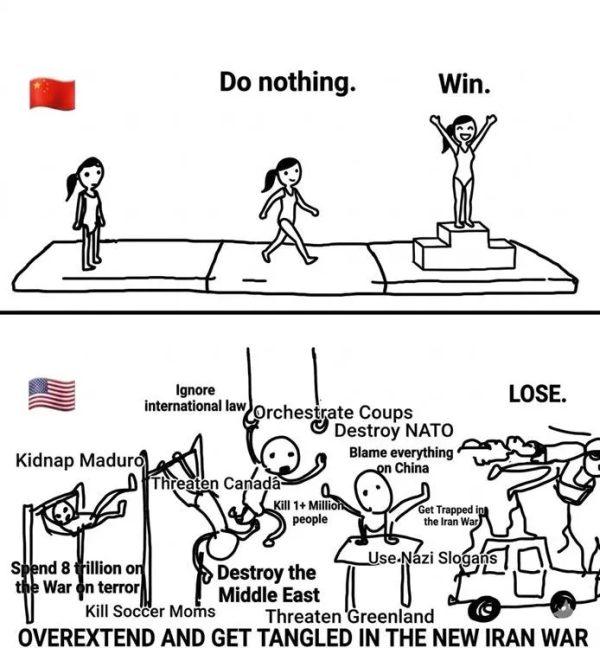
Source: https://www.unz.com/bhua/how-china-wins-wars-that-the-us-launches/
Chinese philosophy is ancient
Taoism is central to that philosophy, it predates Christianity
Tao talks of “action through in action”
So the US “inadvertently” boosts China by its global aggression
China reaps the benefits
Is the US policy really “inadvertent”?
The rise of China was created by the Western oligarchs at the end of 20th Century
See Anthony Sutton and others
China amended it’s ancient legal code to enable it to do business with the west
Specifically, it’s adoption of the western corporate “legal person”
fiction
Can anyone seriously think that the western global oligarchs lost control of China after it had transferred all its factories and technology over there?
Food for thought if you read this Chinese perspective:
“One interesting feature of the US electoral system is the proclivity to accuse the opponent of being a tool for a foreign adversary.
Hillary Clinton accused Trump as a Russian stooge during the 2016 campaign. He, in turn, labelled Joe Biden “Beijing Biden” in the 2020 campaign.
Neither are what they have been accused of, although they are both pawns of another foreign power whose name you are not allowed to say in US politics – except in adoration.
“Tel Aviv Don” and “Israeli Joe” would have been perfect monikers, but of course no one in mainstream USA would ever acknowledge such plain truth.
In China, social media users “warmly”, and sarcastically, call Donald Trump “川建国” (or “Trump the nation builder”) as his policies seem to promote China’s development in effect.
His trade war has forced China to diversity trade with the rest of the world.
His tech war has prompted China to invest in weak links in its tech supply chain.
His financial war has helped China to sanction-proof its economy and pursue de-dollarization with urgency.
So, when Trump attacked Iran earlier this year, we in China naturally expect another boost from the “nation builder”.
We are not disappointed.
Chinese trade has boomed as a direct result of the war
China’s foreign trade value hit US$4.46 trillion for the first 7 months of the year, marking a 17% year-on-year expansion. July alone saw a surge of 24%.
To put the number in context, the trade figure is higher than Japan’s full year GDP in 2025.
Besides rapid growth, China’s trade expansion saw a massive shift in geographic partnerships, away from the traditional Western markets toward the Global South.
China’s trade with ASEAN grew by 35%. Its trade with Russia, Africa, and Latin America also grew faster than Europe and the US.
Trade with the US accounts for a mere 8.8% of China’s total trade, down from nearly 25% when Trump won his first election in 2016.
The trade growth in 2026 is driven by explosive global demand for Chinese green energy and advanced technologies.
The disruption of Gulf energy supply has significantly contributed to the adoption of Chinese green energy products from EVs to solar panels.
Outbound EV shipments registered a 71.2% year-on-year surge in value, driven by demand for energy-efficient vehicles as gas prices rise due to closure of the Hormuz.
Similarly, Chinese lithium battery export climbed 36% as energy storage becomes critical during the crisis.
Wind turbine exports grew by 35% year-on-year. Solar shipment moved up 24%.
The need to electrify the global economy, both due to the energy crisis from the war and the massive demand from AI data centers, drove Chinese export growth of electrical equipment, such as transformers, by 32%.
Artificial intelligence infrastructure development worldwide triggered an unprecedented electronics export surge.
Chinese semiconductor exports nearly doubled in total value.
In addition, the war has also rerouted global demand toward Chinese suppliers for baseline materials like aluminum and urea as traditional gulf suppliers like UAE and Qatar are cut off from the global supply chain.
Unintended consequences of the US war on Iran
The outbreak of the war has acted as a massive economic tailwind for Chinese industrial exports.
While the war has drained Western resources and stoked domestic inflation in the US, China has strategically leveraged the conflict to accelerate growth through three primary channels:
1. Acceleration of the global green energy transition
The closure of the Strait of Hormuz by military blockades triggered a massive, global hydrocarbon and fossil fuel energy shock.
As global oil prices spiked and traditional energy security collapsed, international markets dramatically accelerated their timelines to pivot toward renewables.
Because China possesses the world’s most dominant, scaled manufacturing capacity for green tech, it became the default global beneficiary.
2. AI grid bottleneck and baseline material substitution
The war heavily disrupted specialized industrial downstream supply chains in the Persian Gulf, notably damaging major regional processing facilities such as the Emirates Global Aluminum.
With the Gulf region previously supplying roughly 21% of US and 19% of EU primary aluminum, Western aerospace, automotive, and electronics manufacturers faced immediate structural shortages.
China stepped into the void as a primary backfill exporter for processed metals and industrial materials.
Simultaneously, the intense global build-out of AI infrastructure faced massive grid constraints due to elevated energy costs.
China capitalized on this by supplying critical electrical infrastructure to support strained international power grids.
3. Deep discount energy buffers & de-dollarization
While Western nations suffered from severe war-induced inflation and rising retail fuel costs, China insulated its industrial base through rigorous strategic foresight.
Prior to the conflict, Beijing accumulated an unprecedented 1.8 billion-barrel strategic petroleum reserve, heavily buying discounted Iranian and Russian crude under Western sanctions.
This massive, cheap energy buffer kept Chinese factory floor costs low while Western competitors faced crushing operating costs.
Furthermore, to bypass tightening US maritime blockades and banking sanctions, Iran began allowing tankers through the Strait of Hormuz on the strict condition that transactions were settled directly in Chinese RMB.
The war has effectively fast-tracked China’s long-term geopolitical goal of diminishing US dollar dominance in global commodity trade.
China will be the biggest winner of the post-war reconstruction in Iran
No one knows when permanent peace will be reached in the Persian Gulf. But it’s an easy bet that there will be a massive post-war boom in Chinese-Iranian trade.
A formal resolution to the conflict will immediately unlock unparalleled commercial synergy between Beijing and Tehran.
The Post-war reconstruction
A post-war Iran will require billions of dollars in rapid capital injections to rebuild its decimated energy, shipping, logistics, and civic infrastructure.
Western corporations will remain legally restricted or structurally hesitant to enter the Iranian market; Chinese businesses are poised to act as the default and primary contractors.
This surge will be seamlessly absorbed by the pre-existing China-Iran 25-Year Cooperation Program signed in March 2021.
Under this $400 billion blueprint, China has already mapped out massive post-war investments to modernize Iran’s transport networks, oil facilities, ports, manufacturing hubs, and 5G telecom.
Normalization of the energy pipeline
While the current US naval blockade has temporarily suppressed seaborne crude exports, China remains Iran’s absolute economic lifeline.
A permanent peace deal will remove maritime threats in the Strait of Hormuz, allowing Iranian crude to flow back into China’s industrial base at full capacity.
Chinese state energy giants are slated for priority access to develop Iran’s massive, under-drilled South Pars gas field and primary oil blocks—securing long-term energy contracts at deeply favorable, post-war structural rates.
Institutionalization of the RMB and de-dollarisation
The current war has forced Iran to entirely sever its remaining dependency on the Western financial architecture.
During the conflict, Tehran began routing its commodity trade strictly through Chinese Renminbi (RMB) to bypass US banking sanctions.
Once the war ends, this system will not revert to the US dollar.
The post-war trade boom will be settled via China’s Cross-Border Interbank Payment System (CIPS), locking Iran into Beijing’s global economic orbit.
Clearing frozen assets for immediate consumer demand
Throughout the conflict, a significant portion of Iran’s oil revenue has accumulated in overseas accounts.
When the war ends, these billions will be unfrozen.
Iran is highly likely to convert these holdings directly into immediate credit lines to purchase Chinese machinery, consumer electronics, industrial manufacturing equipment, and medical technology.
In summary, the US launched a criminal war on Iran and were roundly defeated.
It exhausted its weapon arsenal and whatever credibility the US military retained from the past. And it helped to accelerate China’s economic goals.
It turns out, as Trump would say, “a very good deal”. The “master” of the “art of the deal” fully deserves his Chinese moniker “川建国”.
It would be unfair to accuse Trump of being alone in helping China with his belligerence and stupidity.
Before him, Biden’s provocation of Russia with the Ukraine proxy war has solidified China’s energy partnership with Russia.
Now Russia exports most of its oil and gas to China, rather than Western Europe.
Similarly, George W Bush and Obama’s forever wars in the Middle East have seen China emerge as the primary beneficiary of the Iraqi reconstruction.
The Iraqi precedent of China winning US wars of aggression
While the 2003 US invasion overthrew Saddam Hussein, American oil majors have largely withdrawn from Iraq over the last two decades.
In their absence, Beijing has aggressively stepped in, effectively transforming Iraq into a cornerstone of its energy security.
Analysts estimate that between 50% and 65% of Iraq’s entire oil production now flows from fields where Chinese companies operate, invest, or provide engineering services.
The exit of the US vs. the influx of China
Following the war, American corporations like ExxonMobil initially won lucrative rights to develop Iraq’s mega-fields.
However, due to low profit margins set by the Iraqi government, complex security realities, and shifting corporate priorities toward domestic shale, US firms pulled out.
ExxonMobil fully exited Iraq, handing over operations of the massive West Qurna 1 field.
Outside of Iraq’s autonomous Kurdistan region, US companies hold less than a 2% share in active Iraqi oil and gas projects.
Conversely, Chinese firms have acquired the single largest share of foreign oil and gas licenses in Iraq (7.27%), second only to the Iraqi state itself.
Upstream dominance & 2024–2026 tenders
China’s presence spans state-owned heavyweights like PetroChina and CNOOC, as well as highly aggressive, nimble private independent firms.
During Iraq’s major “Fifth+ and Sixth” licensing rounds, Chinese firms won nearly all the contracts to explore and exploit 10+ new oil and gas fields, while US interest was virtually non-existent.
Private Chinese entities like Geo-Jade Petroleum, United Energy Group, and ZPEC are pouring billions into Iraq. They are currently on track to double their independent Iraqi oil output to 500,000 barrels per day (bpd) by 2030.
In mid-2025, Iraq signed a $848 million integrated deal with Geo-Jade to expand the Tuba oil field from 20,000 to 100,000 bpd alongside constructing massive downstream refineries.
The “Oil-for-Construction” mega deal
China’s dominance goes beyond simple drilling; it is baked into Iraq’s national reconstruction via a formal 20-year “Oil-for-Construction” framework agreement.
Under this mechanism, Iraq sends a mandatory 100,000 barrels of crude per day directly to China.
In exchange, Beijing finances and executes massive domestic infrastructure projects.
This arrangement has seen Chinese firms construct over 1,000 schools and hospitals across Iraq, build a major civilian airport in Dhi Qar, and develop massive residential cities.
In April 2026, Prime Minister Mohammed Shia al-Sudani approved a $1.5 billion allocation under this deal to fund the highly anticipated $5 billion Basra-Haditha oil pipeline.
Additionally, China Petroleum Pipeline Engineering Co. secured a $2.5 billion contract to construct Iraq’s massive Common Seawater Supply Project to sustain oil field pressure.
Top energy customer and geopolitical leverage
China imports roughly 1.2 to 1.4 million barrels of Iraqi oil daily, consistently taking roughly 35% of Iraq’s entire national oil output as its top global oil customer.
Unlike Washington, Beijing employs a strict policy of “non-interference” regarding local Iraqi politics and internal governance.
This approach gives Chinese energy firms a continuous edge over Western counterparts when bidding for long-term state contracts.
The pattern is the same in Afghanistan – wherever the US wages wars, China gains influence
In Afghanistan, the same thing is happening.
Despite the ongoing security risks in the country, China has already benefited from the post-war reconstruction through strategic economic access.
Critical minerals and energy extraction
The primary economic benefit is gaining preferential access to Afghanistan’s vast, untouched natural resources, estimated to be worth over $1 trillion.
Chinese mining firms have aggressively pursued access to Afghanistan’s massive lithium and rare-earth element deposits.
China also holds a long-term extraction deal for the Mes Aynak copper deposit, one of the largest undeveloped copper fields in the world.
In northern Afghanistan’s Amu Darya basin, the Xinjiang Central Asia Petroleum and Gas Co (CAPEIC) secured a $540 million oil extraction deal, allowing China to pump oil directly from Afghan territory.
Geopolitical and infrastructure expansion (CPEC 2.0)
The withdrawal of US and NATO troops enabled China to integrate Afghanistan into its Belt and Road Initiative (BRI) without military entanglement.
China extended the China-Pakistan Economic Corridor (CPEC) directly into Afghan territory.
China granted Afghanistan zero-tariff treatment on 100% of tariff lines. This tariff elimination significantly boosts bilateral trade, allowing Chinese manufacturing machinery to flow into Kabul in exchange for Afghan raw materials.
Diplomatic leverage
While Western nations froze Afghan assets and closed their embassies following the 2021 Taliban takeover, China kept its embassy open.
By positioning itself as a leading contributor to peaceful reconstruction through infrastructure contracts (such as building hospitals and residential complexes), Beijing secured a monopoly on diplomatic influence with the Taliban leadership.
China’s formula to win US wars
Beijing’s consistent economic and geopolitical gains from US-led military interventions are the result of a deliberate, structural grand strategy.
While the US approaches global conflicts through a framework of military intervention and regime change, China operates on a framework of economic mutual benefits, long-term infrastructure integration, and strict political neutrality.
By positioning itself as the “builder of last resort,” Beijing naturally inherits the economic landscape once the dust of a conflict settles.
This systematic benefit is driven by several structural dynamics:
1. The “Non-Interference” edge
The core tenet of China’s foreign policy is absolute non-interference in the internal affairs of other nations.
When the US instigates a war or pushes for regime change, it often ties subsequent aid, trade, and diplomatic recognition to heavy political conditions, usually directly undermining the sovereignty of the target state.
In contrast, Beijing places zero political or ideological conditions on its partners.
For war-torn nations eager to rebuild, Chinese businesses represent a highly attractive alternative.
They offer immediate infrastructure development—roads, bridges, airports, and schools—without demanding political alignment, allowing local elites to retain power while rapidly stabilizing their economies.
2. Asymmetry of risk: blood vs. capital
When it starts a war, Washington bears the immense, draining financial and human costs of warfare—trillions of dollars in military expenditures, logistics, intelligence, and active combat operations.
China avoids the battlefield entirely. Instead, it waits for the conflict to conclude or stabilize and then deploys state-backed capital to acquire deep-discounted assets.
In Iraq, while the US spent over $2 trillion on the war effort, Chinese firms stepped into the vacuum left by exiting American oil majors.
Beijing secured dominant upstream oil contracts without losing a single soldier or firing a shot, effectively turning a US military campaign into a secure source of Chinese energy.
3. Capitalize on Western sanctions and de-dollarize
When the US wages economic or kinetic warfare against a country, its primary weapon is isolating that nation from the Western financial system via SWIFT banking blocks and trade sanctions.
By forcing Western companies to exit a target nation (such as Iran or Russia), the US inadvertently wipes out all market competition for China.
China becomes the only major global economy willing and capable of buying that isolated country’s commodities.
This gives Beijing massive leverage to buy vital resources—like Iranian and Russian crude oil—at extreme, below-market discounts, drastically lowering the operating costs of China’s domestic manufacturing base.
Furthermore, because these sanctioned nations can no longer trade in US dollars, they are forced to settle transactions in Chinese RMB, rapidly accelerating China’s long-term strategic goal of de-dollarizing global commodity trade.
4. Geopolitical distraction
Every major US military intervention acts as a massive strategic diversion, drawing Washington’s focus, resources, and political capital away from competing directly with China in the Asia-Pacific region.
The 2001 invasion of Afghanistan and the 2003 war in Iraq effectively bought China a “golden two decades” of unconstrained economic growth.
While the US was bogged down in counter-insurgency warfare in the Middle East, China quietly built up its domestic tech sectors, cornered the global green energy supply chain, and executed its massive Belt and Road Initiative.
The ongoing US-led conflicts and proxy wars of the mid-2020s continue this trend.
As Washington drains its munitions stockpiles, strains its fiscal budget, and fractures its domestic political focus to manage overseas wars, China remains free to systematically expand its trade networks across ASEAN, Latin America, the Middle East, and Africa.
Conclusion
In language that capitalists can understand, conquest and military occupation simply do not yield a positive return on investment in the modern world.
The structural divergence between the US and China over the past several decades serves as a clear, real-world case study of why commercial, peaceful diplomacy is vastly more profitable and sustainable than militaristic imperialism.
US militaristic imperialism relies on sanctions, blockades, and physical destruction, all of which shrink the global economic pie.
On the other hand, Chinese peaceful diplomacy and trade create markets.
China’s Belt and Road Initiative is built on the premise that a country with a new Chinese-built railway, port, or 5G network becomes a long-term consumer of Chinese goods.
You cannot sell high-tech electric vehicles, artificial intelligence hardware, or consumer goods to a country that has been bombed into economic collapse.
By using diplomacy to keep trade lanes open and stable, China ensures that global markets keep growing, fueling its own export-driven economy.
Finally, in international relations, goodwill and predictability are highly valuable economic assets.
China’s strictly business-first, non-judgmental diplomatic stance makes it a safe, low-friction partner for countries in the Global South.
This reputation opens doors to lucrative infrastructure tenders and long-term trade pacts that are closed to Western nations.
Ultimately, the past quarter-century has demonstrated a stark lesson in grand strategy: wealth is generated by building factories, integrating supply chains, and dominating trade routes—not by waging wars or regime change through force.
By choosing the path of commercial diplomacy over military expansion, China has effectively won the economic rewards of the 21st century without paying the devastating price of war.
In the end, the US belligerence has directly helped China’s trade expansion across the world.
LinkBookmarkIn the ultimate ironic twist of fate, the US regime’s efforts to subjugate others and contain China has boomeranged completely – the US bears the costs of its wars and Beijing reaps the benefits.
It’s only half-jokingly that the Chinese call Trump “川建国”.
Beijing has become the biggest winner of America’s wars.