
Modern space fakery – same old story
Sat 3:03 pm +00:00, 26 Sep 2026
On August 23, 2023, India’s government space agency, the Indian Space Research Organisation (ISRO), announced an extraordinary achievement: its Chandrayaan-3 spacecraft had successfully landed on the Moon, see Endnote [i].
Not merely reached lunar orbit. Not flown past the Moon. Landed on it.
The Vikram lander had supposedly travelled approximately a quarter of a million miles from Earth, descended to the lunar surface and deposited a 26-kilogram rover named Pragyan. The little rover then rolled onto the Moon and conducted scientific experiments.
And the reported cost of the mission? Approximately $75 million, see Endnote [ii]
To put that figure in perspective, Star Trek Beyond, a movie about travelling through space, reportedly cost approximately $185 million to make. See Endnote [iii].
Apparently, actually travelling to the Moon can be considerably cheaper than pretending to travel through space in Hollywood. Quite an achievement. But there is a more important question.
What evidence were the rest of us actually shown?
I examine the wider evidence surrounding the claimed Moon landings in my book Fake Moon Landings and the Lies of NASA, including the increasingly important question of how we distinguish genuine photographic evidence from simulation and computer-generated imagery.
Watching a Computer-Generated Moon Landing
ISRO’s Chandrayaan-3 mission was followed enthusiastically in India. Television viewers watched the mission control centre as engineers and officials followed the descent.
There was, however, an obvious problem for anyone expecting to watch something resembling an actual Moon landing.
Much of what viewers were watching was computer-generated visualization as seen below.
[i] Indian Space Research Organisation (ISRO), Chandrayaan-3. ISRO reports Chandrayaan-3 successfully soft-landed on the Moon on August 23, 2023, with the Pragyan rover deployed onto the lunar surface. https://www.isro.gov.in/Chandrayaan3.html
[ii] Government of India, Department of Space, Parliamentary Question, 2023. Chandrayaan-3 expenditure, including the launch vehicle, as of June 2023 was ₹601.34 crore—approximately US$73–75 million. https://www.isro.gov.in/media_isro/pdf/docs/UsefulLinks/ParliamentQuestions/Parliament_monsoon_session_2023_English.pdf
[iii] Star Trek Beyond (2016) had a reported production budget of approximately $185 million. https://www.the-numbers.com/movie/Star-Trek-Beyond
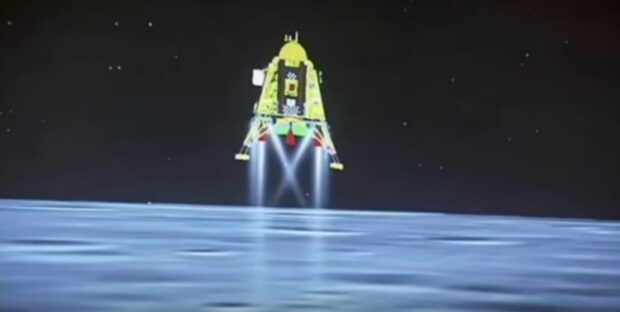
ISRO itself provided mission graphics and computer-generated representations showing the spacecraft travelling around the Moon and descending toward the surface.
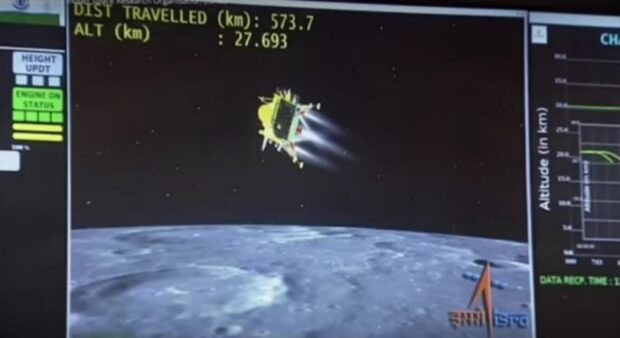
There is nothing inherently suspicious about that. Space agencies routinely use computer visualizations to illustrate telemetry that cannot conveniently be shown directly.
But we should understand what we are looking at.
A computer animation of a spacecraft landing on the Moon is not photographic evidence of a spacecraft landing on the Moon.
As the computer-generated visualization showed the spacecraft touching down on the Moon, the ISRO control room erupted in celebration.
Presumably the engineers were responding to telemetry and other mission data rather than believing the animation itself constituted evidence. Fair enough.
But the public watching television was placed in a rather different position. We saw people looking at screens telling us that something extraordinary was happening approximately 240,000 miles away.
And then we were told it had happened.
Then Came the Pictures
ISRO subsequently released imagery presented as having been recorded by Chandrayaan-3 itself. This distinction is important.
Some images associated with the mission are explicitly illustrations or computer-generated visualizations, for example of the Pragyan rover as seen below.
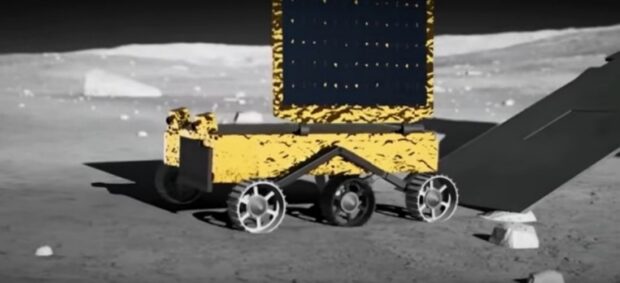
Others are presented by ISRO as actual camera images and video recorded by the spacecraft.
ISRO released footage described as showing the lunar surface during the mission, imagery from the descent, video of the Pragyan rover moving down the Vikram lander’s ramp, images of the lander taken by the rover, and video showing the rover moving across the surface.
That is certainly more interesting than an animation. But look at what we are being asked to accept.
A government organisation says that a machine travelled approximately a quarter of a million miles through space and landed on another world.
We are then shown grainy images of a machine sitting on a barren surface. After landing, ISRO claim the ‘rover’ took the following ‘real’ image of the landing craft.
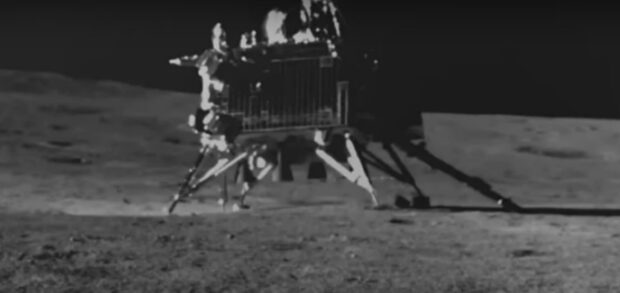
Where is the independently identifiable reference point demonstrating that the landscape is actually on the Moon? There isn’t one visible in such an image.
That doesn’t prove the photograph was taken somewhere else.
But neither does the appearance of a dusty landscape prove that it was taken on the Moon.
That distinction seems to have disappeared from much of modern culture. Show people a grey landscape, put a spacecraft in the middle of it, add the words “Moon Mission” and apparently the location has been established.
Science used to demand rather more than a caption
A Remarkably Camera-Shy Voyage
This is what I find particularly curious. Chandrayaan-3 was not some primitive projectile fired blindly into the sky.
According to ISRO, the lander carried sophisticated equipment including laser and radio-frequency altimeters, a laser Doppler velocimeter, accelerometers, hazard-detection equipment and several cameras. The lander and rover carried instruments capable of investigating seismic activity, plasma, temperature and the elemental composition of the lunar surface, see Endnote [i].
ISRO says the rover travelled around the landing area and ultimately covered approximately 101 metres.
Scientific data were collected and subsequently released to researchers and the public. This was, according to the official account, an extraordinarily sophisticated robotic expedition.
Yet what would have been one of the most spectacular photographic opportunities in human history produced remarkably modest imagery.
Imagine putting a camera on another world.
Wouldn’t you want sweeping panoramas?
Wouldn’t you want prolonged high-quality video of the landscape?
Wouldn’t you want the best possible photographic record of the environment in which this extraordinary machine supposedly found itself?
And wouldn’t you want to turn the camera around and capture a spectacular photograph of the entire Earth—not merely images showing portions of cloud formations?
ISRO did release lunar imagery, including video from lander cameras before touchdown and subsequent rover and lander images, see Endnote [ii]. But considering what the mission supposedly accomplished, I find the visual record surprisingly underwhelming.
Some viewers were themselves unimpressed. On YouTube, one sceptical commenter wrote:
“So far only CGI computer generated images Where are the real images of the Moon? … 99% of footage released was of spectators, Godi media, ISRO cheering instead of the actual Moon Footage. I want to believe India went to the moon but they are making it very difficult.”
A YouTube comment is obviously not evidence that the mission was fabricated. But the reaction illustrates a legitimate question: for an achievement of such extraordinary technological sophistication, why was the visual record presented to the public so comparatively modest?
We can supposedly put a spectrometer on the Moon, analyse sulphur in lunar soil, measure seismic vibrations, and operate a robotic rover from Earth. But apparently producing spectacular, continuous, high-resolution documentary footage of this historic adventure was rather further down the priority list.
Perhaps somebody forgot to bring the GoPro.
But There Is Scientific Data
There is an important counterargument. ISRO did not merely publish photographs.
It reported results from instruments aboard the lander and rover. The APXS instrument, for example, was used to analyse elements in the surface material, while the LIBS instrument reported detection of sulphur. The ILSA instrument recorded vibrations around the landing site. And in 2024 ISRO released Chandrayaan-3 scientific datasets through India’s planetary-data archive, saying that the datasets had been peer reviewed before release to the scientific community and general public, see Endnote [iii].
That evidence should not simply be ignored. But it raises the same epistemological question that runs throughout the history of space exploration:
What can a member of the public independently verify?
If a space agency provides telemetry, photographs, video and instrument readings and says that all of them originated on the Moon, those materials may be internally consistent. But their interpretation still depends heavily upon the provenance of the data.
That is precisely why visual evidence matters.
Seeing Is No Longer Believing
The problem has become considerably more important in the age of CGI and artificial intelligence.
Computer-generated environments can now be extraordinarily convincing. Virtual-production studios can combine physical sets, actors, computer-generated landscapes and digital objects in real time. This does not demonstrate that Chandrayaan-3 was fabricated. It demonstrates something much simpler:
An image alone can no longer establish an extraordinary claim merely because the image looks convincing.
That principle should apply equally to NASA, ISRO, Hollywood, governments, corporations—and everyone else
In my recent article Apollo Footage: Lunar Gravity — or Slow Motion?, I examined a related problem with NASA’s Apollo footage. Rather than merely arguing about whether the footage “looks real,” I suggested examining measurable physical behaviour within the footage itself.
The same principle applies here. Do not tell me to believe. Show me evidence capable of independent examination.
From Apollo to Chandrayaan
This becomes especially interesting when Chandrayaan-3 is considered alongside the Apollo story. NASA claims that between 1969 and 1972 it landed men on the Moon six times. More than half a century later, NASA is spending enormous sums attempting to return people there.
Meanwhile India arrives on the scene and apparently manages an unmanned lunar landing mission for a reported cost of around $75 million.
Technology marches on. Budgets change. Robotic missions are obviously very different from transporting human beings. All true.
But the extraordinary ease with which society accepts claims about events occurring hundreds of thousands—or millions—of miles away deserves examination. Most people did not personally observe Chandrayaan-3 land on the Moon.
They observed representations and data presented by institutions telling them that Chandrayaan-3 landed on the Moon. Those are not quite the same thing.
Where Does the Evidence End and Belief Begin?
I have spent years examining NASA’s Apollo claims, and my conclusion is that NASA has not provided convincing evidence that men landed on the Moon during the Apollo programme.
My book Fake Moon Landings and the Lies of NASA examines the photographic and television record, engineering questions, missing original material, simulation technologies and other aspects of the official story.
Chandrayaan-3 presents a modern variation of the same fundamental problem. ISRO says its lander reached the Moon. It has released photographs, videos, telemetry-related material and scientific data that it attributes to that mission. People are entitled to examine that evidence and reach their own conclusions, see Endnote [iv].
There is also additional evidence worth acknowledging: in December 2023, NASA reported that its Lunar Reconnaissance Orbiter successfully bounced laser pulses off a small NASA retroreflector mounted on the Vikram lander, see Endnote [v].
But there is nothing unscientific about asking exactly what each piece of evidence demonstrates independently—and what requires us to trust the institution supplying it. After all, we supposedly live in an age when computer-generated images can reproduce almost anything imaginable
We are simultaneously told that technology can create astonishingly realistic artificial worlds—and that when a government space agency shows us images from another world, questioning their provenance is unreasonable.
You cannot really have it both ways.
Perhaps Chandrayaan-3 landed exactly where ISRO says it did. But an extraordinary claim does not become established merely because millions of people watched a control room applaud. Nor because a computer animation showed a spacecraft touching down. Nor because a photograph shows a machine sitting on a grey landscape.
The question remains the same one I have asked concerning Apollo:
What does the evidence actually prove?
In an age in which seeing is no longer necessarily believing, perhaps that question is more important than ever.
—
[i] ISRO, Chandrayaan-3 Details. Listed equipment includes laser and RF altimeters, a laser Doppler velocimeter, accelerometers, hazard-detection and other cameras, and scientific payloads investigating thermal properties, seismic activity, plasma and surface composition
https://www.isro.gov.in/Chandrayaan3_Details.html
[ii] ISRO, Chandrayaan-3 Videos. ISRO’s archive includes imagery attributed to Chandrayaan-3’s onboard cameras, including lunar views and footage of the Pragyan rover operating on the surface.
https://www.isro.gov.in/Ch3_Video_Lunar_Orbit_Insertion.html
https://www.isro.gov.in/Chandrayaan3.html
[iii] ISRO, Release of Chandrayaan-3 Science Data to the Scientific Community, August 23, 2024. ISRO reports that Pragyan travelled approximately 101 metres and that mission payloads collected scientific data. The datasets were released in PDS4 format, following peer review for sharing with the scientific community and public, through the Indian Space Science Data Centre’s PRADAN portal.
https://www.isro.gov.in/Release_of_Chandrayaan-3_science_data_to_the_Scientific_Community.html
[iv] NASA reports that NASA’s Lunar Reconnaissance Orbiter photographed the Chandrayaan-3 landing site on August 27, 2023, four days after the reported landing, identifying the lander, its shadow and a bright halo around it.
https://www.nasa.gov/image-article/nasas-lro-observes-chandrayaan-3-landing-site/
[v] NASA, Laser Instrument on NASA’s LRO Successfully ‘Pings’ Indian Moon Lander, January 18, 2024. NASA reports that LRO transmitted laser pulses toward Vikram and detected light reflected from a NASA Laser Retroreflector Array mounted aboard the lander.
[i] Indian Space Research Organisation (ISRO), Chandrayaan-3. ISRO reports Chandrayaan-3 successfully soft-landed on the Moon on August 23, 2023, with the Pragyan rover deployed onto the lunar surface. https://www.isro.gov.in/Chandrayaan3.html
[ii] Government of India, Department of Space, Parliamentary Question, 2023. Chandrayaan-3 expenditure, including the launch vehicle, as of June 2023 was ₹601.34 crore—approximately US$73–75 million. https://www.isro.gov.in/media_isro/pdf/docs/UsefulLinks/ParliamentQuestions/Parliament_monsoon_session_2023_English.pdf
[iii] Star Trek Beyond (2016) had a reported production budget of approximately $185 million. https://www.the-numbers.com/movie/Star-Trek-Beyond
[iv] ISRO, Chandrayaan-3 Details. Listed equipment includes laser and RF altimeters, a laser Doppler velocimeter, accelerometers, hazard-detection and other cameras, and scientific payloads investigating thermal properties, seismic activity, plasma and surface composition
https://www.isro.gov.in/Chandrayaan3_Details.html
[v] ISRO, Chandrayaan-3 Videos. ISRO’s archive includes imagery attributed to Chandrayaan-3’s onboard cameras, including lunar views and footage of the Pragyan rover operating on the surface. Buy New $9.99(as of 10:01 UTC – Details)
https://www.isro.gov.in/Ch3_Video_Lunar_Orbit_Insertion.html
https://www.isro.gov.in/Chandrayaan3.html
[vi] ISRO, Release of Chandrayaan-3 Science Data to the Scientific Community, August 23, 2024. ISRO reports that Pragyan travelled approximately 101 metres and that mission payloads collected scientific data. The datasets were released in PDS4 format, following peer review for sharing with the scientific community and public, through the Indian Space Science Data Centre’s PRADAN portal.
https://www.isro.gov.in/Release_of_Chandrayaan-3_science_data_to_the_Scientific_Community.html
[vii] NASA reports that NASA’s Lunar Reconnaissance Orbiter photographed the Chandrayaan-3 landing site on August 27, 2023, four days after the reported landing, identifying the lander, its shadow and a bright halo around it.
https://www.nasa.gov/image-article/nasas-lro-observes-chandrayaan-3-landing-site/
[viii] NASA, Laser Instrument on NASA’s LRO Successfully ‘Pings’ Indian Moon Lander, January 18, 2024. NASA reports that LRO transmitted laser pulses toward Vikram and detected light reflected from a NASA Laser Retroreflector Array mounted aboard the lander.