
The Judeo-Christian Illusion – How the Roman Empire Transformed the Jesus Movement into an Imperial Religion
Thu 4:28 pm +00:00, 16 Jul 2026 5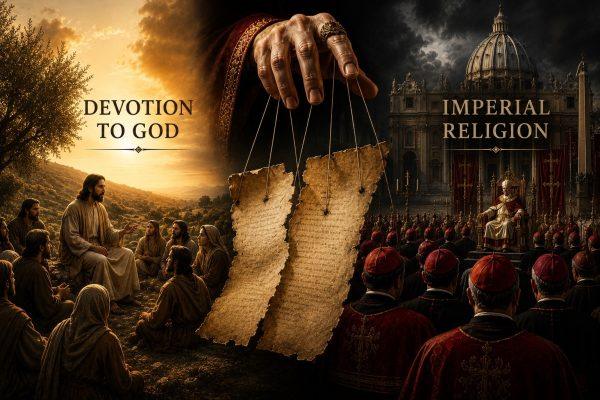
Source: https://www.unz.com/article/the-judeo-christian-illusion/
In my previous article, “The Forgotten Divide Between the Original Jesus Movement and the Modern Church,” I argued that the simple spiritual movement associated with Jesus of Nazareth gradually evolved into a powerful religious institution. I suggested that the earliest communities of believers were centred on devotion to God, personal transformation, and the fellowship of ordinary believers, whereas later centuries witnessed the emergence of increasingly centralised ecclesiastical structures, doctrinal councils, and institutional authority. I also examined the historical development of the New Testament canon, the diversity of early Christian traditions, the significance of the Greek word ekklesia, and the question of whether Jesus himself ever intended to establish the kind of hierarchical institution that later came to dominate Christendom.
But an even deeper question remains. If the original movement was transformed, what exactly was it transformed into? How did a movement centred on inner spiritual awakening become a religion increasingly associated with institutional authority, sacramental systems, imperial power, and theological doctrines that many historians agree developed only gradually over the centuries?
This article traces that transformation from the earliest Jesus movement through the influence of Paul, the development of sacrificial theology, key doctrines and contested translations, the emergence of ecclesiastical authority, the concept of “Judeo-Christianity,” and the Roman Empire’s adoption and transformation of Christianity. Together, these developments gave rise to the dominant form of Christianity that spread throughout the Roman world and, later, much of the modern world.
Throughout this article I distinguish between the historical question of whether Jesus existed and the separate question of whether the earliest teachings associated with his name differ from the institutional religion that later developed. The latter question remains important regardless of where one stands on the historicity debate.
1. The Original Movement Was Not an Institution
Before examining how Christianity changed, it is worth briefly recalling where the Jesus movement began.
Whatever one’s view of the historicity of Jesus, the earliest traditions associated with him describe neither a global religious corporation nor a political institution. They portray a small movement centred upon devotion to God, moral transformation, repentance, humility, compassion, and the Kingdom of God. According to the Gospel accounts, Jesus also challenged the religious establishment of his day and preached under Roman occupation. The earliest followers met in homes and simple gatherings rather than cathedrals, and there is no evidence that Jesus established a Vatican, a college of cardinals, a papacy, or the elaborate ecclesiastical hierarchy that would emerge centuries later.
Jesus left no constitution for a worldwide Church, no canon law, no theological handbook, and no blueprint for an institution that would one day accumulate enormous wealth, political influence, military power, and temporal authority. Even the earliest surviving accounts—which were themselves written decades after the events they describe—portray him primarily as a teacher of devotion to God, prayer, and personal transformation rather than the founder of a global religious institution.
Every enduring movement requires some degree of organisation. The question is whether the institution that eventually emerged faithfully preserved the original spiritual movement or gradually became something fundamentally different.
Christianity did not simply spread across the Roman world. Over the centuries, it was gradually transformed into an institutional religion whose authority would eventually be reinforced by imperial power. Over that period, doctrines were debated, scriptures selected, theological boundaries defined, competing beliefs increasingly came to be identified as heresy, and ecclesiastical authority progressively centralised. By the time Christianity became closely allied with imperial power, it had developed many characteristics that would have been unrecognisable to the small assemblies that first gathered around the teachings attributed to Jesus.
2. Paul and the Birth of a Different Christianity
If the original Jesus movement was gradually transformed into something new, one figure stands at the centre of that transformation more than any other: Paul of Tarsus.
Whatever one’s view of Paul’s legacy, his influence upon Christianity is difficult to overstate. Of the twenty-seven books that comprise the New Testament, thirteen—and traditionally fourteen—are attributed to Paul or his immediate circle. For many Christians today, Paul’s letters provide the principal theological framework through which the life and teachings of Jesus are understood.
Yet this raises an important historical question. Why does the New Testament contain so much of Paul’s theology and comparatively little of Jesus’ own teaching?
The earliest followers of Jesus were centred under the leadership of men such as James, traditionally identified as the brother of Jesus, together with Peter and the other apostles. Their movement emerged within Roman-occupied Judea. Jesus repeatedly criticised many of the Pharisees and religious authorities of his day for elevating legalism, ritual observance, and institutional authority above humility, justice, and sincere devotion to God. The Gospel accounts portray these confrontations in remarkably forceful terms, with Jesus accusing some religious leaders of hypocrisy and spiritual blindness.
Paul’s mission took a different direction. His letters increasingly emphasised faith in Christ’s death and resurrection, salvation through grace, and the universal mission of the Church. In Christian theology, “salvation through grace” means that a person is reconciled to God and receives eternal life not because they earn it through their own good works, but because God freely grants it through the sacrificial death and resurrection of Jesus Christ. This represented a marked shift in emphasis from the teachings attributed to Jesus in the Gospels, which repeatedly stress devotion to God, compassion, humility, and the transformation of the individual. Over time, Paul’s theological framework came to dominate the developing Christian tradition.
The historian Hans-Joachim Schoeps observed that some early Christian groups regarded Paul with profound suspicion, believing that his teachings departed fundamentally from those of Jesus and the original community. According to Schoeps, some traditions even portrayed Paul as the great adversary of the original movement.
Whether or not one accepts that conclusion, there is little doubt that tensions existed between Paul and parts of the early leadership. The New Testament itself records disagreements between Paul and Peter, while other early Christian writings, such as the Clementine literature, preserve traditions portraying Paul as an opponent of the original leadership and questioning his claims to apostolic authority.
One of the most significant theological developments associated with Paul was the increasing emphasis placed upon Christ’s sacrificial death as the central mechanism of salvation and the idea that his death atoned for the sins of humanity. Whether this represented a faithful development of Jesus’ original teachings or the beginning of a significant later theological reinterpretation remains one of the central historical questions surrounding the origins of Christianity.
Did Christianity gradually shift from following the teachings attributed to Jesus towards theological doctrines that developed later about his person, his sacrificial death, and the nature of salvation? If so, the focus of the religion would have shifted from living according to Jesus’ message to believing particular doctrines about Jesus himself.
If Paul’s interpretation became the dominant framework through which later generations understood Christianity, then the religion that eventually spread throughout the Roman Empire may have reflected Paul’s theological framework at least as much as the original movement associated with Jesus.
The issue, therefore, is not simply whether Paul was sincere, but whether his influence marked a turning point in which a movement centred upon devotion to God gradually evolved into an increasingly institutionalised religion whose theology increasingly centred upon claims concerning Jesus’ death and resurrection, together with hierarchical authority structures and institutional practices that differed in important respects from the earliest traditions.
3. Where Did the Word “Christ” Come From?
One of the most familiar words in Christianity is also one of its least understood. Many people think of “Christ” almost as though it were Jesus’ surname. Historically, however, this is not the case.
“Christ” derives from the Greek Χριστός (Christos), meaning “the Anointed One.” Long before the time traditionally associated with Jesus, the translators of the Septuagint—the Greek translation of the Hebrew Scriptures—were already using Christos to translate the Hebrew word Mashiach (“Messiah” or “Anointed One”). In other words, the word Christos was already in use before Jesus; it was not a title created exclusively for him.
This raises an intriguing question. If the title “Christ” already existed, how did it become so closely identified with one individual that millions of people today think of “Jesus Christ” almost as though it were a personal name?
The New Testament applies the title “Christ” to Jesus because its authors present him as the promised Messiah. Over time, however, the emphasis of Christianity increasingly shifted from the teachings attributed to Jesus towards theological claims concerning Christ’s death, resurrection, and their significance for salvation. In time, the title became inseparable from the institutional religion that developed around it.
The distinction is significant because it marks a profound change in emphasis. According to the earliest traditions, he spent years teaching devotion to God, humility, and inner transformation. Yet the institutional religion that emerged over the following centuries increasingly centred upon theological claims concerning the final events of his life and the meaning attached to his death.
4. From Inner Transformation to Blood Sacrifice
Paul’s letters increasingly place the crucifixion at the centre of Christian theology. If this represented a decisive shift in emphasis, then it raises an unavoidable question: how did the religion of Jesus gradually become a religion centred primarily upon the death of Jesus?
If the central emphasis of Jesus’ ministry was love of God, and inner transformation, why did the central ritual of institutional Christianity become the commemoration of his violent death? The Mass directs the believer’s attention toward Christ’s crucifixion, while the Eucharist symbolically invites participation in his body and blood.
According to the Gospel accounts, Jesus spent approximately three years travelling throughout Galilee and Judea, teaching people how to live, how to love God, how to pray, how to care for the poor, and how to transform the human heart.
Yet the central ritual of institutional Christianity does not primarily commemorate those years of teaching. Instead, it commemorates the final hours of Jesus’ life. The Cross became the defining symbol of the religion. The Eucharist became its central sacrament. The crucifixion became the theological centre around which much of later Christianity revolved.
This development raises an important historical question: why did the principal symbol of Christianity become the instrument of Jesus’ execution rather than the teachings for which he is portrayed as living?
Paul’s letters help explain this historical shift. Throughout his writings, the Cross occupies a central theological position. Salvation is presented as flowing through Christ’s sacrificial death, and faith in that sacrifice becomes the foundation of redemption. Over the centuries, this emphasis came to dominate Christian theology and was embodied in the liturgy of the Mass, where the death of Christ is ritually remembered and proclaimed.
My own conclusion is that this transformation marked a profound shift in the centre of gravity of the religion. The principal act of worship of institutional Christianity became the commemoration of the stories of Jesus’ crucifixion, sacrificial death, and resurrection rather than the years he is portrayed as spending teaching and calling people to spiritual transformation.
To me, the Mass appears less as a celebration of what Jesus taught, than as a commemoration of his death and the theological doctrines later constructed around it. If that interpretation is correct, then the institution did not simply preserve the name of Jesus—it gradually redefined the movement around the circumstances of his persecution and execution. It is worth remembering that, according to the Gospel accounts, Jesus is portrayed as standing in opposition to both the Roman occupation and significant elements of the Pharisaic religious establishment. Yet the institutional religion that later developed under Roman patronage placed its greatest emphasis upon venerating the very event that brought his earthly ministry to an end. To me, this transformation has always seemed deeply paradoxical.
5. How Scripture Was Reshaped
If the theology of Christianity evolved over the centuries, an equally important question concerns the transmission and interpretation of the scriptures themselves. Although many readers assume that the Bible has reached them essentially unchanged from the first century, the books of the New Testament passed through centuries of copying, translation, canonisation, textual revision, and theological interpretation before reaching their modern form. Throughout that process, questions concerning disputed translations, later textual additions, and the authenticity of particular passages have continued to occupy historians and biblical scholars.
One example, discussed in greater detail in my previous article, illustrates how profoundly translation can shape theology. In Matthew 16:18, Jesus is traditionally rendered as saying to Peter: “Upon this rock I will build my church.” For centuries, this verse has been cited by the Roman Catholic Church as one of the principal scriptural foundations for papal authority and the institutional Church itself.
Yet the passage is more complex than it first appears. The Greek text uses the word ekklesia, which originally meant an assembly or gathering of people rather than a church institution in the later ecclesiastical sense. There is also a significant distinction between the Greek words Petros (Peter, a stone) and petra (bedrock or foundation), raising the long-standing question of whether Jesus was referring to Peter himself or to Peter’s confession made moments earlier: “You are the Christ, the Son of the living God.”
If the latter interpretation is correct—as many Christian scholars have argued—the enduring foundation is not the authority of a particular office or institution, but faith in Christ himself. Under that reading, Matthew 16:18 provides a much weaker basis for exclusive institutional authority than has often been assumed. The true ekklesia becomes not a hierarchy of priests, bishops, cardinals, and popes, but the fellowship of all sincere believers united in their devotion to God. Whether or not one accepts this interpretation, it illustrates how questions of translation and interpretation have profoundly influenced the historical development of Christian doctrine and institutional authority.
Another significant verse in modern Christianity is John 14:6:
“I am the way, the truth and the life. No one comes to the Father except through me.”
For many Christians, this verse establishes that the institutional Church possesses the unique and exclusive path to God. Yet the Greek text and its immediate context suggest a more limited meaning. In my view, Jesus’ words are better understood primarily as an instruction to his immediate disciples in the circumstances in which they were spoken, rather than as a universal declaration that God provides no valid means of approaching Him before Jesus’ ministry or among peoples beyond the later Christian world.
This raises a broader question. If God is eternal, would divine guidance have been unavailable to the countless generations and civilisations that existed before the first century? Or is it possible that later theological interpretation expanded the scope of Jesus’ words in ways that supported claims of exclusive religious and institutional authority of the Roman church? If such an interpretation became widely accepted, it could be used to legitimise the claim that one institution alone possessed the unique path to God.
As later sections will show, such claims became closely intertwined with the growth of ecclesiastical authority and, eventually, political and military power.
Other examples illustrate how translation and textual development have shaped Christian doctrine. One of the best-known is the so-called Comma Johanneum (1 John 5:7), long cited in support of the doctrine of the Trinity. Modern textual scholarship has shown that the explicit Trinitarian wording familiar to many Christians is absent from the earliest surviving Greek manuscripts and appears to have entered the biblical tradition at a later stage. Whatever one’s view of the doctrine, this example demonstrates that important theological formulations have not always rested upon the earliest textual evidence.
Another example is the Longer Ending of Mark (Mark 16:9–20). The earliest surviving Greek manuscripts end at Mark 16:8, while the final twelve verses describing appearances of the risen Jesus and the commissioning of the disciples appear to be later additions. Most modern Bibles acknowledge this textual dispute in a footnote. If the earliest version of Mark’s Gospel ended at verse 16:8, what does that imply about the later narratives describing appearances of the risen Jesus?
Whatever conclusion one reaches, the example illustrates that the New Testament reached its present form through a complex process of transmission and editorial development.
Individually, such examples may appear technical. Collectively, however, they raise an important historical question. To what extent has Christianity been shaped not only by the original teachings associated with Jesus, but also by centuries of translation, editorial decisions, doctrinal development, and institutional interpretation?
If the meaning of key passages gradually shifted over time, then the transformation of Christianity was not accomplished solely through councils and imperial patronage. It also occurred through the words believers read, the doctrines those words came to support, and the authority claimed by those who came to reinterpret them.
6. The Invention of “Judeo-Christianity” and the Question of Jesus’ Identity
One of the most familiar expressions in modern political and religious discourse is the phrase “Judeo-Christian values.” It is invoked by politicians, church leaders, commentators, and historians as though it described a continuous religious tradition stretching from ancient Galilee through Jesus to the modern Christian Church. Yet surprisingly few people stop to ask a simple historical question: when did Christians begin describing their faith as “Judeo-Christian”?
The earliest followers of Jesus would almost certainly not have recognised the expression. The New Testament itself records repeated conflicts between Jesus and influential religious authorities of his day, particularly the Pharisees.
The Gospel accounts consistently describe Jesus as Jesus of Nazareth, a Galilean who lived and preached in Galilee and Judea under Roman occupation. The historical and cultural landscape of first-century Palestine was considerably more complex than the modern expression “Judeo-Christian” implies.
Although the expression “Judeo-Christian” dates back to the nineteenth century, the idea of a unified “Judeo-Christian tradition” or “Judeo-Christian values” appears to have gained widespread cultural and political prominence only during the mid-twentieth century. Whether it should also be projected backwards onto the first-century Jesus movement is another matter entirely.
This naturally leads to a second historical question. If the modern expression “Judeo-Christianity” projects later categories backwards onto the first century, what do the historical sources actually suggest about the identity of Jesus himself?
Within modern Judeo-Christian discourse, it is commonly asserted that “Jesus was Jewish”, “Jews are God’s chosen people”, and that Christianity emerged directly and continuously from Judaism. In my view, these assumptions have profoundly influenced how many Christians understand both Jesus and the origins of their religion, while also reinforcing the modern concept of a shared Judeo-Christian heritage.
Various writers, including James Combs, Jacob Conner, and Willie Martin, have challenged the assumption that Jesus was Jewish and that the modern expression “Judeo-Christianity” accurately describes the earliest Jesus movement.
In Christian Sheep and Satan’s Wolves (1971), Combs claims:
“Never, in the Holy Testament, did Christ call Himself “Jewish.”…. A proper Latin translation would better be, “Jesus, the Nazarene, leader of the Judeans.”… it carried the greater geographical connotation, for all people who lived there… It is blasphemous to call Christ a “Jew.” No group was a greater foe of Christ… His spiritual antecedents were Hebraic and Davidic… not Jewish.”
In the book Christ Was Not A Jew An Epistle to the Gentiles (1936), Conner wrote:
“Christ… was a Galilean, and the Galileans were not Jews, in race… but Gentiles, and mostly Aryan Gentiles like ourselves. Many of them… remained outside of the Jewish cult… The history of the Aryans in all that part of the world goes back some centuries beyond the year 4000 B. C.”
Willie Martin in A Chronology of the International Conspiracy To Form the New World Order asserts that:
”The Jews are not Israelites, but are the descendants of the Khazars of Eastern Russia… It is highly probable that the bulk of the Jew’s ancestors ‘never’ lived in Palestine ‘at all’… The occult, worshipers of Lucifer, used the cross as its sacred symbol… What is usually referred to as the Jewish-Christian traditions exists only in Christian or secularist fantasy… it was implanted there by the persistent propaganda… “
Whether or not one accepts these controversial interpretations, they illustrate that the historical identity of Jesus and the earliest Christian movement remains the subject of continuing debate. The important point is not whether every alternative interpretation is correct, but that the modern expression “Judeo-Christianity” should not be accepted uncritically as though it were a description used by the earliest followers of Jesus themselves.
This distinction matters because language shapes historical understanding. If the expression “Judeo-Christian tradition” is treated as though it describes an uninterrupted continuity stretching from Jesus to the modern Church, centuries of theological development, institutional transformation, and political change risk being compressed into a single misleading narrative.
My own conclusion is that the expression “Judeo-Christianity” is better understood as a historical construct than as an accurate description of the earliest Jesus movement. I explore that argument in greater detail in my book The Judeo-Christian Illusion: How Institutional Power Concealed the Original Christian Teachings.
7. Did Jesus Teach a New Religion? Where Did Jesus’s Teachings Actually Come From?
Another question naturally follows from this discussion. If the institutional form of Christianity developed gradually over several centuries, did Jesus himself intend to establish an entirely new religion, or was he calling people back to timeless spiritual principles that had long been known?
The teachings attributed to Jesus repeatedly emphasise love of God, repentance, humility, compassion, inner purification, and the transformation of the heart. These themes were not unique to first-century Palestine.
Similar spiritual principles can be found throughout earlier religious traditions and among several of the Hebrew prophets, who repeatedly emphasised justice and sincere devotion to God over mere ritual observance.
According to the Gospel accounts, Jesus presented his teachings as consistent with truths that had already been revealed through the Law and the Prophets.
Nor are these principles confined to the Biblical tradition. Ideas such as devotion to God, purification of consciousness, the eternal nature of the soul, and liberation from material illusion also appear in ancient Vedic literature that predates Christianity by many centuries. In the Vedic tradition these timeless principles are often described as Sanātana Dharma (“the eternal dharma” or “eternal religion”), reflecting the idea that genuine spiritual truth transcends any particular historical institution. This does not mean all religions are identical, nor does it diminish the uniqueness of Jesus’ ministry. It does, however, suggest that many spiritual principles associated with Jesus belong to a far older stream of divine wisdom that predates the later institutional form of Christianity.
The Nobel Prize-winning physicist William D. Phillips expressed a similar sentiment when reflecting upon his own Christian faith:
“Jesus often said that he was only preaching what the Law and the prophets had taught long ago… I certainly won’t claim that all religions are the same, but when so many have such common features, I find it hard to argue that the loving and personal God I experience is not at work in the hearts of those people of other faiths.”
This broader perspective also helps explain why many spiritual traditions have shown deep respect for Jesus without accepting every later institutional development carried out in his name.
A.C. Bhaktivedanta Swami Prabhupada, who lectured extensively on the ancient Vedic Vaiṣṇava tradition, likewise described Jesus as a genuine representative of God while simultaneously criticising the failure of institutional Christianity to live according to Jesus’ own teachings. Speaking at La Trobe University in Melbourne in 1974, he said:
“We respect Jesus Christ as you do. Because he is the representative of God, son of God, and we are also speaking of God, so we respect him with our greatest veneration.”
Whether one approaches the question from Christianity, the Vedic tradition, or another spiritual perspective, the same historical question remains. Was Jesus establishing an entirely new religion, or was he restoring eternal spiritual truths that had gradually become obscured? If the latter is correct, then the greatest transformation occurred not in Jesus’ teachings themselves, but in the institutional religion that later developed around his name.
8. The Empire Needed a Religion
By the beginning of the fourth century, Christianity had undergone a remarkable transformation. What had begun as a small and often persecuted religious movement was about to enter an entirely new relationship with the Roman state. The decisive turning point came during the reign of the Emperor Constantine.
Before Constantine, Christians were frequently viewed with suspicion by the Roman authorities. Ancient sources record periods of imprisonment, torture and execution, including in some cases condemnation ad bestias—being exposed to wild animals in public arenas. Although historians debate the scale of these persecutions, there is no dispute that the early Christian movement endured periods of severe repression under several Roman emperors.
Yet within little more than two centuries, this persecuted movement would become the religion favoured by the very imperial power that had once sought to suppress it.
Afterwards, Christianity gradually became intertwined with imperial government. The Emperor convened councils, supported the Church, and increasingly intervened in disputes concerning Christian doctrine. Christianity was no longer simply a spiritual movement; it increasingly became intertwined with imperial administration and policy.
The Council of Nicaea in AD 325 marked a watershed. Bishops from across the Empire gathered under imperial patronage to settle theological disputes and establish a common orthodoxy. In the centuries that followed, further councils continued to define authorised doctrine, determine which writings belonged within the biblical canon, and identify alternative interpretations as heresy. Christianity became progressively standardised, centralised, and institutionalised.
From an imperial perspective, the advantages were considerable. A unified religion, claiming divine authority and administered through an organised ecclesiastical hierarchy, provided a powerful means of consolidating political authority, encouraging conformity, suppressing dissent and rival movements, and reinforcing imperial rule throughout a vast and culturally diverse empire.
The long-term consequences of this alliance between Church and Empire became increasingly apparent over the centuries that followed. Beginning in the eleventh century, successive Crusades were launched under papal authority, not only to the Holy Land but also against groups within Europe itself that were deemed heretical or politically unacceptable.
Perhaps the clearest illustration of Christianity’s transformation into an institution of coercive power was the Albigensian Crusade (1209–1229). Unlike the better-known Crusades against Muslim powers, this campaign was directed against fellow Christians—the Cathars of southern France—who were judged heretical by the Roman Church. The Cathars emphasised personal spiritual purity, voluntary poverty, and a simple religious life, rejecting many of the institutional practices and sacramental claims of the medieval Church. Entire towns were devastated, thousands of people were killed, and the movement was effectively destroyed. Whether viewed as a tragic necessity or a grave abuse of ecclesiastical power, the campaign demonstrates how, by the High Middle Ages, religious conformity could be enforced through military force under papal authority. In many parts of Europe, conversion to the Roman Church became closely associated with political submission to the religious authority of Rome. Christianity had become not merely a spiritual movement but an institution capable of exercising military, legal, and political power over entire populations.
How can such actions be reconciled with the teachings attributed to Jesus himself—to love one’s neighbour, and to live by the commandment “Thou shalt not kill”? Is there any clearer example of the divide between the original spiritual message and an institution increasingly concerned with authority, conformity, and domination?
The Roman conquests and expansion across much of Europe also contributed to the decline and transformation of many indigenous religious, spiritual, intellectual, and cultural traditions, including those of Celtic, Germanic, and Illyrian peoples. Much of their pre-Christian religious and philosophical heritage was gradually lost, displaced, or absorbed over the centuries.
This transformation raises a fundamental question. Did the Roman Empire simply adopt Christianity because it had become influential, or did imperial authorities reshape the movement by appropriating the name and perceived authority of Jesus for broader political purposes?
As Christianity became increasingly associated with councils, creeds, bishops, imperial patronage, and later the authority of Rome, the distance between the original spiritual movement and the institutional Church continued to grow. The religion no longer functioned merely as a community of believers; it became one of the principal institutions through which religious authority, political power, and social order were exercised throughout the Empire.
It is for this reason that I believe the Roman Church did more than simply preserve the name of Jesus—it gradually appropriated, and ultimately hijacked, the name of Jesus together with the authority associated with it, attaching both to an expanding institutional structure that claimed to speak uniquely on his behalf. Whether this process should be understood as legitimate development or as the gradual replacement of the original movement is ultimately for the reader to decide. My own conclusion is that the institutional Church came to use the name and authority of Jesus to consolidate religious and political power in ways that the earliest movement itself would scarcely have recognised.
If that conclusion is correct, then the greatest transformation in Christian history was not simply theological. It was the conversion of a spiritual movement into an institution that increasingly served the needs of empire while claiming continuity with the man from whom it derived its authority.
9. From Spiritual Movement to Institution of Power
By this stage, the historical pattern begins to emerge with increasing clarity. The movement associated with Jesus had become far more than a community of believers devoted to God.
The Bishop of Rome gradually became the Pope, presiding over an increasingly elaborate hierarchy of bishops, archbishops, cardinals, priests, religious orders, canon lawyers, and ecclesiastical courts. The Church accumulated enormous wealth through land ownership, taxation, donations, and political patronage, becoming one of the most powerful religious and political institutions in Europe.
With wealth came influence, and with influence came power. Popes crowned kings, deposed rulers, negotiated treaties, authorised wars, and frequently intervened in the political affairs of kingdoms. The institutional Church increasingly exercised authority not merely over matters of faith but over law, education, government, property, and daily life. To question ecclesiastical authority increasingly meant challenging rulers, kingdoms, and the wider political order itself—a principle expressed most clearly in Pope Boniface VIII’s Unam Sanctam (1302), which asserted the supremacy of the Roman Pontiff over temporal rulers.
The Crusades, the suppression of movements declared heretical, and the development of institutions such as the medieval Inquisition illustrate how the preservation of religious orthodoxy became closely intertwined with the preservation of institutional authority. The medieval Inquisition was a system of ecclesiastical tribunals established to investigate, judge, and suppress those accused of heresy or religious deviation. Whether viewed as necessary responses to perceived threats to religious unity or as serious departures from the teachings attributed to Jesus, these developments demonstrate that the Church had become an institution capable of exercising immense temporal power.
For example, Pope Boniface VIII’s papal bull Unam Sanctam (18 November 1302) asserted one of the strongest claims to papal authority ever made. It declared that all temporal rulers and kings were ultimately subject to the spiritual authority of the Roman Pontiff and concluded that “it is absolutely necessary for salvation that every human creature be subject to the Roman Pontiff.” Such claims illustrate how far the medieval papacy had evolved from the small fellowship of believers described in the earliest Christian traditions.
Once Christianity became closely associated with political authority, wealth, and social order, preserving the institution itself inevitably became one of its foremost priorities. Councils defined orthodoxy, competing interpretations were condemned, authorised scriptures were distinguished from rejected writings, and claims to religious authority became increasingly central to the identity of the Church.
This raises the central question of this article. Was the institutional Church primarily preserving the teachings of Jesus, or was it preserving its own authority by claiming to speak uniquely in his name? These are not necessarily the same thing.
My own interpretation of the historical evidence goes further. I believe the institutionalisation of Christianity was not simply an unintended consequence of history but part of a longer historical process in which the name and authority of Jesus were progressively appropriated by an expanding institutional structure for purposes of religious, political and temporal power. If so, Christianity became an institution that exercised forms of authority the earliest movement appears never to have contemplated.
The historical transformation described in this article was far too extensive to be explained as a series of isolated accidents. It unfolded over centuries through the actions of emperors, bishops, Church councils, theologians, canon lawyers, and ecclesiastical institutions, each contributing to the development of an increasingly centralised Church. Whether this represented a spontaneous historical evolution or a more deliberate process of institutional consolidation remains one of the central questions of Christian history. My own conclusion is that the remarkable consistency of this historical pattern increasingly served the interests of both imperial and ecclesiastical power.
Some historians and writers have argued that, although the Western Roman Empire formally collapsed in the fifth century, important structures of Roman administration, law, political culture, and elite influence continued within the institutions that succeeded it, including the medieval Church. If so, the institutional Church became one of the principal vehicles through which the Roman imperial system, together with its concepts of authority, governance, and institutional power, was preserved while increasingly claiming unique spiritual authority through the name of Jesus.
10. The Enduring Question
The central question is not whether millions of Christians throughout history have been sincere in their faith. Undoubtedly many have. Nor is it whether countless priests within the institutional Church have sincerely served their communities.
Rather, the question is whether the institution has always faithfully preserved the original teachings, or whether those teachings gradually became intertwined with political authority, institutional interests, and theological developments that emerged over many centuries.
Does a person’s relationship with God ultimately depend upon membership of a particular institution, or does it depend upon sincere devotion, inner transformation, and the pursuit of truth wherever it may be found?
If Jesus repeatedly directed people towards love of God and personal transformation, then perhaps those teachings deserve once again to stand at the centre of the conversation. Even if one remains unconvinced about the historical details of Jesus’ life, or even about his historicity itself, the teachings traditionally associated with his name retain profound moral and spiritual value. They also resonate with older spiritual traditions that emphasise devotion to God, inner transformation, and the defence of truth against evil.
My purpose has not been to attack individual Christians or diminish sincere faith, but to encourage readers to distinguish between what can be discerned of the earliest movement and the institutional structures that later developed in his name.
Perhaps the most important question of all is this: if Jesus of Nazareth were to walk into one of today’s great cathedrals, would he recognise the religion that bears his name—or would he simply call people back to the timeless principles that formed the heart of his original message?
Conclusion
My own conclusion is that the greatest fraud in Christian history was persuading countless generations that an institutional religion, which gradually evolved under the influence of imperial power, theological development, and ecclesiastical authority, was identical with the original spiritual movement associated with Jesus of Nazareth.
History belongs to no institution.










Initially, the Caesars labelled the followers of Jesus as Christians, designating them as heretics against the Roman religious system; this was considered a crime against the state punishable by death.
Furthermore, the term “Judeo-Christian” is a contradiction, as one must be either Jewish or Christian. Yet even the word “Jewish” contradicts the term as Jews reject Jesus and hate Christians.
True followers of Jesus should refer to themselves as “disciples,” consistent with the terminology used for his original followers. The term derives from the Greek *mathētēs* (μαθητής), meaning a student or learner. This originates from the verb *manthanō* (μανθάνω), which signifies the act of learning or understanding. – (cf. Strong’s G3101 and G3129).
https://www.youtube.com/watch?v=X8B27HL87M8
Essentially this post is correct. Just a few details are where it might be fruitful to comment.
The word Jew is always a problem having multiple meanings. Ju in Hebrew means government. Judaeism is the religion created by the Pharoahs (Ahkenaton and Nefertiti) to contain the mass of the people in Egypt. It succeeded. The Romans decided they needed a Judaeism for the Gentiles, and after defeating what hstorians call the Jewish Revolt in Judaea led by who the bible calls Jesus (Izas Manu) in AD70, Josephus Flavius had the religion we call Christianity written, as instructed by Vespasian.
Izas was king of the country neighbouring the Roman province of Judaea, a buffer state between Rome and Persia called Osrhoene, supremely rich and tax free, hugely influential in Judaea – Mary Magdalene Izas’ wife the richest woman in Judaea (of Bethany) He was a Nazarene a branch of the Essenes, and did not subscribe to Judaeism, or the religions of Rome, the city of Saturn or Satan, which like Judaeism permitted sacrifice and torture of (at least) animals.
The Nazarenes and Essenes did not permit animal torture and sacrfice. And were against usury and exploitation, believing in economic freedom of the people. The difference today is that the Epstein Cult (secret government) is hidden from view, while the Christian echo of the real Izas who was with the creator God, is increasingly occulted, corrupted and destroyed. The divide is still exactly the same.
The word Jew is also used to denote those who live in the country of Judaea, today referred to as Israel/occupied Palestine. The same word defining a territory, a religion and a hidden political structure. Coming from Judaea/Palestine. Judaeist or Judaeic. Secret government. All are called Jew.
Judaeo-Christian is the attempt to bolt the two religions together when as Gordon says, you either believe in suppression of people with usury, torture and sacrifice, using demonic power, or you believe in Nazarene/Essene values working with and for God to build a better world through free sovereign human beings.
England like Scotland and Wales and Ireland is a Christian country. The UK is a Zionist government structure, part of the secret world government that is demonic and anti-Christian. King Charles and the supposedly superior beings that wish us to be sacrificed and gone, whether through warfare, medication or otherwise. The name Jesus is the only name the demons fear and have to back down to. God is more powerful than the Devil, but you have to listen to what he wants you to do, and comply. Or we are left on our own to be consumed.
Thanks both, your comments are both helpful additions to the post
Having been raised by an atheist father and a lapsed Methodist mother then, it took me far far too long to realise the distinction between Jesus the man and all his teachings, versus Christianity the religion with so many contra teachings to Jesus. I was literally brainwashed
Btw, I hold no resentment for that brainwashing by my parents. Particularly from my wonderful father
Because he saw far too much, far too young. Drove a truck onto the beach on D Day when 22, saw the allied bombing of Caen from very close up when they killed 20k+ French civilians, camped near Holland in the winter of ’44/’45 when the Dutch were starved by the war, he subsequently met a Dutchman who was so hungry that he ate his pet dog, he visited Hamburg after the allied area bombing that killed many thousands of German civilians, said that the place smelled of death, even visited Belsen camp just after “liberation”, that shocked him to his core. All this before he was 24. No wonder that he struggled with faith all his life afterwards. He was a rock and didn’t really let any of it drag him down for the rest of his life
No counsellors for guys like him afterwards. He’d have called that “LMF” himself, lack of moral fibre, an old WW1 expression. He overused alcohol all his life after then. Born in a drinking town, so second nature. In hindsight I suspect an element of self medication, I’ll never really know now, he passed in 2003. God rest his soul
Don’t really know why I’ve said all that here, seemed appropriate to me somehow. And helped me a bit I suppose. Certainly brought a few tears to my eyes
The only way to unload is to pass it on to another to handle for you. Forget about religion. He was human. Humans can only take so much then we crack. Trauma can be healed by hemp, which seals the trauma off in your brain, by hypnotherapy which didn’t exist probably, or by asking a spiritual helper to carry the load that you can’t. He did well. I wonder if people today will struggle even more with mass trauma having no belief in anything as far as I can see apart from material possessions. Not wanting religion should be an opening of the mind to the real spiritual world, but people feel if they don’t believe the formal doctrine of their given religion, they cannot ask for help from a spiritual helper. The opposite should be the truth, in my opinion. Instant relief comes from bypassing structured belief systems. The real Jesus would not have needed any such thing.
Thanks Tap, very good advice there