
It’s all BS – the 1976 heatwave during the last week of June through to mid July was every bit as intense as this year’s
Sun 11:15 am +00:00, 9 Aug 2026 1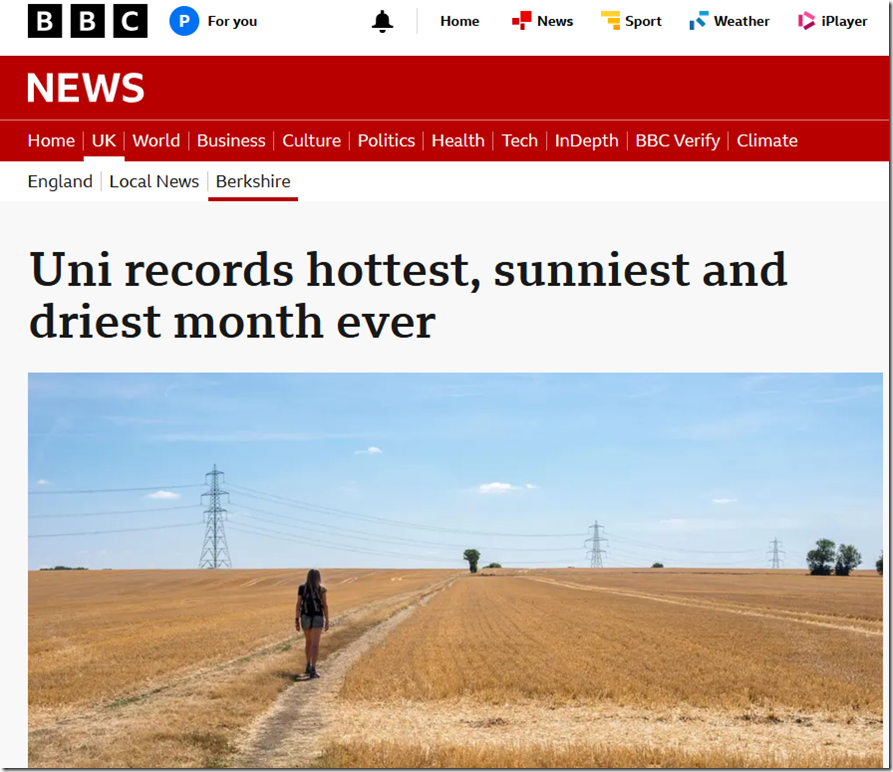
Source: https://notalotofpeopleknowthat.wordpress.com/2026/08/09/why-has-it-been-so-hot-this-summer/
We’ve been bombarded with claims all summer of record heatwaves. But away from the Met Office’s dodgy weather stations next to airport runways and in walled gardens, the Central England Temperature Series tells a different story.

https://www.metoffice.gov.uk/hadobs/hadcet/data/download.html
The daily data shows that the 1976 heatwave during the last week of June through to mid July was every bit as intense as this year’s.
In 1976, there were nine days over 30C; in comparison there were just six this time. (There were also two in May this year). The hottest day in 1976 was 33.1C, against 32.8C this year.
It is also worth noting that the highest recorded temperature at a pristine Class 1 site this year was 34.3C at Rothamsted.
The biggest difference is that in 1976, temperatures dropped below average in the second half of July. This year they have been slightly above average. As a result, June/July this year is running about 0.4C hotter.
There have been the inevitable claims that this year’s heat is due to global warming. This frankly is a juvenile argument.
As always in summer, the heat comes from the sun. Anticyclonic weather, particularly when it “stuck” for a time, brings sunny, dry weather, and with it high temperatures.
The intensity of the heat is largely dependent on the position of the high. If it is over the continent, winds will draw in heat from Europe. If it is out in the Atlantic, winds tend to come from the west or north, with temperatures lower as a consequence.
Slow moving highs also tend to lead to hot weather, because there is little mixing of the air.
All of this is basic meteorology. But the question remains – is climate change making such weather conditions more common. In short, are UK summers getting drier?
We know that this summer has so far been exceptionally dry and we we must wait and see how it finishes up. But one summer is weather, not climate.
What we do know though is that summers here have not been getting drier. On the contrary, there is little evidence of any change in long term trends.
Certainly, there have been many severe summer droughts in the past.

It was also an unusually dry spring, but, again, the long term data shows that this year has not been particularly unusual where rainfall is concerned:

https://www.metoffice.gov.uk/pub/data/weather/uk/climate/datasets/Rainfall/date/England.txt
Another claim I have come across is that when it does rain, it is heavier than it used to be – “extreme rainfall” offsets long dry spells. The old, discredited Met Office argument.
Once again, however, the data debunks the claim.

https://www.metoffice.gov.uk/hadobs/hadukp/data/download.html
So the question is not “why has it been so hot this summer?”. It should be “why has anti-cyclonic weather dominated this summer?” There is nothing in the data to link this to climate change.
I have seen no explanation of this by the Met Office, nor even any attempt to do so.
Isn’t that what we are paying them for?
If they want a clue, they should look across to Greenland, where their summer has not really started yet!

https://polarportal.dk/en/greenland/surface-conditions
The wet weather we have missed out on this summer has been parked out in the Atlantic, where it has brought snow.
Meanwhile, temperatures across the Arctic have not got above freezing yet this summer either:











The 1976 heatwave began during the final week of June. Earlier that week, in the Scottish Borders, the weather was cold enough for two inches (5 cm) of snow to fall.
Through years of observation, I have learned that nature maintains its own equilibrium. A long, cold, wet winter is often followed by a hot, dry summer, and this year has been no exception. When intense summer heat persists, significant autumn rainfall typically follows, resulting in widespread flooding. This is beneficial to the ecosystem, allowing Atlantic salmon and sea trout to leave the sea and head upstream to their spawning grounds. Likewise, in the spring, a lot of flooding occurs to allow the fish to return to the sea. This is all a natural process.
According to the BBC, the United Kingdom is experiencing its fifth heatwave this summer. While such temperatures are expected during this season, with the south reaching approximately 30°C and Edinburgh and the Borders remaining near 20°C, the media frequently attributes these conditions to human-induced global warming and fossil fuel consumption. However, these claims are disputed, as I believe the primary issues involve poor land and air quality management.