
How the empire weaponized human rights
Wed 11:53 am +00:00, 25 Mar 2026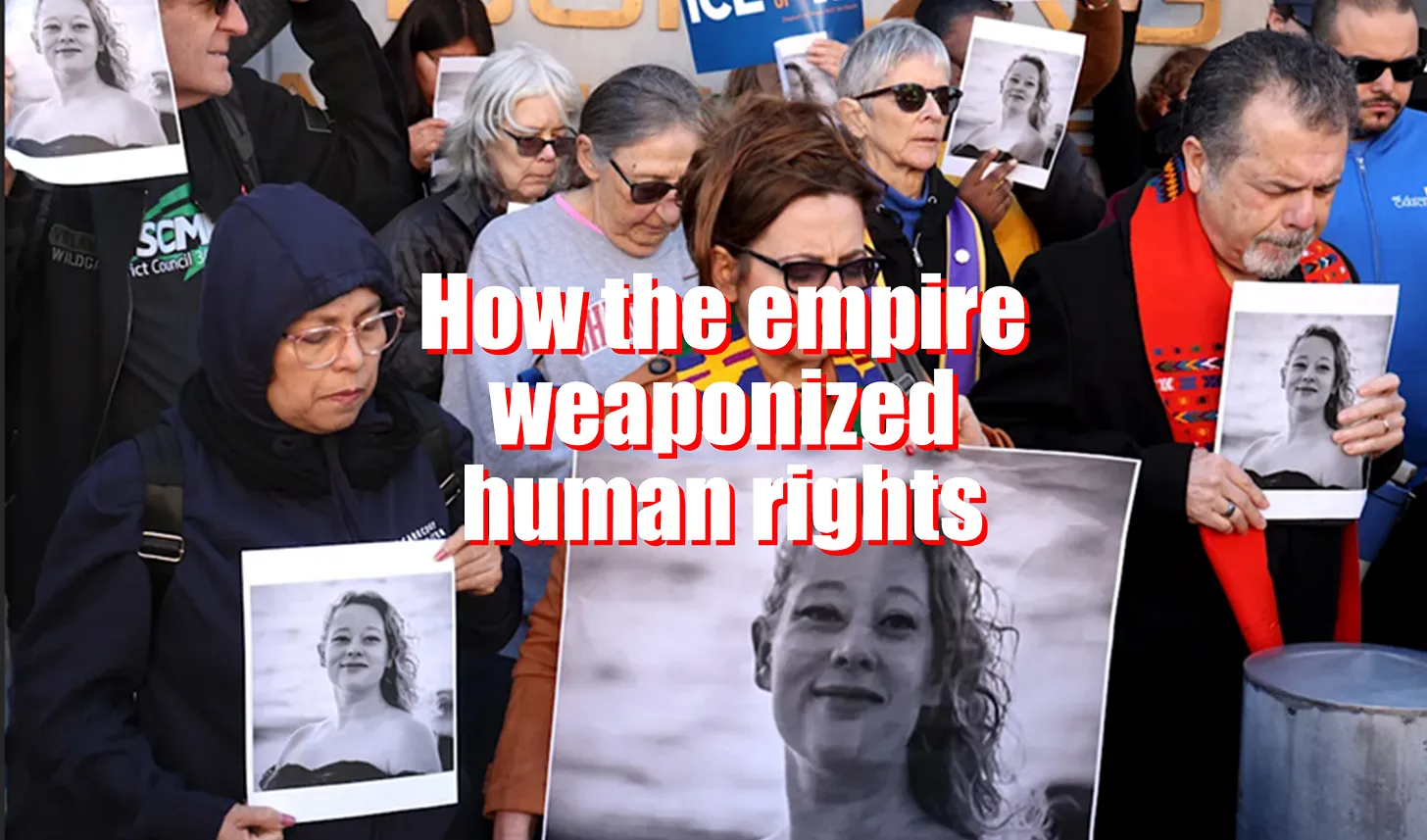
Multinational banks, organized crime and “human rights/social justice” complex have formed a formidable army waging war on sovereign nations and humanity. USA is their target #1!
Source: https://alexkrainer.substack.com/p/how-the-empire-weaponized-human-rights
War against Iran has overshadowed another war that is today a far greater threat to the United States: it’s the 21st century Opium War where drug cartels are mere foot soldiers who only play the most visible role. The real kingpins waging this war are high-level executives of Global Systemically Important Banks. We can appreciate how devastating an opium war can be by the fact that during the 1800s, British Empire waged two Opium Wars against China.
The Opium Wars set off a “Century of Humiliation,” reducing a 6,000-year old civilization and the greatest economic power to the world’s poorest country by the 1960s. The same methods, deployed by the same structures of power today have the U.S. in their crosshairs.
But in addition to the drug cartels, they’ve been able to mobilize another powerful force: large standby armies of human rights and social justice warriors. Their role is to attack the forces of law and order as soon as drug cartels and other organized crime networks are in jeopardy. We’ll explore this dynamic in this 2-part article. The full video report is below:
United States under assault
The year 2026 started with a foreshadowing of civil uprisings in the United States. Starting in December 2025, U.S. Department of Homeland Security launched the Operation Metro Surge, the largest immigration enforcement operation ever carried out. What has actually taken place is far more fascinating and consequential than what’s been triggering social justice warriors and human rights crusaders.
In December of 2025 and January of this year, the Department of Homeland Security deployed at least 2,000 Immigration and Customs Enforcement officers, also known as ICE agents, and 1,000 Customs and Border Patrol officers to Minneapolis-St. Paul metropolitan area, initially targeting organized fraud in Somali-American community.
Minnesota fraud: $2,500 per taxpayer
The uncovered fraud was extensive and very substantial: preliminary estimates suggested that more than half of the $18 billion spent across 14 Minnesota state programs since 2018 may have been fraudulent, implying that more than $9 billion was stolen from U.S. taxpayers. How much is $9 billion? It corresponds to over $1,500 per every man, woman and child living in the state of Minnesota, or about $2,500 per taxpayer.
Presumably, fraud on that scale should justify law enforcement action. Accordingly, the DHS launched its operation, which led to arrests of some 4,000 people in Minneapolis in January and February of this year. The Trump administration also requested that state and local authorities in Minnesota turn over all incarcerated “criminal illegal aliens” and those with active warrants to Federal authorities, and that local law enforcement assist federal officers in apprehending individuals.
The bizarre complicity of Minnesota government
But instead of gratitude and relief that the Federal cavalry came to assist Minnesota’s government to clean up the state and crack down on organized crime, state authorities turned outright hostile against the Federal officials. Almost from the get-go, the DHS operation in Minnesota was accompanied by protests, obstruction and non-cooperation by local law enforcement agencies.

By mid-to-late December, student groups at the University of Minnesota organized protests and “noise demonstrations” in the metro-area. These intensified significantly on 7 January after an ICE agent shot and killed one Renée Nicole Macklin Good. The same night, thousands of protesters gathered for a vigil at the site of her death. The following day, large-scale protests erupted across Minneapolis, and spread to other cities like Portland and New York as the news of Renée Good’s death spread in the news media nationwide.
The protests even included walkouts by high school students demanding the withdrawal of Federal agents from Minneapolis-St. Paul metropolitan area. State authorities encouraged the protesters: Minnesota attorney general Keith Ellison filed a lawsuit against the DHS to halt ICE deployments, arguing that the ICE operation was unconstitutional and that it violated the state’s sovereignty.
Deploying the human rights warriors
Then, on 23 January, an estimated 50,000 protesters braved the below-freezing cold to march in downtown Minneapolis. That day saw the first public use of the “ICE Out” slogan and a general strike where some seven hundred Minnesota businesses closed in solidarity with the demonstrators. On that same 23 January, there was a clergy-led protest at Minneapolis St. Paul Airport.
The following day, two Federal agents shot and killed another protester, the 32-year old nurse Alex Pretti. His death, like that of Renée Good, was reported and sensationalized nationwide, further exacerbating tensions between the Federal law enforcement and the protesters. Adding to the inflammatory rhetoric, on 24 January Governor Tim Walz gave a speech, in which he said that QUOTE,
“This federal occupation of Minnesota long ago stopped being a matter of immigration enforcement. It’s a campaign of organized brutality against the people of our state. And today that campaign claimed another life. I’ve seen the videos from several angles, and it’s sickening.”
Senator Elizabeth Warren further polarized the situation by denouncing ICE brutality and describing Alex Pretti almost as a saint for contrast:
“Caring for people was at the core of who he was. He was incapable of causing harm. Alex carried patience, compassion, and calm, as a steady light within him. Even at the very end, that light was there. I recognized his familiar stillness and signature calm composure.”
It’s not clear how exactly Senator Warren recognized Pretti’s familiar stillness, because the subsequently discovered footage of Pretti’s actions showed him as an antagonistic, aggressive, protester spitting on Federal agents and attacking their vehicles with physical force. Nonetheless, the outrage over his death triggered yet another wave of strikes and protests which erupted on 30/31 January, branded as the “National Shutdown.”
A well organized insurgency
The sequence of events as they unfolded suggested that they were not driven by people’s spontaneous reactions to police brutality. They were clearly well organized and aggressive obstruction of Federal agents which was deliberately encouraged in order to provoke violence, which could then be used to orchestrate larger protests and justify noncompliance by state and local authorities.
One former Special Forces Warrant Officer with multiple rotations running counterinsurgency operations characterized the events in Minneapolis as a, “low-level insurgency infrastructure, built by people who’ve clearly studied the playbook.” He added:
“This isn’t spontaneous outrage. This is C2 (command and control) with redundancy, OPSEC hygiene, and task organization… The most sobering part? It’s domestic. Funded, trained (somewhere), and directed by people who live in the same country they’re trying to paralyze law enforcement in.
When your own citizens build and operate this level of parallel intelligence and rapid-response network against federal officers—complete with doxxing, vehicle pursuits, and harassment that’s already turned lethal—you’re no longer dealing with civil disobedience. You’re facing a distributed resistance that’s learned the lessons of successful insurgencies.”
Journalist James O’Keefe, who was on the ground, corroborated this view, stating,
“What strikes me is how organized these agitators in Minneapolis are. They have spotters everywhere in the city and suburbs, on street corners, even 30 minutes away from downtown. … I was inside what appeared to be a fully autonomous Zone. No police presence. The police were told to leave. I identified myself as Press and they said they will kill Press and will not let me leave.”
But perhaps the most worrisome was what former special operations agent E.M. Burlingame wrote. Note, he was not even involved in any of the events in Minnesota. I’ll quote his X post word for word:
“Those behind all of this are using social media to directly threaten special operations guys and their families. I’ve had it directed at me and mine in the last week and a half. And not minor threats. … There’s more than color revolution underway here in the US. There is the very beginning of Phase V to Phase VI civil war which those backing intend to be an outright revolution that breaks the US up. For only if the US is broken up can Russia and China eventually be broken up.”
There seems to be a playbook
This leads us to the view that the events in Minnesota, just like the “No Kings” protests in the U.S. during the summer months and October of 2025, were deliberate, coordinated attempts to destabilize and weaken the Trump administration and effectively use the people of Minnesota as human shields, protecting organized crime networks from law enforcement.
In other words, an organized, coordinated action by an extensive network of progressive-leaning non-governmental organizations harnessed popular outrage over police brutality in order to neutralize Federal law enforcement and protect the organized crime networks.
If that seems like a stretch, let’s examine an episode that played out about ten years ago in another country, in Mexico. It involved the struggle between the Mexican state and its drug cartels. But before we get to the heart of that story, it’s important to appreciate the history of this struggle and of the drug cartels, which we’ll cover briefly.
How bankers empowered drug cartels in Mexico
Drug cartels have existed in Mexico for over a century, but their organization and power increased dramatically in the aftermath of President Carlos Salinas de Gortari’s economic reforms in the 1990s, aligned with the “Washington Consensus.” Salinas de Gortari’s reform included wholesale privatization of the banking sector in 1991 and 1992, along with constitutional reforms in 1993 that granted independence to Mexico’s central bank. The law went into effect in April 1994, when the bank officially began operating as an autonomous institution, free from public oversight.
It would take less than two years for Mexico’s financial system to collapse: the 1995 financial crisis necessitated a $150 billion government bailout. But even as the Mexican taxpayers were rescuing the newly privatized banks, large Western banks moved to take advantage of the crisis.
In its aftermath, Global Systemically Important Banks like BBVA, Santander, Citi, and HSBC acquired about 85% of Mexico’s banking sector for pennies on the dollar. This is how the terrain was prepared for the rise to power of Mexico’s drug cartels. The nature of the relationship between banks and cartels is important to understand so we’ll briefly touch upon that subject next.
The symbiosis of banks and cartels
In 2008, General Barry McCaffrey, the drugs czar in Bill Clinton‘s administration visited Mexico on a fact-finding mission. His report revealed that Mexican drug cartels were earning more than $460 million per week – more than $25 billion per year on their drugs trade. In 2017, the US Treasury Department estimated the total drugs trade industry in the US at more than twice that: $64 billion/year, which is more than $1.2 billion per week.
According to General McCaffrey, the cartels were repatriating about 40% of those proceeds back into Mexico in bulk cash. This issue alone posed a number of tremendous problems for the cartels, illustrated in the following graphic:

This is the reality that any organized crime networks face and it can severely limit the organization and scalability of their business. In the 1980s, the Columbian kingpin Pablo Escobar was allegedly spending $8,000 per month just on rubber bands to hold the banknotes together. All that cash must be counted, stockpiled, and guarded in secure warehouses, leaving it vulnerable to law enforcement raids, confiscation, or theft by disloyal cartel members or rival gangs.
Limitations of cash

Furthermore, using banknotes severely limits the cartels’ purchasing options. If you are limited to using physical cash, there’s only so much you can buy with it: perhaps some houses, luxury cars and jewelry, caviar and champagne, handguns and items like that. But as General McCaffrey’s investigation found, Mexican cartels were able to field armies, capable of outgunning Mexico’s military and police. Already in 2008, they had:
“… platoon-sized units employing night vision goggles, electronic intercept collection, encrypted communications, fairly sophisticated information operations, sea-going submersibles, helicopters and modern transport aviation, automatic weapons, rocket propelled grenades, Anti-Tank 66 mm rockets, mines and booby traps, heavy machine guns, 50 calibre sniper rifles, massive use of military hand grenades, and the most modern models of 40mm grenade machine guns.”
You can’t pay for helicopters and submarines with cash on pallets. For that you need bank accounts with clean balances, and a legitimate-looking front, which is where banking services come in handy. In particular, it is the international banks’ money laundering services that enable the cartels’ business to transcend the limitations of physical cash. The banks’ willingness to accept large amounts of cash and turn them into clean bank deposits absolutely essential support for organized crime operations.
Money laundering is also extremely lucrative for the banks. It is believed that they charge between 10% and 20% against the cartels’ proceeds. If Mexican cartels generate $65 billion per year, their bankers’ cut of that business would be between $6.5 and $13 billion – a very substantial amount. Of course, money laundering would not be the only service the banks could offer to their extremely wealthy cartel clients, so we can safely assume that the above estimate is a conservative one, particularly in light of the nature of the relationship between organized crime and the bankers.
Bankers run the show
Accepting large amounts of cash and laundering the proceeds of illegal activities gives banks power over the cartel leaders, mobsters or any other form of organized crime. The mobsters can’t well call the police or file lawsuits to complain about the bankers’ extortionate commissions.
They might try to intimidate the bank executives they deal with, but the executives they know will be relatively low-level employees who don’t call the shots. Their bosses are concealed high up in the hierarchy, sitting secure in their London, New York, Paris or Zurich offices. Even if the mobsters killed their account managers, nothing at all would happen to the bank, which would have a number of options to retaliate against the mobsters if they got uppity.
Banks can also easily replace any incapacitated executives without ever exposing the top of their own command and control hierarchy. In effect, this puts the mob in subordinate position to the bankers and it can only be the bankers who call the shots in that relationship. The bankers are even in the position to demand special favors from the mob, including arms smuggling, beatings, kidnappings or political assassinations – favors that could be hard for the mob to decline.
In light of all this, it is almost certainly the bankers who anoint and protect the heads of organized crime groups. They do this in cooperation with intelligence agencies like the CIA or MI6. Let’s think back to those huge piles of cash that the cartels haul from the US back to Mexico. That cash could be taken by anyone who could wrest physical access to it.
Suppose a cartel boss like Joaquín Archivaldo Guzmán Loera, also known as “el Chapo,” tasked one[ of his faithful captains to guard a part of his cash hoard. That man could easily be tempted to seize the cash for himself and to convince the men under his command that rather than working for El Chapo for a salary, they could simply take the cash and create their own cartel.
In this way, El Chapo would be permanently vulnerable to palace coups by any ambitious rival. Or he could be threatened by tipoffs to rival gangs, military units or law enforcement agents. An offer of a bribe, lenience or protection could easily induce many lower-level mobsters to turn on their bosses.

By contrast, if El Chapo’s money is clean in a bank account where only he or his CFO are authorized signatories, then they have full control over the money, the payrolls and any acquisitions or investments. If his banker recognizes El Chapo as the head of his organization, then El Chapo is secure in control of his cartel and in possession of his financial wealth.
If he were limited to only hoarding and safeguarding cash, his cartel would soon splinter into dozens of rival gangs that would quickly turn on each other. The whole cartel structure would disintegrate and become easy for law enforcement to finish off.
To be continued…
In part 2 of this report, we’ll explore how two successive Mexican governments went to war against the cartels, started to subdue them, slowly reducing the rates of violent crime in Mexico. But in doing so, they were ruining an industry that was too lucrative for money laundering banks to let go. To neutralize the forces of law and order, the bankers mobilized human rights warriors who successfully blunted government attack on drug cartels. Today, cartels are more powerful and wealthier than ever and the rates of violent crime in Mexico have soared to new highs.