Globalism really is Global – And that includes China, and Russia – Multipolar – Not
Fri 9:32 am +00:00, 6 Mar 2026
Source: https://winteroak.org.uk/2026/03/06/china-and-the-same-old-global-mafia/
All the usual anti-democratic global institutions
=======================================
It never fails to amaze me that there are people out there who oppose globalism while refusing to acknowledge that it really is… global!
They apparently find it impossible to believe that Putin’s Russia and, even more so, Communist China, could be controlled by the same gang that dominates our own societies.
I have tried to put the record straight on a number of occasions, alongside Mees Baaijen, Hrvoje Moric and others. [1]
But some handy new information has now come my way thanks to Pierre Hillard’s 2019 Archives du mondialisme (‘Globalist archives’), a veritable goldmine of information from which I aim to extract further nuggets in future essays.
The 770-page tome includes a chapter from a 1981 book by Yann Moncomble, entitled L’irrésistable expansion du mondialisme (‘The irresistable expansion of globalism’), which begins by stating: “The instauration of a New World Order could not take place, obviously enough, without China”. [3]
I regard the drawing of China into the global empire as having begun with the Opium Wars of the mid-19th century when, as Carroll Quigley puts it, “Chinese resistance to European penetration was crushed by the armaments of the Western Powers, and all kinds of concessions to these Powers were imposed on China”. [4] 
But Moncomble starts the story in 1890, when “John D. Rockefeller gifted the Chinese 300,000 little paraffin lamps, to ‘encourage’ them to use his oil; ten years later, the Chinese were already buying 450 million litres of paraffin a year, of which more than 90% came from Standard Oil”. [5]
Standard Oil was, of course, Rockefeller’s business, although I should point out that by this stage the family had been taken over by the Rothschilds and were merely an “American Protestant” figleaf for City of London machinations – more on that in my 2024 booklet The Single Global Mafia: The Rockefeller Foundation’s multiple links to Zionism and military-industrial-financial neo-imperialism. [6]
Hillard, for his part, points to a 1984 essay by Frank Ninkovich, entitled ‘The Rockefeller Foundation, China and Cultural Change‘, about the Rockefeller Foundation’s plans in 1915 to set up a medical school in Peking/Beijing. [7]
This states: “The Rockefeller Foundation’s attempt over the course of forty years to channel China’s modernization in a liberal direction epitomizes the marriage of national interest and private policymaking”. [8]
Public-private corporatism and “modernization” are once again aligned!
In 1949, the year that the People’s Republic of China was proclaimed, The Chinese People’s Institute of Foreign Affairs was created. [9] 
If the name sounds vaguely familiar, this is probably because it is a sister organisation to the Royal Institute of Foreign Affairs in London, aka Chatham House, whose role as a tool of the global cabal I have also previously established, [10] and also to the US equivalent, the Council on Foreign Relations.
Moncomble identifies one of the men involved in setting up the CPIFA as Chester Ronning, who had worked for Canadian Air Force Intelligence during the Second World War, and then set about trying to persuade the world to recognise Communist China.
He says Canada was one of the first countries to normalise its relations with China in the 1970s and Ronning’s personal friend Huang Hua became China’s ambassador to that country. [11]
But the main figure behind the CPIFA was Walter Lockhart Gordon, “founder of the firm Clarkson and Gordon, charged with approving the accounts of three of the five biggest banks in Canada: the Bank of Nova Scotia, the Toronto Dominion Bank and the Canadian Imperial Bank”.
“As if by chance, W.L. Gordon was one of the most longstanding leaders of the Canadian Institute of International Affairs (CIIA) – founded by the RIIA [Chatham House] – and we find him, as it happens, in the Bilderberg Group”. [12]
The banksters’ hand was again visible in 1966 when the Rockefeller Foundation was joined by the Ford Foundation – whose zio-imperialist nature I have also firmly demonstrated [13] – in establishing the National Committee on United States-China Relations. [14]
Moncomble describes this entity, which still exists today, as “a vehicle for propaganda in favour of a more moderate policy with regard to red China”. [15] 
He adds: “Two years later, in 1968, election year in the USA, Mr Nelson Rockefeller spoke of the need for a dialogue with Communist China, for the ‘improvement’ of relations with the USSR and for the creation of a ‘New World Order’”. [16]
The very next year, on March 22 1969, a significant conference was staged in New York on relations between the West and China.
Moncomble explains: “The principal participants, who directed the conference towards a certain conclusion, were the Democrat senator Arthur Goldberg, president of the American Jewish Committee, and the Republican senator Jacob Javits, honorary president of the Jewish War Veterans and vice-president of the Independent Order of B’nai B’rith”. [17]
For those unware, B’nai B’rith is a judeo-supremacist freemasonic entity notorious for having critics of Israel/Zionism “cancelled” and intimidated for alleged “anti-semitism”. [18]
The conference came out, of course, in favour of a rapprochement between the USA and China.
Moncomble says that, in particular, Goldberg sought the admission of Communist China into the United Nations – which came about two years later in 1971 – while Javits asked for the Chinese to be provided with photos taken of their country by American satellites. [19]
Funnily enough, the New York gathering coincided with the new US government, under President Richard Nixon, announcing a desire to build more constructive ties with China, which led to the president’s high-profile trip to the Communist-run country in February 1972.
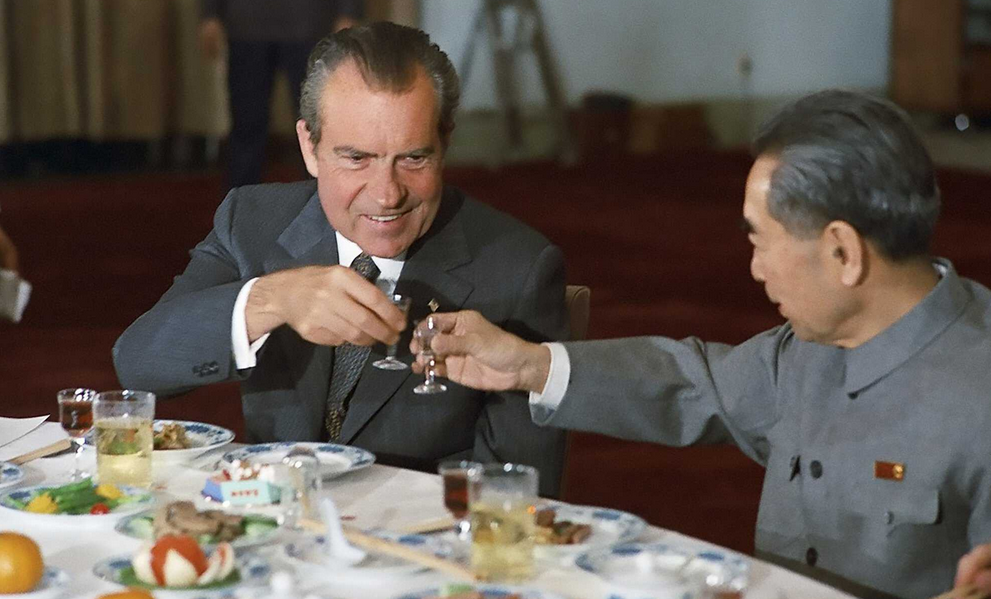
The press made much of this visit, adds Moncomble, “but what it systematically forgot to do is to tell its readers of prior negotations”. [20]
These had been carried out by notorious Jewish globalist Henry Kissinger, of the Council on Foreign Relations, Bilderberg and the Trilateral Commission. [21]
There followed a number of lucrative business deals with China, such as the $290 million contract won by Pullman Kellog of Texas and its Dutch subsidiary Kellog Continental in 1973 involving the construction of eight agrochemical complexes. [22]
In addition, Louis Dreyfus & Co, specialists in cereal transportation, sold 400,000 tonnes of American wheat to Communist China. [23]
Under Jimmy Carter’s presidency, in 1977, Secretary of State Cyrus Vance – also, coincidentally, of the Council on Foreign Relations, Bilderberg and the Trilateral Commission, as well as the Rockefeller Foundation – visited China with talk of getting relations out of a dead end. [24]
As it turned out, David Rockefeller was in the Chinese capital that same year on business matters. [25]
Then in 1978, another leading globalist, Zbigniew Brzezinski (Council on Foreign Relations, Bilderberg and Trilateral Commission), visited the Chinese authorities. [26] 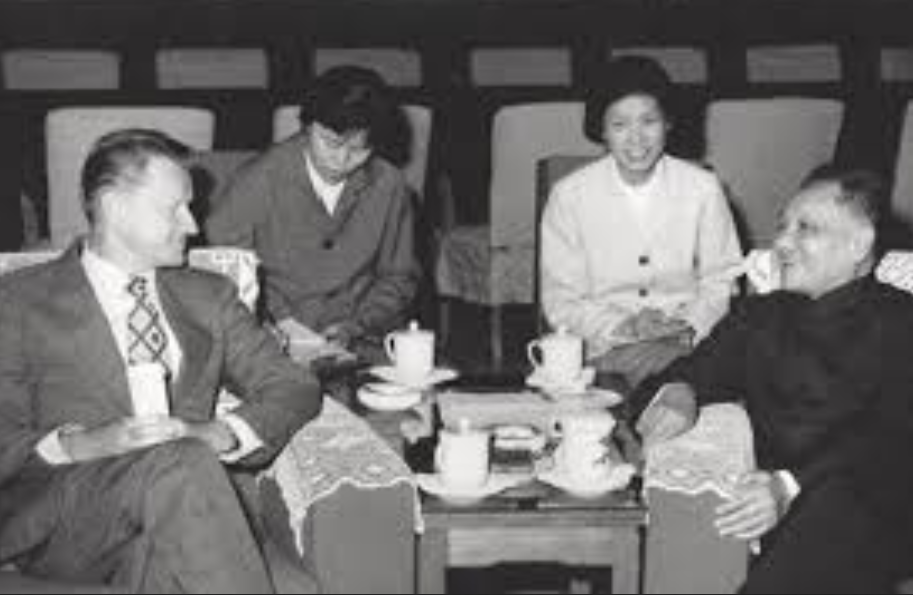
Moncomble says that “16 months of secret talks” culminated in the USA recognising the Communist regime in China in December 1978 and officially reestablishing relations on January 1 1979. [27]
He quotes Georges Berthoin as writing in Le Monde on April 22-23 1979 that “the Chinese authorities seem to approve the idea of a New World Order”. [28]
The “consecration” came in May 1981 when the globalist Trilateral Commission actually held a meeting in Peking/Beijing, on the initiative of Chatham House’s colleagues at the CPIFA. [29]
Those in attendance included Peter Shore, a British Labour Party MP and Fabian; Winston Lord, president of the Council on Foreign Relations and Bilderberg member; Bruce MacLaury, president of the Federal Reserve Bank of Minneapolis and of the Brookings Institution and member of Bilderberg and the Council on Foreign Relations and, needless to say, David Rockefeller. [30]
Moncomble’s account finishes there, in the year his book was published, but Hillard refers to some subsequent developments from his 2019 vantage point, remarking that “China’s progressive rise in power has led it to now constitute one of the pillars of global political organisation”. [31]
He points, for example, to a report from Reuters from July 7 2009 entitled “Russia, China to push global currency at G8 summit” [32] – this was held in Italy, by the way, and greeted with massive anti-globalist protests.
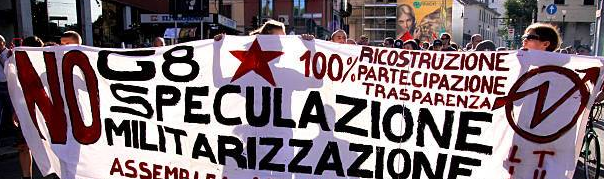
The report states: “China, which has up to 70 percent of its $1.95 trillion in official currency reserves in the dollar, underlines that the dollar is still the most important reserve currency.
“But it believes over-reliance on the dollar has exacerbated the financial crisis and sees the International Monetary Fund’s special drawing rights (SDRs), based on a basket of currencies, as a viable alternative for the future”. [33]
Hillard also provides a link to a 2017 article from Foreign Affairs, the “very globalist” review of the Council on Foreign Affairs. [34]
This refers to China’s long-standing position that the SDR – the synthetic currency created by the IMF – should play a greater role in the international monetary system. [35]
Hillard writes that China is the final piece in the jigsaw puzzle of globalist control. [36]
He describes its notorious use of facial recognition technology linked to a social credit system which rewards or punishes behaviour as the state sees fit.
“China is a dream model for the global oligarchy eager to roll out these methods across the planet… officially, for our security”. [37]
Just to ram home the real and serious role played by China in the globalists’ bid for worldwide tyranny, I would refer readers to a talk given in Beijing at the Chinese state’s Lanting Forum by foreign minister H.E. Wang Yi, who is member of the Political Bureau of the Communist Party of China’s Central Committee, on October 27, 2025.
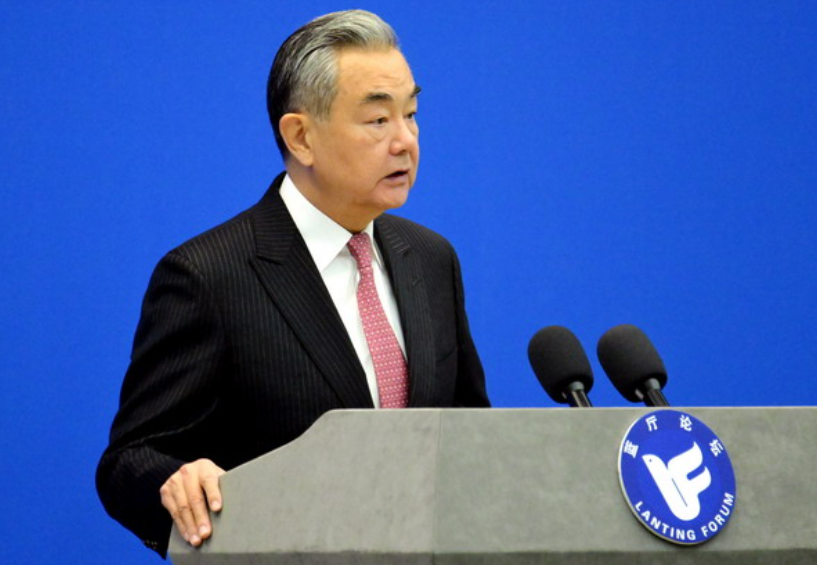
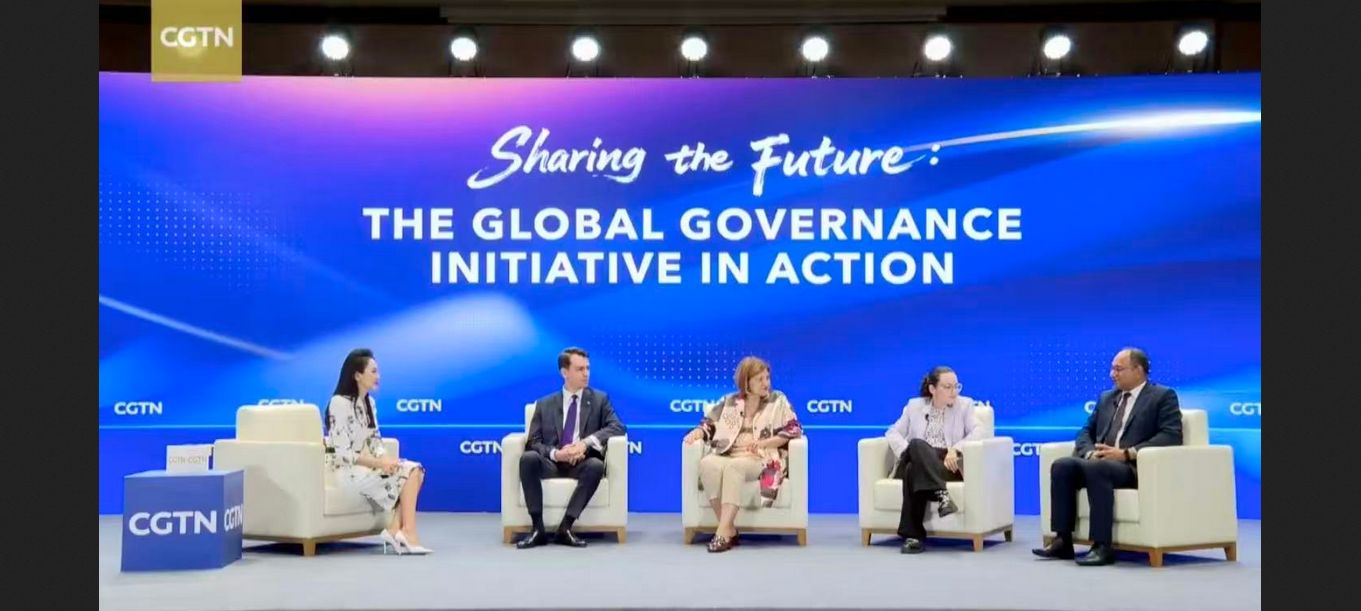
Featured on the website of the CPIFA, China’s Chatham House, it is entitled “Implementing the Global Governance Initiative for a Community with a Shared Future for Humanity”. [38]
Wang Yi claims that “over the past 80 years, the international system with the UN at its core has been standing as a bedrock of world peace and development”.
He says that in the face of obstacles, President Xi Jinping “solemnly put forth the Global Governance Initiative (GGI), offering the Chinese answer to this question of our times”.
This was obviously drawn up by the same networks that are behind similar efforts in “The West” because we hear all the same sickening language!
It is all about “international rule of law for a just and orderly global governance system”, “a people-centered approach for universally beneficial and inclusive outcomes of global governance” and “real results for a pragmatic and efficient global governance process”.
Lying through his teeth, Wang Yi declares: “The GGI responds to the needs of the world and wishes of the people.
“Together with the Global Development Initiative (GDI), the Global Security Initiative (GSI) and the Global Civilization Initiative (GCI), it promises much needed stability and provides certainty for this volatile world, and has received swift and clear support from more than 140 countries and international organizations”.
Here he is confusing the vile aims of globalist-controlled states and entities with “the needs of the world and wishes of the people”.
Behind all this verbiage is the familiar imperialist agenda of pillage and profit.
Wang Yi says: “We should put development back at the center of [the] international agenda, mobilize global resources for development, and foster an equal and balanced global development partnership.
“China has been advancing high-quality Belt and Road cooperation with partner countries, benefiting over three-fourths of all countries in the world.
“We have implemented the 10 partnership actions for modernization with African countries, carried out five programs with Latin American and Caribbean countries, developed five cooperation frameworks with Arab states, and built seven cooperation platforms tailored to Pacific Island countries, bringing about shared progress on our paths toward modernization.
“China is actively implementing the Global AI Governance Initiative, and has initiated the World AI Cooperation Organization (WAICO), to advance AI for good and for all and support capacity building in Global South countries”.
“We support the Asian Infrastructure Investment Bank and the New Development Bank in playing a greater role as useful complements to existing financial institutions, jointly contributing to global financial stability”.
You may choose to believe Wang Yi that all of this is nice and cuddly and harmless because it is “multipolar”. He insists: “The most desired vision of the GGI is a future of fairness”.
But the aim of imposing a World State is very clear when the Communist politician stresses: “We should stand together to tackle pressing challenges and shore up the weak links in global governance”.