In latest effort to deny reality, leftist German word police announce that a standard colloquialism for ethnic German is racist,
Mon 7:32 pm +00:00, 13 Jan 2025
In Germany, we suffer under an annual media ritual in which a “jury” consisting of four linguists and a journalist select an “Unwort des Jahres” – an “Unword of the year” – to condemn as politically incorrect. The entire German press then reprint excerpts of the press release issued by these self-appointed language police, and the Gutmenschen can either pat themselves on the back for never have used that evil word in the first place, or strive like hell to keep it from their lips in the future. As with many deeply retarded conventions, the Unword of the Yearbecame a thing after the fall of the Berlin Wall, in 1991 – as a “linguistically critical” campaign to lecture the masses about all the things they should not say. Its present guardians preach that “linguistic expressions become Unwords because they are used by speakers either thoughtlessly or with intentions worthy of criticism.” They furthermore hope that their “reflection and criticism on the use of Unwords” might “raise awareness about discriminatory, stigmatising, euphemistic, misleading or inhumane language usage.” That might sound all very transparently contentious, politically loaded and ridiculous to you, dear reader, but in Germany the Unwordians are experts and the media treat them like a minor lexicographical priesthood. Let us go through a few past Unwords of the year, to gain an understanding for what our Unwordians get up to:
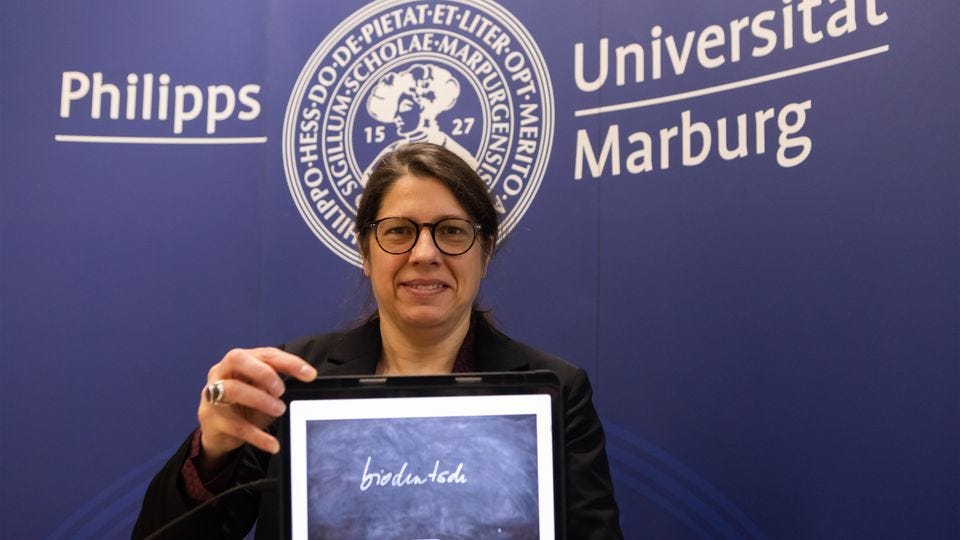
On and on it goes like this. Over the years the, our speech police have produced a dubious catalogue of Unwords that reveal nothing so much as the emotional and political fragility of the Unwordians themselves. In 2019, the year of St. Greta, the Unword was “climate hysteria”; in 2017, the first year of the Trump administration, it was “alternative facts”; in 2015, the year Angela Merkel opened the borders, it was “Gutmensch.” This brings us to the Unword of 2024, a particularly infuriating choice announced today by our unbiased and unpartisan Unwordian jury. It is biodeutsch, or “bio-German,” an adjective used to distinguish ethnic Germans from more recent arrivals. From the decree of our Unwordians:
This is dumb for several reasons. First of all, “biodeutsch” does not “construct” a “biological form of nationality,” despite the bio- prefix. Linguists – even linguists as stupid and politically addled as the Unwordians – ought to know there is a powerful distinction between etymology and meaning. Second of all, as the Unwordians themselves reluctantly acknowledge, biodeutsch originated in leftist circles with ironic overtones that are too tiresome to describe. Later, it came to be used more seriously by those who asked why migrants require special designations (like “people of migrant background”) and why ethnic Germans should not be the ones singled out by marked and specific terminology.¹ Over a decade ago the Green politician Cem Özdemir – the son of Turkish immigrants – used the term repeatedly, and generally in a negative sense:
Because the distinction between ethnic Germans and non-ethnic Germans is very important (even if our present political religion insists that it does not exist); and because Özdemir was beyond accusations of racism, and furthermore precisely because he had christened biodeutsch as a specific ethnic pejorative – one intended to deny Germans the status of being simply German – Germans happily adopted the word for themselves. At least biodeutsch should be safe, they thought; at least biodeutsch would be a way to describe ethnicity, which is one of the most salient and important divisions in human populations next to gender. Nothing, however, is safe from the left – particularly not the German left, and especially not when it comes to finding some way to describe or articulate Germanness. In the Anglophone world, “racism” is commonly understood to involve the (alleged) devaluation or dehumanisation of racial outgroups. Only recently and in the race-critical circles of particularly noxious radicals did the idea emerge that Europeanness itself (“whiteness”) is a false and racist concept worthy of abolition. The German left are altogether more eager to embrace this programme of aspirational self-annihilation by insisting the primary racist sin lies in believing that there are ethnic Germans at all, or at least in talking as if there were. The Unwordians argue that the term biodeutsch has become “discriminatory” because “it violates the idea of democratic equality” and “excludes” non-ethnic Germans from the notional community of the Biodeutsche. We have achieved such an elaborated understanding of what “democratic equality” requires, that it is impossible to reconcile with everyday social realities. Perhaps if equality is to mean that we can’t even acknowledge or describe our own existence, we should strive to have a bit less of it. Or perhaps the Unwordians should try chasing down all the Turkish immigrants, the Chinese immigrants, the Syrian immigrants, and all the other immigrants who invariably maintain their own exclusionary ethnic identities long after receiving their German passports, and inform them that they, too, are guilty of undemocratic racism. That project is likely to turn out well. 1 As Welt points out, we find this important use in a 2010 book by the Ethiopian-German author Asfa-Wossen Asserate (Draußen nur Kännchen): “Recently, the strange term ‘people with a migration background’ has been in vogue. But what is the point of a term that is used to turn German citizens back into foreigners? Wouldn’t it be better to introduce a counterpart for the ‘people living in Germany without a migration background’? How about the term biodeutsch, for example?”
|