
Centuries of theft: the starvation of the periphery by the core
Mon 4:21 pm +00:00, 10 Aug 2026
Source: https://winteroak.org.uk/2026/08/10/centuries-of-theft-the-starvation-of-the-periphery-by-the-core/
An important focus of my work in recent years has been showing how authority, exploitation, empire and industry are all merely aspects of one overall process.
Looking back, I should acknowledge that a significant chunk of that understanding came from the late Richard Hunt (1933-2012).
In the 1990s I read his magazine Alternative Green, corresponded with him and even visited him at his home in Oxford on a couple of occasions.
This was not some grandiose mansion on university grounds, by the way, but a tiny flat in a 1960s shopping centre!
Our paths ended up diverging and we lost touch because while, back then, I was moving ever deeper into the vibrant UK eco-anarchist milieu, Hunt was moving away from it.
Although he was the original editor of the journal Green Anarchist – in whose pages the name “Paul Cudenec” would later make its first appearance in 2004 [1] – he had fallen out with his colleagues.
Accused of expressing dangerously nationalistic views, Hunt found himself in the grey zone of beyond-right-and-left dissidence into which I have also now been pushed in recent years.
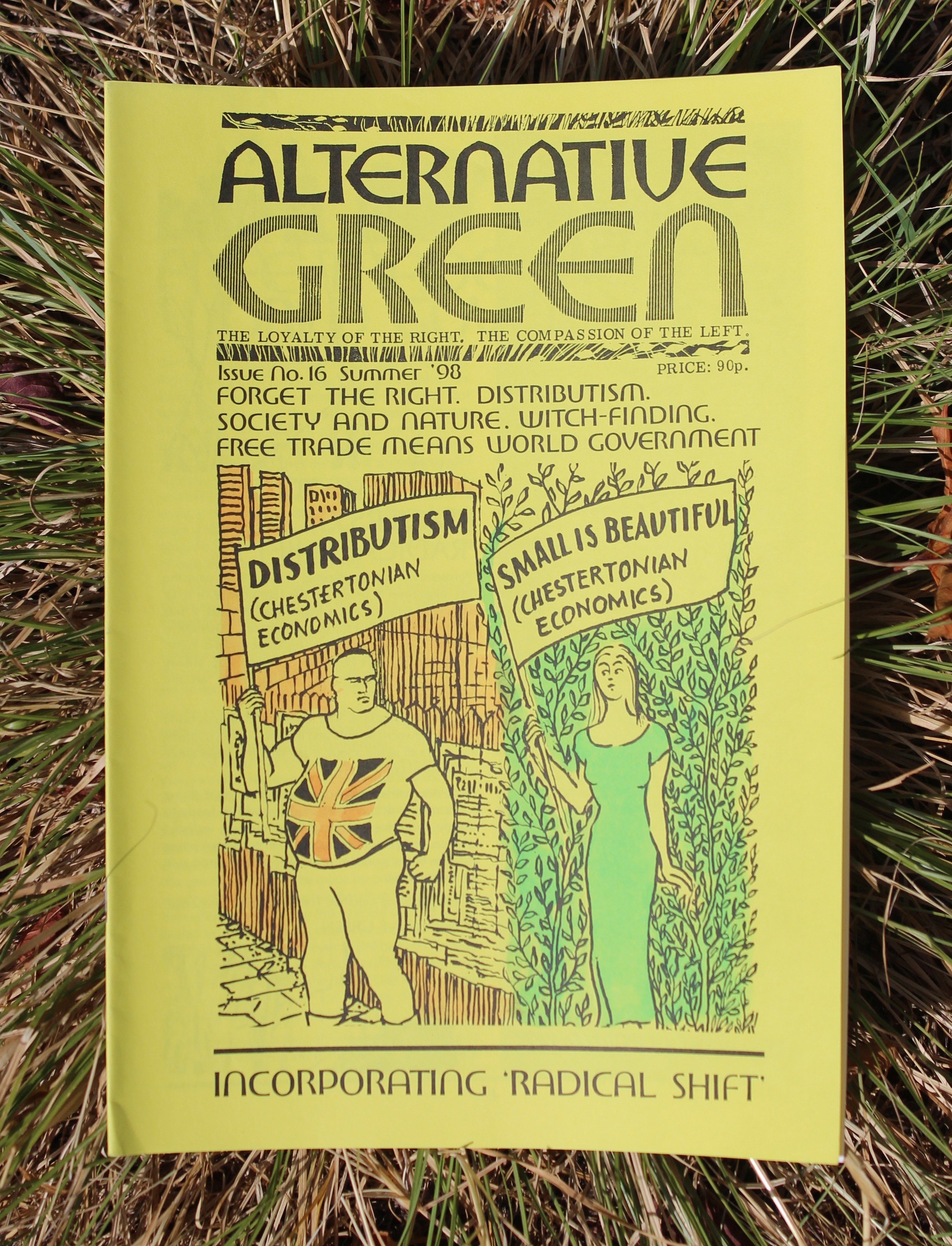
Alternative Green, which he started in 1991 and which declared that it combined “the loyalty of the right” with “the compassion of the left”, prided itself on being open to contributions from people from all kinds of political backgrounds.
This did not go down so well in certain “left-wing” circles, of course, and Hunt had to keep defending himself against the smear-mongers.
For instance, there is a letter from him in what turned out to be the final issue of the UK Situationist journal Here and Now (Winter 1997/98), [2] of which I still have a hard copy, complaining that someone in the previous issue [3] had labelled him “fascist” and suggested that he was in some way dishonest.
He responded: “I have bent over backwards to be honest in the mag ‘Alternative Green’. If I have had embarrassing letters, I have printed them. I have made as clear as I possibly can where I stand on each issue and I’ve got into big trouble for it… You can justifiably accuse me of not being left wing. You can accuse me of talking to the decentralist right. What you cannot accuse me of is dishonesty”.
Hunt had indeed by then made his political position very clear, not just in his journal but in his 1997 book, To End Poverty: The Starvation of the Periphery by the Core, which I have just re-read for the first time in nearly 30 years.
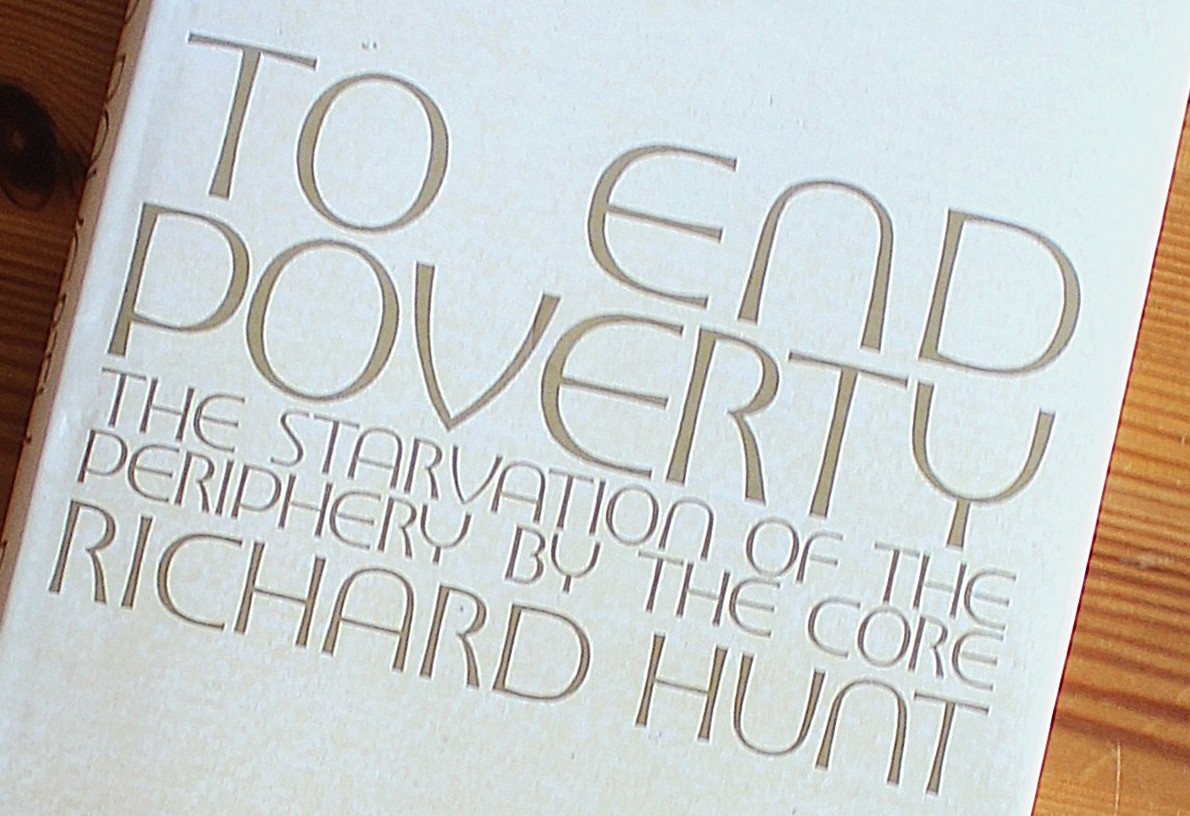
In his “Postscript” he writes: “You will find it difficult to say whether this book is leftwing or rightwing. It is neither. It is moderate, but decentrally extremist…
“The division between left wing and right wing will be replaced by the division between the centralists and decentralists, right wing centralists with left wing centralists against right wing decentralists with left wing decentralists”. [4]
He provides a table with examples of centralists and decentralists, pitting the centralist idea of equality against the decentralist idea of liberty, “economies of scale” against “small is beautiful” and pro-technology versus anti-technology.
On the side of centralism he places capitalists, liberals, fascists, Marxists, internationalists, townspeople and Third World rulers, while on the side of decentralism he includes anarchists, nationalists, greens, regionalists, survivalists, country folk and Third World people.
He asks: “So, dear reader, which side of the barricades will you be on?” [5]
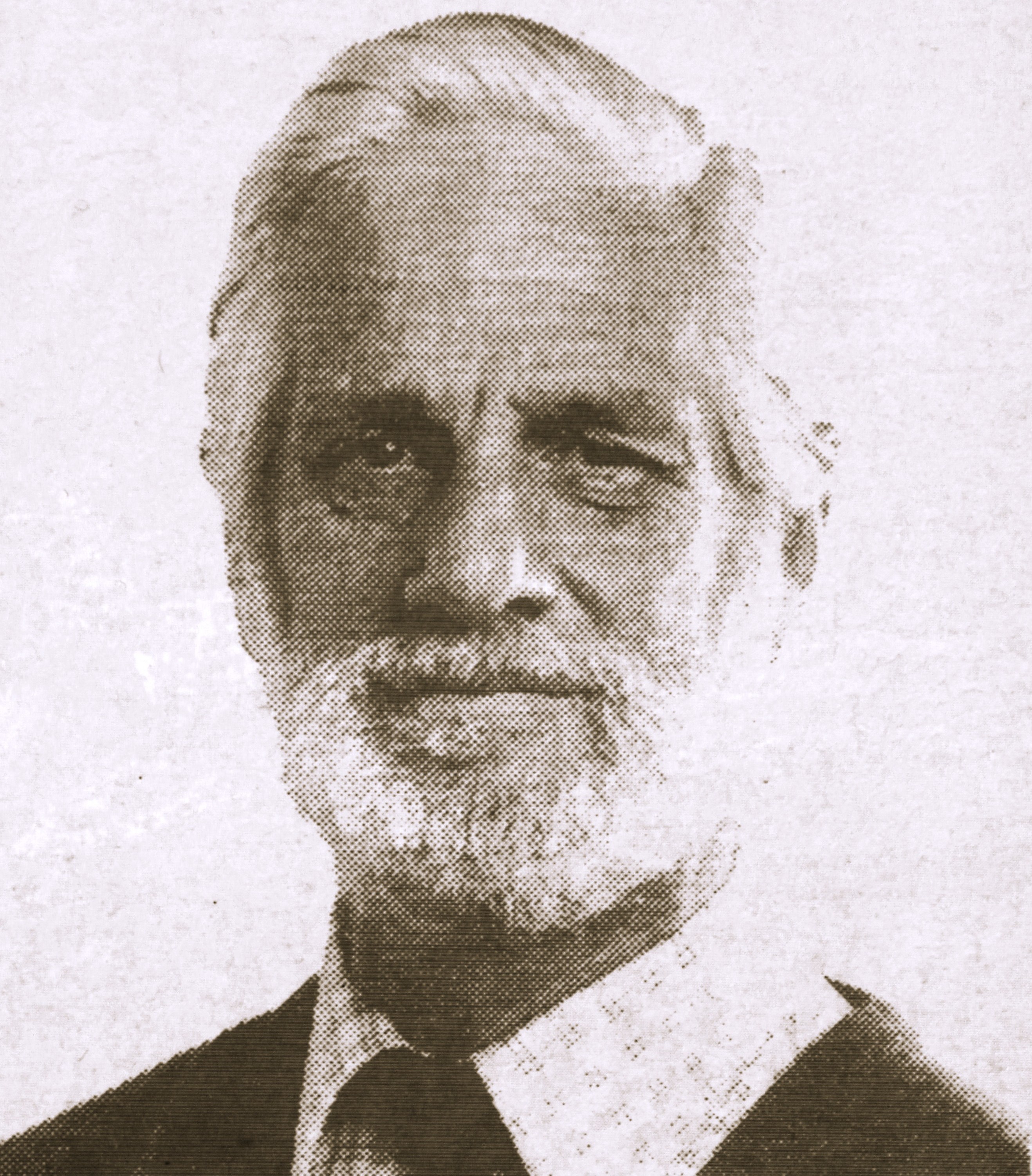
The back cover of the book features an enthusiast for Hunt’s work predicting that “one day he’ll be seen as one of the shapers of the 21st century”, but unfortunately that day has not yet come – Hunt (pictured) remains virtually unknown and his book does not currently seem to be available in any form.
The short version of the book’s title is rather misleading with regard to its contents, as it is only in a final short chapter that the author addresses the question of “how to end poverty” – and it is no easy fix, as we will see.
The essence of his analysis is really captured by the second part of the title, and in his place I think I would have given it something like the title I have lent to this piece – Centuries of Theft: The Starvation of the Periphery by the Core.
Hunt’s account takes us back to a time when the big historical crime had not yet been committed – “For two or three million years people lived fairly happily, warm enough, with enough to eat, like the few remaining hunter-gatherer societies today”. [6]
Citing many anthropological sources, he shows that people only then “worked” one to three days a week and spent the rest of the time resting, playing games and visiting friends.
“There are no policemen to keep order in these groups, no prisons to punish wrongdoers. Yet they manage”. [7]
He explains that laughter, humiliation and temporary social ostracism are very powerful tools to guide individuals’ behaviour: “The key is that everyone knows everyone else and nearly everyone is related to everyone else”. [8]
“Respect and influence” maintained social cohesion, rather than artificial authority, and disparity of wealth was avoided. [9] 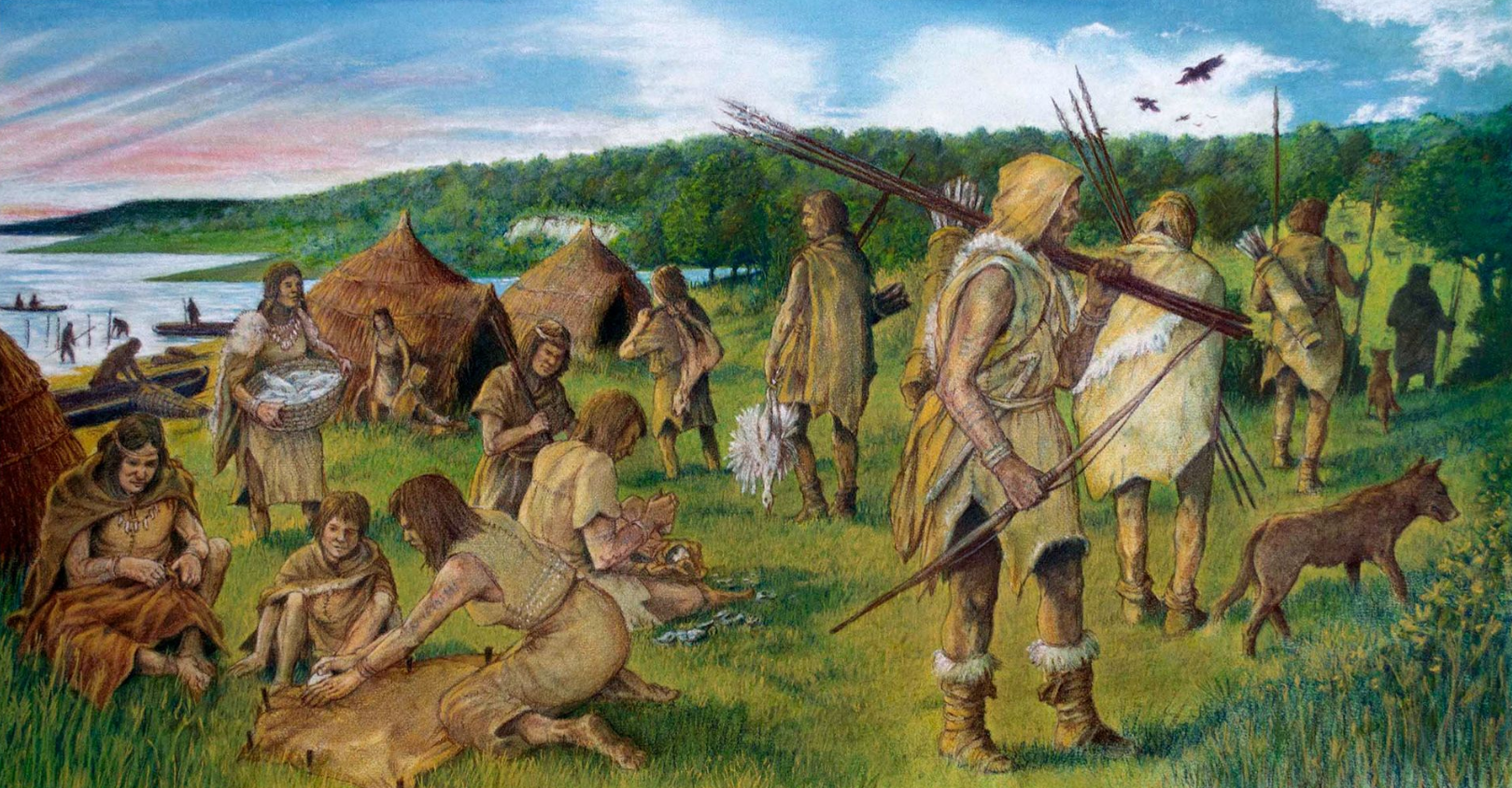
Hunt considers that the first steps away from this existence may have been caused by changes in climate of the kind which turned the “Fertile Crescent” in Mesopotamia into a desert by 5,000 BC. [10]
Population increases may also have been a factor although, as he says, when left to their own devices, groups naturally limit their size to fit the available resources.
In any case, the original step into agriculture was not a complete disaster in that people were generally still only working a few hours a day. [11]
Hunt explains that the Law of Least Effort means that humans will generally only grow what food they need, with a little put aside in case of emergencies.
What would be the point of slogging away to produce vast amounts of food if nobody is going to end up eating it?
But the trouble came, and the crime began, when other people started demanding that the peasants grew food for them as well, forcing them to work longer and longer hours to do so.
Hunt pinpoints the role played in this process by organised religion – for instance, in ancient Sumer, around 2,500 BC, most of the land was said to belong to the gods, meaning that peasants were forced to grow food for priests. [12] 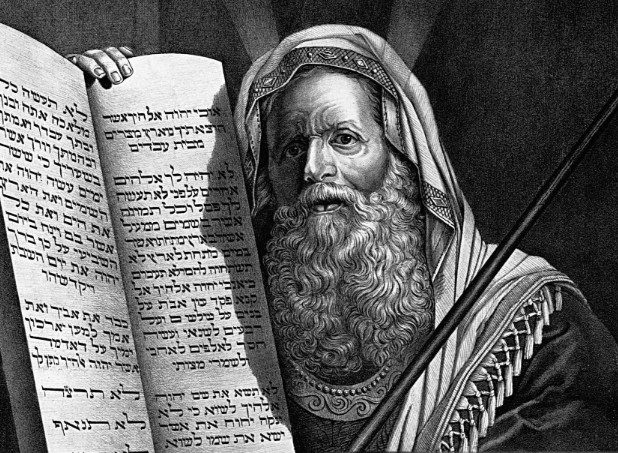
The same thing happened with Moses and the Jewish religion, he says: “Having established the principle of obedience to the law, the Lord proceeded to take His people to the cleaner’s.
“‘A tenth of the produce of the land, whether grain or fruit, is the Lord’s and is holy. If anyone wants to buy back this fruit or grain, he must add a fifth to its value. And the Lord owns every tenth animal of your herds and flocks’, etc (Leviticus, 27.30). That is to say income tax and wealth tax at 10% or 12% in cash. And where did all this wealth go? To the Chief Priest, of course, who just happened to be Moses’ brother, Aaron”. [13]
In the same pattern that Hunt shows repeating across the world and across the centuries, the wealth of the countryside was stolen and accumulated at the core, where it fed an urban civilisation that was essentially parasitical in nature.
He writes: “The Temple of Solomon at Jerusalem was truly wealthy. It had storehouses bursting with grain, hides, oil, etc. It had craftsmen with great skill producing sophisticated works of art. It had writers, philosophers and a growing body of knowledge.
“But all of this was at the specific expense of the peasants who had to feed the artisans, the writers, the experts. Jerusalem created no wealth at all. It generated no jobs. It was the food which generated the jobs. With this taxation the rulers could feed their artists, their philosophers, their architects, builders and workmen, their servants, their master-craftsmen.
“From the peasants’ food were made the great buildings, the epic poems, the statuary, the philosophies, the roads, the bridges, the ports which are called civilisation, the culture of cities. Without that taxation of agricultural hinterland a city and its culture could not exist”. [14]
Meanwhile, the peasants in all such situations were left overworked and underfed, leading Hunt to conclude: “The major cause of poverty is government taxation”. [15] 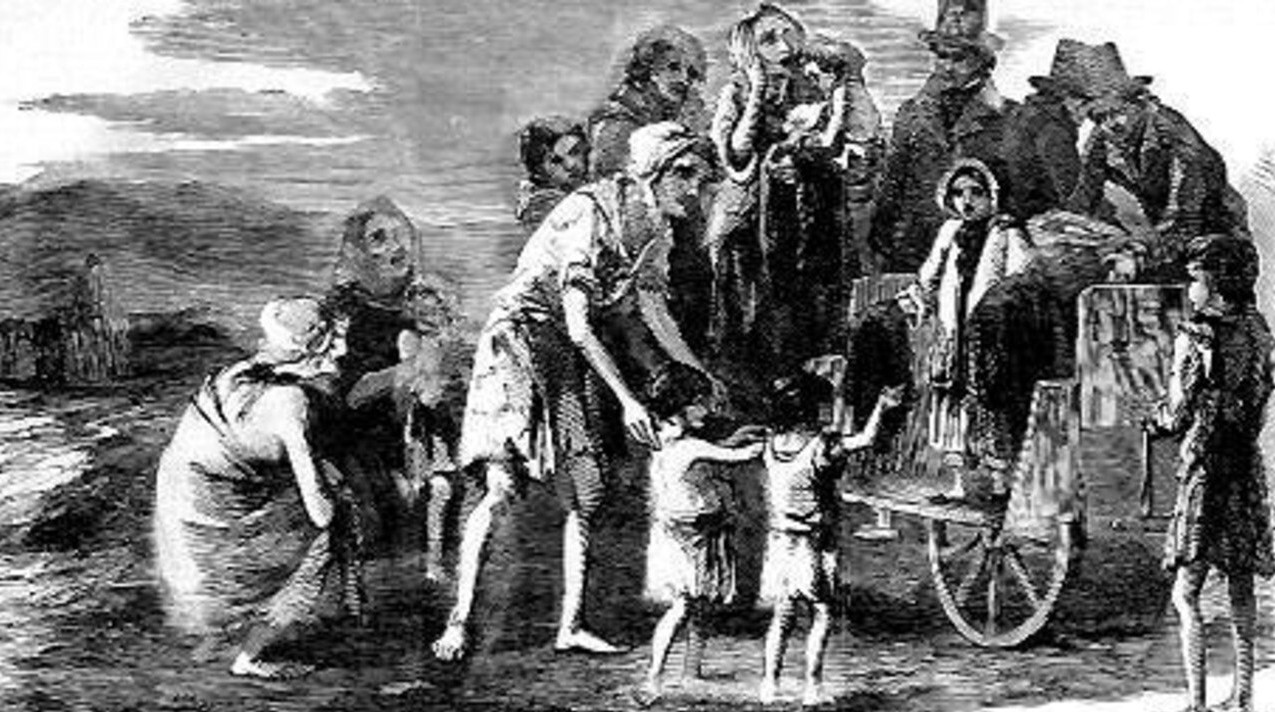
Because the food surplus was removed from the countryside to the towns, poorer peasants were forced to move to the towns to share in the looted wealth.
Once they lived there, their interests completely switched: “Urban workers depend for their subsistence on a strong ruling class. There are indeed two classes, not the workers and the bosses but the workers with the bosses against the peasants; the town against the countryside”. [16]
The entire infrastructure of “civilisation” is about extracting wealth from the periphery to the core – roads and railways are like Leviathan’s tentacles reaching into a land to strip it clean of all that it can offer.
Communities, as well as the land, suffer from this ever-advancing commercialisation, explains Hunt: “Trade breaks down the co-operative instinct of the group – the need for mutual aid, the inter-dependence. Successful individuals in the group no longer depend for their wellbeing on the others inside the group, but on the traders”. [17]
Towns were planted by kings or lords both to control a population and to allow exchange of produce, in authorised markets, to be taxed and thus further increase the wealth of the core: “The reason for town walls is much less to do with defence and much more to do with tax collection”. [18] 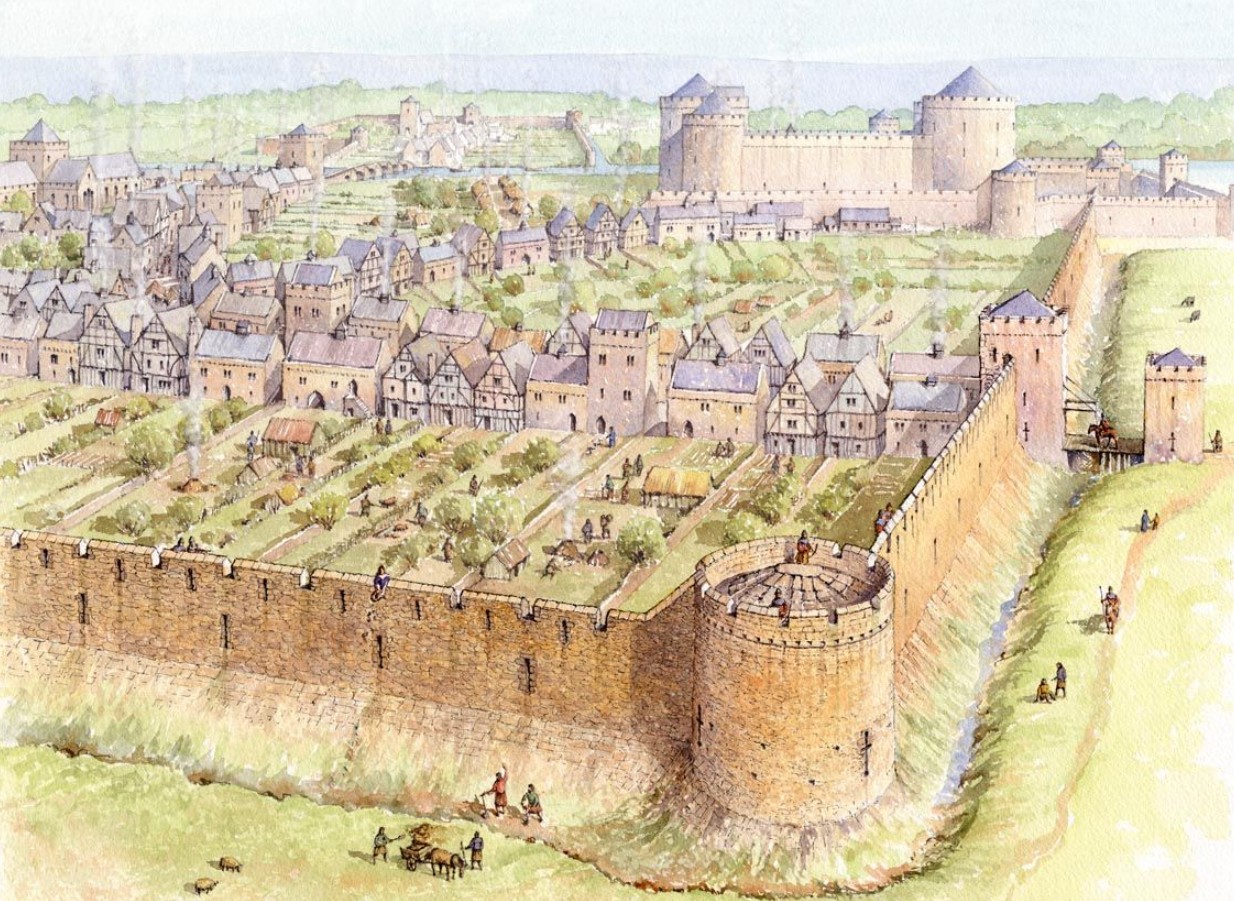
Taxation, and the money with which it is so closely associated, was a key tool in forcing once-free peoples inside the “economic” work camp – the phenomenon today euphemistically hailed by our globalist overlords as “inclusivity”.
Hunt says: “To obtain the coins to pay the taxes, the people must work for the elite, the only source of the coins. Or they must give their crops to the elite for the coins which they then give back in taxes. It’s a neat trick”. [19]
In this regard he cites Basil Davidson, a specialist in African history: “A Cape Colony Act of 1894 imposed a tax in cash of ten shillings on ‘fit adult males’ so that, as Prime Minister, Cecil Rhodes, blandly explained, rural producers might be removed from their life of sloth and idleness and made to give some return ‘for our wise and good government’.
“The idea took on fast. To pay cash taxes Africans would have to earn cash: almost invariably in that period this meant leaving the village for European employment. If they faulted to pay they must naturally be punished and would work as prison labourers instead”. [20]
Hunt adds: “That was the way they forced the Africans down the mines, with cash taxes”. [21]
And I will briefly remind readers that, in Carroll Quigley’s words, Cecil Rhodes “feverishly exploited the diamond and goldfields of South Africa” [22] and that, as Gerry Docherty and Jim Macgregor put it, “his success was largely due to the financial backing of Lord Natty Rothschild (pictured)”. [23] 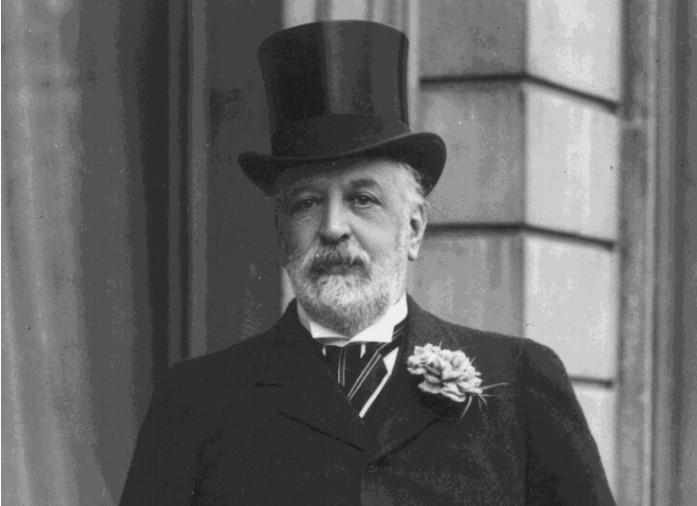
Here we see starkly exposed the way that money is a weapon for enslavement and exploitation.
Hunt comments: “If all the money in a country vanished, would that country be any poorer? All the things which had been desirable and obtainable would still be there, still available.
“It would only mean that those who manufactured the money could no longer remove the desirable objects with their enforced legal tender.
“Gold or any other kind of money is not the desirable object in itself but only the means to acquire the desirable objects… Money is a means of taking wealth from the periphery and giving it to the core, taking it from the poor and giving it to the rich”. [24]
“Banking developed, not as a benefit to the general population, but as a financial service to the very rich. Nor did anyone at the time suggest that banking in any way created or helped to create wealth.
“Banking is not neutral. It helps those-who-have against those-who-have-not. Banks would claim that they help to create wealth. As we have seen, wealth is not created, only moved around. If the banks are helping those-who-have have more, then those-who-have-not have less. Banks harm the poor”. [25] 
Hunt says that the very way in which wealth and poverty are measured by our society is absurd. Primitive societies in which everyone is well-fed and healthy, where food and fuel are free and there is no need for money, are considered “poor” because their Gross Domestic Product (GDP) is zero.
“If they are driven off their land and have to get a job, the politicians would say their wealth had increased even though their greater income could buy less food”. [26]
He points out that GDP is “the total of all monetary transactions, so that a car crash, needing towing away, repairs, ambulances and medical treatment, all increase monetary transactions, so the GDP has gone up and, in their book, everyone is richer.
“A prison is built and therefore everyone is richer. More thefts needing more policing means we are supposed to be richer. More pollution to be cleaned up means we are richer”. [27]
The same broad techniques have been used again and again by the rich “core” rulers. Everywhere, the people are deprived of their land and its wealth is stolen from them. They are also disarmed to stop them from taking it back.
In pre-industrial medieval England, land was taken from peasants to raise sheep and export wool for the textile industry in Flanders – more about that in a follow-up article.
And for centuries the British people fought a losing battle against the Enclosures, which Hunt describes as “legalized theft, which took the people’s land, making it into the private property of the rich”. [28] 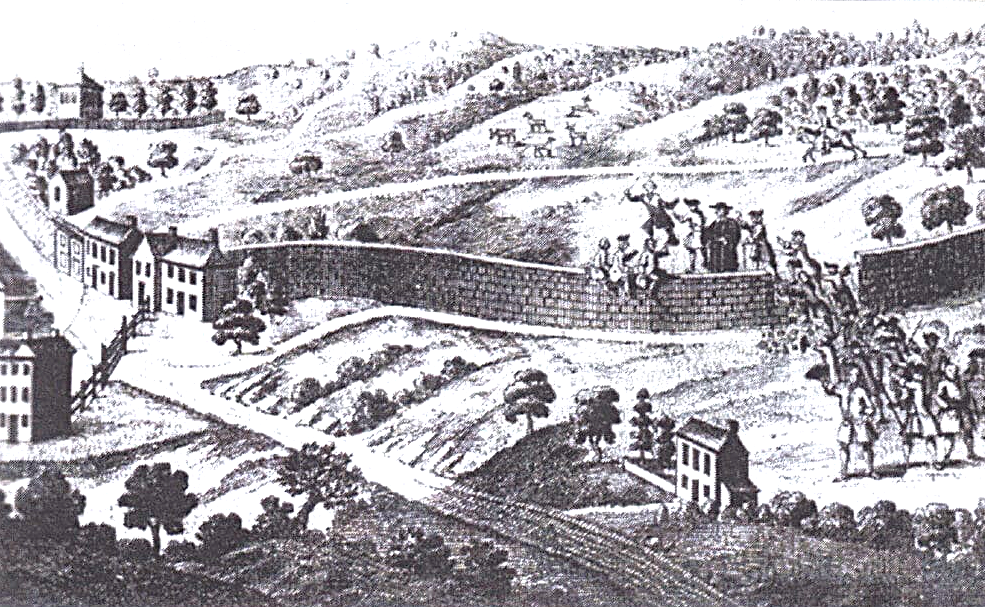
This internal imperialism turned outwards to Ireland, which became “Britain’s first and most important colony”. [29]
Hunt writes: “The exploitation started with the English need for timber. In about 1600, since Ireland was covered with forests, she became a supplier of timber to England and developed, again for her masters, an iron industry which collapsed of itself when the island had been completely deforested after a hundred years.
“Following the normal course of the periphery, after the trees had been cut down the land was used to grow grain for the core, and then cattle. The Irish themselves were forced to eat potatoes…
“When the famine came [1845-1852], the export of food continued. The English lords owned the land and sold their crops to England as usual. The starving Irish had no money to buy the wheat when their potatoes were destroyed by blight. As usual the periphery starved to feed the core”. [30]
It was a similar story in India: “The terrible famine of the 1770s was caused by Britain forbidding the Indians to grow food for themselves, but instead opium for export to China”. [31]
He identifies the same theft happening with ancient Athens, whose periphery was around the Black Sea; [32] with France, which extracted the wealth of Algeria and its colonies; [33] and with the USA, where the periphery was initially internal (the South) [34] and then Latin America. [35] 
Imperial “inclusivity” has been imposed by force across the world. Hunt quotes the historian Eric Hobsbawm to this effect: “Any countries which did not care to enter into relations were forced to do so with gunboats and marines; the last ‘closed’ countries of the world, China and Japan, were thus forced into unrestricted intercourse with the modern economies between 1840 and 1860”. [36]
This armed robbery by the core has often been carried out in collaboration with corrupt local rulers, as Hunt illustrates with an example which was fairly recent at the time.
He writes: “The British government (the core ruler) supplied President [Ferdinand] Marcos of the Philippines (the periphery ruler) with military equipment…
“In return Marcos drove 2,000 peasants and tribespeople off 4,000 acres for our Commonwealth Development Corporation with Guthrie Inc (the trader) to grow palm oil for our margarine etc.
“Our government kept Marcos (pictured) in power with our guns. In return he handed over his people’s land to the traders to make profit on crops grown for us. More than 80% of Philippines farmland now grows crops for export”. [37] 
What we have collectively experienced under the yoke of this parasitical empire is the systematic removal of our wealth and freedom.
For instance, we enjoyed many more work-free days in the Middle Ages than we do now.
Hunt writes: “In the seventeenth century governments started to crack down. Up till then: ‘In what some craftsmen may have regarded as the golden age before the advent of [prime minister Jean-Baptiste] Colbert, Parisians celebrated 103 holidays a year’”. [38]
“As the nineteenth century progressed and more and more were forced into the factories, so the harder the population worked as a whole, 10 hours a day, six days a week for those in the factories.
“But it got rougher for the farmworkers too. ‘Farmworkers were being compelled to consume cheaper foods than those to which previous generations had been accustomed and also they were working many more days in the year, and hours in the day’”. [39]
Hunt sees right through the lie that “labour-saving” technology has ever benefited the exploited. “The worker still has to work as long. Labour-saving devices save labour in the product, not labour for the worker”. [40]
“It is just horribly untrue that technology benefits everyone. It benefits the core. It destroys the periphery”. [41] 
The immediate effect of the industrial revolution in England was to plunge the people into wage-slavery poverty.
Says Hunt: “Because of the high cost of the new machines, they had to be kept running as long as possible. Life was no fun in the new factories…
“At first the factories were worked by orphans handed over on a contract from the orphanages. ‘In 1771 Richard Arkwright created a cotton spinning mill where he was soon employing about 600 workers, most of them children’. [42]
“Then the poorest women came and only finally, driven by starvation, the men. The working hours demanded by the machines influenced the hours worked by the whole population.
“In the Cornish tin mines: ‘From the four hours which were customary in Elizabethan times, cores of six, eight, or even twelve hours had been substituted in the eighteenth century’”. [43]
As the economist James Edwin Thorold Rogers wrote in 1884: “I am convinced that at no period of English history for which authentic records exists, was the condition of manual labour worse than it was in the forty years from 1782-1821, the period in which the manufacturers and merchants accumulated fortune rapidly and in which the rent of agricultural land was doubled”. [44]
He added: “Relatively speaking the working man of today is not so well off as he was in the fifteenth century”. [45] 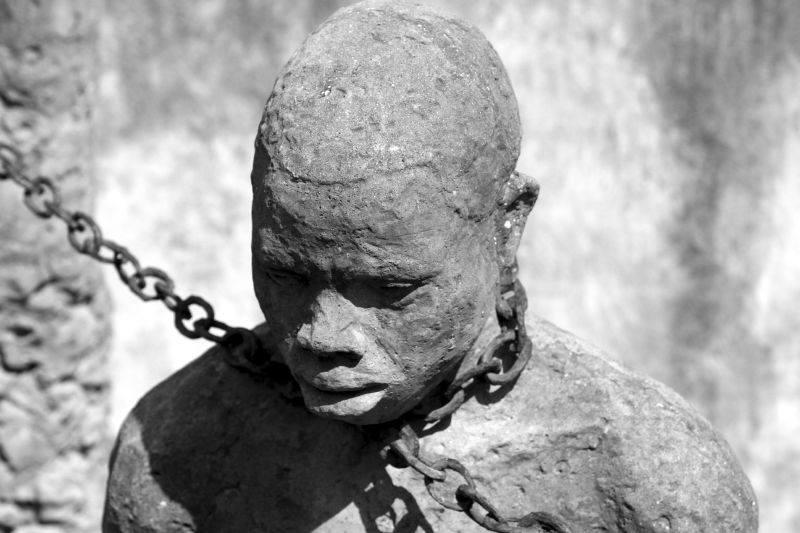
Standards of living at the industrial core only improved because of the wealth stolen from the colonised peoples of the British Empire, including through the use of black slaves, who were literally worked to death. [46]
Rather than amounting to glorious “progress”, the industrialisation process has been more like a grotesque downwards spiral.
“Timber had to be replaced by coal, which no one liked. It smelt and made much more smoke and at the beginning was only used by the poor…
“As more coal was used so they had to dig deeper for it. The deeper the mines, the more difficult it became to stop them filling with water. To solve this problem, [Thomas] Newcomen invented the steam engine, which was able to pump out the flood water.
“It was expensive, i.e. harder work, but inevitable, necessary. The steam engine was not needed until the timber shortage”. [47]
Similarly, says Hunt, the construction of canals was the forced consequence of the high price of horse feed.
Only when competition for land had forced that price sufficiently high was it worth paying for the artificial waterways which allowed larger loads to be drawn by fewer horses. [48] 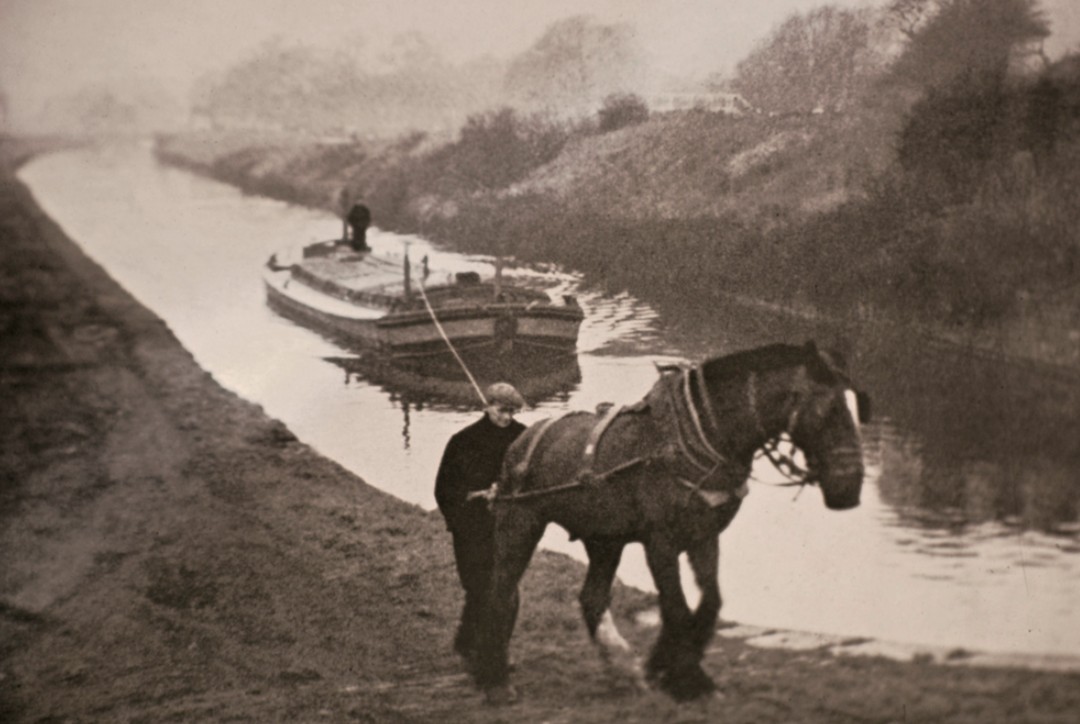
The end result of this industrial spiral is hard for most people to face up to: “Industry is making the planet uninhabitable. We can’t have nuclear power without nuclear waste. Nor can we have industry without poisonous industrial waste. Clean industry is a contradiction in terms”. [49]
Accordingly, insists Hunt, “the implication of this book is that there will have to be technological regression”. [50]
The exit from the industrialist trap would obviously involve a complete change in the way we live, he says.
“Since government is the cause of poverty, we must end government. But it seems likely that for a group to work without government it must be smaller than about 500 people, which is about the maximum number that one person can know”. [51]
“How then do we get back from here to autonomous, self-sufficient, armed villages? There are three main methods which could operate concurrently, revolution on the periphery, progressive break-up of the political units, and cutting taxation to reduce the power of government until there is no taxation and therefore no government”. [52]
Hunt says that in Britain the first step in the break-up of the political unit would be to leave the European Union – this has sort of already happened now, although Brexit is meaningless when the country is still very much under globalist control.

He then suggests a further ongoing breaking-up of the political unit, through Scottish, Welsh and Ulster nationalism, then regionalism, until we ultimately reach the level of autonomous villages.
But he stresses that this will have to be a gradual process, given Britain’s lack of self-sufficiency, and also one that is happening in other countries, if Britain is not to be colonised by them. [53]
“As self-sufficiency increases, people move about less. Communities regain their strength. The social sanction by the community against anti-social behaviour gets stronger.
“There is less crime. Because of the community support, there is less poverty and loneliness in old age. The community replaces the state in providing necessary welfare.
“It’s a grubby sort of utopia, not cultured, or liberal, or advanced, or powerful. Instead it will be warm and well-fed, kind, peaceful, healthy, lazy and parochial. And it will work because it has worked for hundreds of thousands of years”. [54]