
Muslim Brotherhood (Iran, Hamas etc.) are Controlled Opposition
Fri 11:16 am +00:00, 30 Oct 2026
Source: https://henrymakow.com/2026/10/muslim-brotherhood-controlled-opposition.html
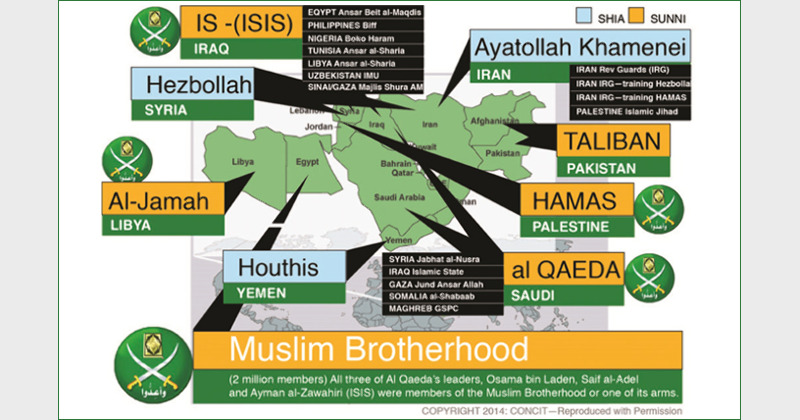
In order to foment Albert Pike’s Third World War between Zionism and Radical Islam, the Illuminati had to create Radical Islam: The Muslim Brotherhood (left.)
Organized Jewry (Rothschilds) controls the world by pitting its Masonic Left Wing (Communism) against its Right Fascist Zionist one.
Radical Islam clearly belongs to the Left Communist branch which includes Russia, China and the BRICS.
World wars are engineered by Freemasons on both sides to destroy Christian civilization and murder believers & patriots. Trump, Netanyahu, Putin and the leaders of Iran are Freemasons. The first three belong to Chabad, a doomsday cult dedicated to starting a nuclear war.
Proof on this website and in my Illuminati books. https://henrymakow.com/Illuminati4.pdf
How Rothschild High Finance, the Freemasonic Lodge, and the Muslim Brotherhood Were Engineered as a Hegelian Engine for Global Convergence
“The result is a self-reinforcing loop: the Brotherhood is cast as the boogeyman; operations against it justify further centralization; the centralization is then cited as proof that only a coordinated global response can succeed….The resulting enemy is real enough to kill and be killed, yet artificial enough to be directed, amplified, and never finally defeated. Its continued existence is the prerequisite for the next stage of convergence: the argument that only a single planetary government possesses the authority and the permanence required to contain it.”
(Abridged by henrymakow.com)
For more than a century the public has been shown two opposing forces locked in permanent struggle: on one side, the guardians of the existing order–Western states, liberal institutions, and their financial patrons; on the other, a militant Islamic revival that threatens them.
The conflict is presented as organic, tragic, and inevitable. It is none of those things. It is a deliberately constructed dialectic whose purpose is to generate a permanent, manageable enemy. That enemy justifies surveillance, centralization, and the progressive erosion of national sovereignty until the only remaining solution is a single planetary authority capable of “keeping the peace.” The Muslim Brotherhood is not an accident of history. It is one of the most successful instruments of that design.
THE FINANCIAL TRIGGER
In November 1875, the Egyptian Khedive, drowning in debt from infrastructure projects that had already bound his country to European creditors, offered 176,602 shares–roughly 44 percent–of the Suez Canal Company for immediate sale. British Prime Minister Benjamin Disraeli required £4 million at once. Parliament was not sitting. He turned to Lionel de Rothschild. Within forty-eight hours the money was advanced on the Prime Minister’s word. The British state became the dominant shareholder; the Rothschilds collected their commission and interest and stepped back. The Canal was secured. Egypt’s remaining independence was finished. British occupation followed in 1882.
The same debt crisis that produced the Rothschild transaction also produced the political vacuum in which the next stage of the operation could be launched. High finance did not merely profit from the Canal. It created the conditions in which a controlled opposition could be incubated.
THE LODGE AS INCUBATOR
Jamal al-Din al-Afghani arrived in Cairo in the 1870s, precisely as the Khedive’s finances collapsed under British and French pressure. He did not join Freemasonry for philosophical reasons. He joined it because the lodges were the only semi-protected spaces in which the country’s officers, officials, journalists, and intellectuals already gathered. In 1876 he entered Kawkab al-Sharq, the Star of the East lodge, under the Grand Orient of France. By 1878 he was its Worshipful Master. Lodge meetings ceased to be ritual and became political cells. Constitutional reform, press freedom, and resistance to European creditors were openly discussed. His closest disciple, Muhammad Abduh, and the nationalist Yaqub Sanu were among those drawn in.
When conservative and British members objected that politics had no place in the Craft, al-Afghani simply left. He founded an independent national Egyptian lodge, still affiliated with the Grand Orient of France, whose sole function was political mobilization. In August 1879 Khedive Tawfiq expelled him. The networks remained. They supplied the ideological core of the Urabi Revolt of 1879-1882–the first major nationalist rising against European control. The revolt was crushed. The occupation was consolidated. The pattern was established: a politicized lodge produces a nationalist explosion; the explosion justifies tighter foreign control; the control generates the next generation of resistance.
THE CANAL ZONE BIRTH
Forty-six years later the next stage was activated in the same geography. In March 1928, in Ismailia–the city whose existence was defined by the Canal the Rothschilds had helped place under British ownership–Hassan al-Banna and six workers of the Suez Canal Company founded the Society of the Muslim Brothers. The Company itself later helped finance the mosque that became the movement’s first headquarters. Al-Banna’s public program was Islamic revival, social welfare, and the eventual application of Sharia. His organizational method was something else.
He built a pyramidal cell structure whose basic unit, the usra of four or five men under a naqib, met for study, moral surveillance, and absolute discipline. Membership advanced through graded stages. The binding oath, the bayʿah, rested on ten pillars formalized in his Risālat al-Taʿālīm: understanding, sincerity, action, jihad, sacrifice, obedience, perseverance, devotion, brotherhood, and trust. Obedience to the leadership was framed as obedience to God.
A secret military wing–the Special Apparatus–was organized in still tighter cells of five, kept hidden even from ordinary members, and tasked with operations against British targets, Palestinian fronts, and domestic opponents. Assassinations followed, including that of Prime Minister Nuqrashi in 1948. Al-Banna himself was killed in 1949. The Apparatus was later officially disavowed; its methods and personnel did not disappear. They migrated into successor organizations, including the Palestinian lineage that produced Hamas.
None of this was spontaneous. The hierarchical secrecy, the graded oaths, the cellular discipline, and the dual public/clandestine face were the direct organizational inheritance of the politicized lodges al-Afghani had mastered.
The location–inside the Canal Zone whose strategic control had been purchased with Rothschild liquidity–was not accidental. A movement born in the shadow of the Canal, structured like a lodge, and aimed at both colonial power and domestic secular authority was perfectly positioned to serve as the permanent antithesis.

THE DIALECTIC IN OPERATION
The design is classical Hegelian.
Thesis: the liberal, financial, and imperial order that controls the Canal and the debt. Antithesis: a disciplined, oath-bound Islamic movement that can be portrayed as an existential threat to that order.
Synthesis: the progressive centralization of power required to “defeat” the threat. Each new atrocity attributed to the Brotherhood or its offshoots–whether carried out by genuine radicals or amplified by intelligence services–tightens the ratchet. Domestic surveillance expands. International coalitions form. National sovereignty is redefined as an obstacle to security. The ultimate destination is not the victory of either side but the exhaustion of both, at which point a single supranational authority can be presented as the only remaining guarantor of order.
The Brotherhood’s own campaigns supplied the necessary raw material. Its welfare networks built parallel institutions that competed with the state. Its secret apparatus conducted bombings and assassinations. Its international branches embedded themselves in European and American civil society under the cover of education and charity.
Later, rival Muslim-origin actors–particularly those aligned with the Abraham Accords–funded extensive dossiers, media placement, and online amplification branding anyone connected to the Brotherhood as an extremist.
The Abu Dhabi Secrets leaks documented millions of euros paid to a Swiss firm and files on more than a thousand individuals and hundreds of organizations across eighteen European countries. The result is a self-reinforcing loop: the Brotherhood is cast as the boogeyman; operations against it justify further centralization; the centralization is then cited as proof that only a coordinated global response can succeed.
THE END GAME
The reporter who follows the money, the lodge records, the founding location, the oath, and the secret apparatus does not find a tragic clash of civilizations. He finds a managed conflict. The Rothschild transaction secured the strategic asset and the debt trap. Al-Afghani’s politicized lodges demonstrated how Western fraternal structures could be turned into engines of controlled agitation. Al-Banna’s Brotherhood, born inside the Canal Zone those structures had helped dominate, institutionalized the method at mass scale. The resulting enemy is real enough to kill and be killed, yet artificial enough to be directed, amplified, and never finally defeated. Its continued existence is the prerequisite for the next stage of convergence: the argument that only a single planetary government possesses the authority and the permanence required to contain it.
The facts of the 1875 loan, the Star of the East lodge, the 1928 founding in Ismailia, the ten pillars of the bayʿah, and the Special Apparatus are not in dispute. What has been disputed is their connection. That connection is no longer theoretical. It is the architecture of the dialectic itself.