
Functional Oligarchy
Mon 4:13 pm +00:00, 29 Jun 2026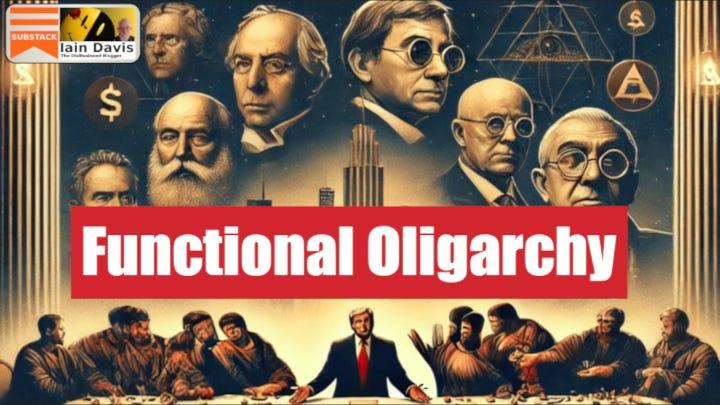
Source: https://iaindavis.substack.com/p/functional-oligarchy
Democracy?
No, we live under an oligarchy, and have done for thousands of years too
Rich lists are utterly meaningless, because they exclude the oligarchs
============================
Oligarchy is a very old system of governance and one we have never really escaped. More than 2000 years ago, Aristotle stated that oligarchy (oligarchia) becomes the governance system “when men of property have government in their hands.” Today, we define “oligarchy” as “government by the few, especially despotic power exercised by a small and privileged group for corrupt or selfish purposes.” When oligarchs exercise political power by virtue of their wealth, we call it “plutocracy”.
A branch of political science called ‘Elite Theory’ has tried to justify the plutocracy of contemporary oligarchs. Generally, however, both plutocracy and oligarchy are considered pejorative terms.
We are told that we live in “representative democracies” precisely because oligarchy is widely viewed as unacceptable. Despite the fact that representative democracy is the antithesis of democracy, the purported virtues of our fake democracies are constantly extolled simply to convince us that we don’t live in oligarchies. Political science, though, clearly reveals that we do.
In 2014, political scientists Professor Martin Gilens and Professor Benjamin I. Page conducted a multivariant analysis of nearly 1,800 policy decisions made by the US government over more than a thirty-year period. Their objective was to understand:
Who governs? Who really rules? To what extent is the broad body of US citizens sovereign, semi-sovereign, or largely powerless?
The pair considered different theoretical models of democratic governance to assess which most accurately explained the US policymaking process over the studied period. The models Gilens and Page examined were the following:
- Majoritarian electoral democracy: policymakers respond to the electoral will of the majority.
- Majoritarian pluralism: policy is shaped by the competing influence of interest groups.
- Economic-elite domination: policies are made in the interests of the wealthiest in society.
- Biased pluralism: majoritarian pluralism is corrupted by the wealth, power, and influence of the economic-elite.
Gilens and Page concluded:
Economic elites and organized groups representing business interests have substantial independent impacts on US government policy, while average citizens and mass-based interest groups have little or no independent influence. The results provide substantial support for theories of Economic-Elite Domination and for theories of Biased Pluralism, but not for theories of Majoritarian Electoral Democracy or Majoritarian Pluralism.
In 2025, reevaluating the work of Gilens and Page, Harvard academics Professors Archon Fung and Lawrence Lessig noted that Gilens and Page’s multivariant analysis was “one of the most important studies you’ve probably never heard of.” Fung and Lessig acknowledged that Gilens and Page had demonstrated that the US was not a democracy but actually a functional oligarchy.
Further research has subsequently demonstrated this to be the case. For example, when In Song Kim, associate professor of political science at the Massachusetts Institute of Technology (MIT), and Helen V. Milner, professor of public affairs at Princeton University, looked at how US foreign policy was formed between 1999 and 2019, they found:
[T]he direction of US foreign economic policy in the past decades suggests [multinational corporations (MNCs)] have been very powerful. The lowering of trade barriers via the GATT/WTO and various preferential trade agreements, the opening of capital markets and signing of bilateral investment treaties and economic agreements with investment protections, and the harmonization of regulations in many areas in preferential trade agreements are all policies that the US government has pursued actively and ones that MNCs have championed. MNC preferences [. . .] seem to be very congruent with much of recent American foreign economic policy.
The US governance system is by no means an oddity. Nearly all governments operate as functional oligarchies.
It is primarily through their controlling interests in multinational corporations (MNCs) that oligarchs rule today. Via the global public-private partnership and so-called “policy coordination”, set within their Deep State, oligarchs can exert their power and influence over both domestic and foreign policy. As Fung and Lessig observed, “you’ve probably never heard” of the research studies that expose functional oligarchy. This is because the mainstream media and its social media partners are the “gatekeepers of news and information” whose task it is to keep us engaged in fake democracy and divert our attention away from oligarchy.
Anyone who publicly reports the activities of the oligarchy is dismissively labelled a “conspiracy theorist”. Again, the propaganda objective is to protect the oligarchy. Nonetheless, irrespective of the obfuscation, the hand of the oligarchs can be seen.
Global institutional investment houses, such as BlackRock, Vanguard, and State Street, carefully guard the identities of their individual investors. They each have slightly different ownership models. BlackRock, for example, is a publicly traded company with shareholders. Vanguard is owned by its own investor funds, which means Vanguard’s investors are also its owners.
As reported by the US Institute of Business & Finance (IBF), collectively the major investment houses represent the dominant shareholders of nearly ninety per cent of S&P 500 companies—the most powerful US corporations. Noting that this “level of concentration is unprecedented in the history of capital markets”, the IBF rhetorically asks what happens “when the firms that manage [investment funds] also hold enough voting power to shape the companies those funds own?”
Political science provides the answers. The investment houses act as front organisations for functional oligarchies which control the policy decisions made by the oligarchs’ primary front organisation: the government.
By maintaining investor anonymity, a kind of investment shell game further protects the oligarchy. That said, we can see how oligarchy operates.
To illustrate: Chengdu Aircraft Corporation (CAC) is a subsidiary of the Aviation Industry Corporation of China (AVIC), which is supposedly a “state-owned”, Beijing-based, publicly traded defence conglomerate. The leading “private” investment house backing AVIC is China Asset Management Co., Ltd. (ChinaAMC). Originally based in Hong Kong, ChinaAMC currently has $0.5 trillion of assets under management. ChinaAMC’s leading investors include the Canadian-based Mackenzie Investments, which is a subsidiary of the Canadian financial services company IGM Financial Inc. IGM is largely controlled by the Power Corporation of Canada, which is dominated by the Desmarais oligarch dynasty. Doubtless, many of the other leading oligarch shareholders of IGM are represented by BlackRock and Vanguard.
The only remaining question is who are the oligarchs?
Official disclosures of alleged wealth captivate our interest, and we are told by mainstream media outlets who the richest people on earth are supposed to be. As wealthy as these named individuals are, their wealth appears to be significantly less than the generational wealth accrued by a number of, what we can call, oligarch dynasties.
Elon Musk, Sergey Brin, Larry Ellison, Michael Dell, Mark Zuckerberg, Jeff Bezos, and Jensen Huang are among the people served up to us as the officially wealthy. All of them are busy creating the centralised authoritarian model of digital infrastructure that will enable the completion of a global surveillance state, which is evidently what the oligarchy desires. Policy agendas are agreed with these oligarchs in Deep State enclaves like Dialogue, not through government policy committees. Doubtless, these people are very wealthy, but basic logic tells us something is very wrong with the media’s rich lists.

There are dynastic oligarch families, thriving today, who can trace the growth of their immense financial empires, and their resultant political power and influence, back through more than a thousand years of history. Yet they have never been mentioned, and their closest representatives are rarely mentioned, on any so-called ‘rich lists’. These oligarch dynasties do not formally disclose their wealth, ever.
If these lists are supposed to tell us who holds and controls the bulk of wealth on this planet, and therefore who the oligarchs are, the complete absence of these oligarch dynasties from any of them renders such lists and indexes redundant. They serve as yet another diversion from reality, not a reflection of it.
For example, we are told that Elon Musk is the world’s first trillionaire. Yet in 2024, Newsweek reported that the Rothschilds were worth an estimated $15.7 trillion, though Newsweek noted that the Sunday Times had reported they were worth $1 billion just a year earlier. These wild reporting disparities exist because the Rothschild family, which has served as the dynastic oligarch’s commercial bankers and frequent representatives for the best part of three centuries, does not officially disclose its wealth.
Of course, because the Rothschilds happen to have a German-Jewish lineage, questioning what influence their plausible wealth buys is, according to Newsweek, dabbling in “antisemitic conspiracy theories”. This additional but effective diversion is argued whenever anyone questions the Rothschilds’ and other oligarchs evident power, irrespective of whether the questioner even mentions their heritage or religion. Antisemitism is widely exploited for propaganda and social engineering purposes to, once again, protect the oligarchy.
Sadly, though antisemitism is a real prejudice that often has appalling consequences, those who exploit antisemitism for propaganda purposes couldn’t care less. They ladle the accusation on so thickly and with such abandon that they devalue the meaning of the word and stoke the kind of misplaced resentment that can lead to genuine antisemitism. This immorality is often conducted simply to protect the establishment, and the oligarchy that leads it, from public scrutiny and criticism.
It is not antisemitic to ask if Donald Trump appointed Wilbur Ross as his first-term secretary of commerce to repay a debt owed to the Rothschilds. Like Elon Musk’s, Donald Trump’s business acumen is highly questionable—numerous Trump businesses have been declared bankrupt. He would almost certainly have gone personally bankrupt in the early 1990s were it not for the bailout loan, brokered by Ross, that he received from Rothschild Inc., for whom Ross was a career-long representative.
It is not an antisemitic conspiracy theory to highlight the fact that, in reference to Trump’s bailout, Ross said, “[t]he Trump name is still very much an asset.” An asset, for whom? It is another reasonable question. Again, policy research studies provide the answer: Trump, like all US presidents, serves the oligarchy.
So we, the people, have a choice. We can either carry on pretending that electing the next puppet is in our interest, and thereby consent to live as the chattels of oligarchs, or we can put aside childish things and do something about it. There are many solutions we could pursue. Personally I suggest that we build societies based upon what I call ‘voluntary democracy’, but I’m sure there are better solutions many others would prefer.
The most important thing is that we stop allowing functional oligarchies to rule us. Whatever solutions we choose, we just need to get on with implementing them.