USI Farm Bill aims to destroy farmers
Tue 8:35 pm +00:00, 26 May 2026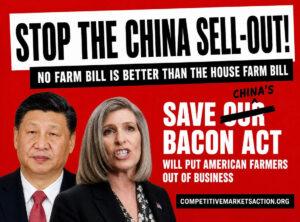
The “Save Our Bacon” Act (Section 12006 in the House Farm Bill) needs to be removed, and a strong response from constituents can do it
Section 12006 is a food quality, animal rights and states’ rights disaster, but we can stop it as we did the pesticide liability shield
|
|

| |||||||||||||||


I am providing several resources on this Farm Bill rider below, so this will be one of my longer posts.
- Here is a (surprisingly good) one pager from Harvard Law School’s Animal Law and Policy Program if you want a quick legal summary:
https://animal.law.harvard.
- Here is a call to action. The Senate needs 60 votes to pass a Farm Bill, and therefore in order to get the bill passed, concessions will need to be made. Those who are well funded by Big Ag sponsored the misnamed “Save Our Bacon” Act, which harms livestock and only benefits CAFOs and meat importers, and harms small farmers who raised their animals more humanely.
- There is a longer piece that Zahra Sethna and I wrote about it, as the last item
There’s a battle happening in Washington right now, that you probably don’t know about, and it affects your dinner plate, your wallet, and your vote.
- Deep inside the newly proposed federal Farm Bill, corporate factory farming lobbyists successfully sneaked in a backdoor handout. It is called the Save Our Bacon Act. If it passes the Senate, it will:• Overturn local laws: It will instantly erase animal-welfare and food-safety laws passed democratically by voters in states across the country.
• Bail out corporate giants: It protects massive, foreign-owned agricultural conglomerates that refuse to give up cruel crate confinement for pigs.
• Punish family farmers: It hurts the honest, independent American farmers who already spent millions to upgrade their facilities and follow the law.This is a massive federal overreach designed to protect corporate profits over consumer choices. But the fight isn’t over. The bill is in the Senate right now, and we can stop it.
2 Quick Actions You Can Take Today:
1) Call your Senators: Call your senators and tell them to “vote NO on any Farm Bill that includes the Save Our Bacon provision.” THIS WEEK Senators are at home, as the Senate is in recess. Next week they will meet to determine what will be included in the final version of the Farm Bill.
2) Spread the Word: Forward this email to three friends or family members to help expose this corporate bailout.
____________
Here is the longer story about the “Save Our Bacon” Act:
Should an industry-friendly rider in the Farm Bill supercede state animal welfare regulations, nullify animal disease prevention measures and override over 1,000 state laws?
How the misnamed Save Our Bacon Act would strip states of control over food and farming, while accelerating corporate consolidation in American agriculture.
By Zahra Sethna and Meryl Nass, from Door to Freedom and Save Our Food and Farms
There is an alarming but little-known provision in Congress’ 2026 Farm Bill that is likely to find its way into law within the next few weeks.
· It attempts to remove the right of Americans to maintain local control over our food and farms.
· It could also nullify over 1,000 state laws that are already on the books.
The Farm Bill, also known as the Farm, Food, and National Security Act of 2026, which includes the Save Our Bacon Act as Section 12006, was passed by the House on April 30, 2026 and now heads to the Senate, where the Agriculture Committee is expected to draft its own version of the bill.
Embedded in the legislation is the so-called “Save our Bacon” (SOB) Act, which would strip state and local governments of their ability to make agricultural policies for meat consumed in the state–preventing state and local governments from establishing food production and distribution safeguards.
As often happens, the language is designed to confuse. No doubt written by industry wordsmiths, the language sounds very reasonable, as long as you don’t know what it really means. Let me explain the bill language by quoting the first four sections and then decoding them:
(1) [The purpose of this bill is to] protect the free movement in interstate
commerce of products derived from covered livestock;
(2) encourage a national market of such products;
(3) ensure that producers of covered livestock
are not subject to a patchwork of State laws restricting access to a national market; and
(4) ensure that the United States continues to uphold its international trade obligations.
Now the decode:
(1) “free movement” in fact means that states will not be able to restrict the entry and sale of meat produced under conditions that states deem improper.
(2) “national market” means no state will be allowed to refuse the entry and sale of meat, despite existing state laws that would prohibit sales of meat from certain locations, or meat produced under inhumane conditions.
(3) “patchwork of State laws” means that this single federal law will supercede and nullify all state laws, ignoring constitutional limits on federal power, to impose this single law on the whole country.
(4) “uphold its international trade obligations” means the states cannot restrict the sale of meat from any country, even when that country is inflicted with a pest like the New World screwworm.
Where did this bill come from?
This law is the meat industry’s response to a California ballot initiative that passed in 2018, titled Proposition 12. The industrial production of pork and veal is frequently accomplished by growing breeding pigs and veal calves in crates or boxes where they have no room to move or even turn around. Proposition 12 required that livestock be given a minimum amount of square feet per animal–and the amount is only 24 square feet for breeding pigs and 43 square feet for veal calves.
Because California’s 38 million people are a major market, and the bill applied to all veal and pork sold in California, 19,000 hog farmers in the US converted their farms to be compliant with California’s law–or were already compliant. This cost them up to a million dollars each.
On the other hand, the National Pork Producers Council claimed that complying with the law would increase production costs by 9%, leading to more expensive and less available protein, and harming small farmers. The organization also claimed that allowing the animals room to walk would not improve animal welfare, based on “scientific research.”
In fact, after the law came into effect in 2024, there was no shortage of meat, and prices did not rise appreciably. What did happen was that small hog farmers became able to compete with the large, confined animal operations, providing them with critical market opportunities that keep them farming.
The larger ramifications of this bill
The battle over the Save Our Bacon Act is not merely a dispute about pork production or animal welfare standards. It is a constitutional and political struggle over whether states retain meaningful authority to govern agricultural commerce within their own borders — or whether that authority will increasingly be consolidated in Washington at the urging of large corporate interests.
At the center of the debate lies a broader question that has shaped American federalism since the founding of the republic: who decides how communities govern themselves? The states and localities closest to the people affected, or distant federal lawmakers operating under pressure from nationally consolidated industries?
California’s Proposition 12 is a test case for the larger argument. Supporters argue that the measure represents a legitimate exercise of state sovereignty. Prop. 12 established minimum confinement standards for pigs, egg-laying hens, and veal calves whose products are sold within California. The law did not dictate how farmers in Iowa, Missouri, or North Carolina must raise animals inside their own states, but it established conditions for access to the California marketplace — a distinction that became central in subsequent legal challenges.
In 2023, the U.S. Supreme Court upheld Prop 12 in National Pork Producers Council v. Ross, rejecting arguments that California had violated the Constitution’s dormant Commerce Clause. Writing for the plurality, Justice Neil Gorsuch emphasized that states have long possessed authority to regulate goods sold within their own jurisdictions, even when those regulations have ripple effects beyond state lines. The Court effectively affirmed that states may reflect the moral, health, and economic preferences of their citizens through marketplace standards.
The proposed Save Our Bacon Act seeks to overturn that principle legislatively.
Buried within the broader Farm Bill framework, Section 12006 would prohibit states and local governments from imposing agricultural production standards on products originating outside their borders. Framed by supporters as a means of preventing “patchwork regulation,” the legislation would dramatically expand federal preemption over agricultural governance. In practice, it would nullify not only California’s Proposition 12, but potentially a wide range of state-level agricultural, food safety, environmental, and animal welfare laws.
The constitutional irony is difficult to ignore. For decades, conservative legal and political movements have championed states’ rights as a safeguard against federal overreach. Yet in this instance, many of the same political forces are advocating for sweeping federal intervention precisely because certain states adopted standards disfavored by large agribusiness interests.
This tension exposes a deeper transformation in modern American federalism. Increasingly, appeals to “states’ rights” appear contingent not on principle, but on outcome. When states pursue policies aligned with national corporate priorities, decentralization is celebrated. When states pursue policies that disrupt large-scale industrial models, federal preemption suddenly becomes acceptable.
The implications extend far beyond pork production.
Modern agriculture in the United States is already characterized by extraordinary concentration. Four firms control roughly two-thirds of pork processing capacity nationally. The US’s largest pork producer, Smithfield, is owned by China. The US’s largest beef producer, JBS, is owned by two Brazilian brothers who have both spent time in jail in Brazil for corrupt business practices, including bribing public officials. It is probably safe to assume that attaining high standards for animal welfare and meat production are not top of mind for either company.
 |
Similar consolidation exists across beef, poultry, grain trading, seed production, and agricultural chemicals. Economists and antitrust scholars have repeatedly warned that concentrated market structures reduce farmer bargaining power, suppress prices paid to producers, and weaken rural economic resilience.
Measures like Proposition 12 introduced an alternative market pathway. Rather than forcing all producers into a race toward maximum scale and lowest cost, the California standards created demand for farmers using less intensive confinement systems. Independent producers who had already adopted such practices suddenly gained access to premium markets that rewarded husbandry methods otherwise ignored in commodity pricing systems.
Farmers like Missouri producer Bob Street argue this was not regulatory punishment, but economic opportunity. Because his operation already aligned with Prop 12 standards, he did not need to undergo costly restructuring. Instead, the law created a viable market niche that allowed him to compete against vertically integrated industrial operations.
That dynamic helps explain why opposition to Prop 12 has been driven disproportionately by the largest corporate actors in the pork industry. Uniform national standards generally benefit firms operating at enormous scale, because scale itself becomes the decisive competitive advantage. Diverse state-level standards, by contrast, create market fragmentation that can open space for smaller, regional producers to survive.
The Save Our Bacon Act would therefore not simply standardize commerce. It would standardize power.
Its passage would further entrench a model in which agricultural policy is increasingly shaped by multinational corporations capable of exerting influence at the federal level, while states and local communities lose the ability to express differing values through democratic governance. Rural communities would become even more dependent upon centralized supply chains and concentrated processing systems that have already demonstrated significant fragility during crises ranging from COVID-era shutdowns to avian influenza outbreaks.
There is also a profound democratic dimension to the issue. Proposition 12 was not imposed by bureaucratic decree. It was approved directly by California voters through the ballot initiative process. Whether one agrees with the policy or not, it represented an expression of democratic self-government. The Save Our Bacon Act would effectively tell states that even when citizens vote overwhelmingly for agricultural standards within their own marketplaces, those decisions can be overridden federally if they interfere with national industrial efficiencies.
Historically, states have often functioned as policy laboratories. Food labeling laws, environmental protections, workplace standards, and public health measures frequently emerged first at the state level before influencing national norms. Federal preemption of state laws that aggressively suppresses such experimentation risks freezing policy innovation in favor of the lowest common denominator acceptable to dominant national industries.
Supporters of the legislation contend that interstate commerce requires uniformity and predictability. They argue that allowing individual states to establish differing production standards creates compliance burdens that complicate national distribution systems and increase costs for producers. There is validity to the concern that excessive regulatory fragmentation can strain interstate commerce.
Yet the American constitutional system has never required perfect uniformity. Federalism inherently allows states to embody differing priorities and social preferences. Texans and Californians routinely make divergent choices on energy policy, firearms regulation, labor law, environmental standards, and countless other matters. Agriculture has historically been no exception.
The deeper question is whether efficiency should override local self-determination.
The debate surrounding the Save Our Bacon Act ultimately reflects two competing visions of agriculture itself. One views food production primarily as an industrial system optimized for scale, efficiency, and national uniformity. The other sees agriculture as intertwined with regional identity, local economies, ethical standards, environmental stewardship, and democratic control.
If Congress adopts sweeping federal preemption in this area, it will not merely reshape meat markets; it will establish a precedent that states may no longer meaningfully govern the terms under which food is produced and sold within their own borders whenever those standards inconvenience nationally consolidated industries.
For advocates of decentralized governance and states’ rights, that should raise alarms regardless of political affiliation. Because once the principle is established that federal power may override local agricultural standards in service of corporate uniformity, it is unlikely to remain confined to meat production alone.
Consider sharing your views on this issue with your Senator before the final Farm Bill version is determined.
You can find the phone number for every Senator’s DC office here:
https://www.senate.gov/
 |