
The First Draft of a New World
Thu 4:00 pm +00:00, 23 Apr 2026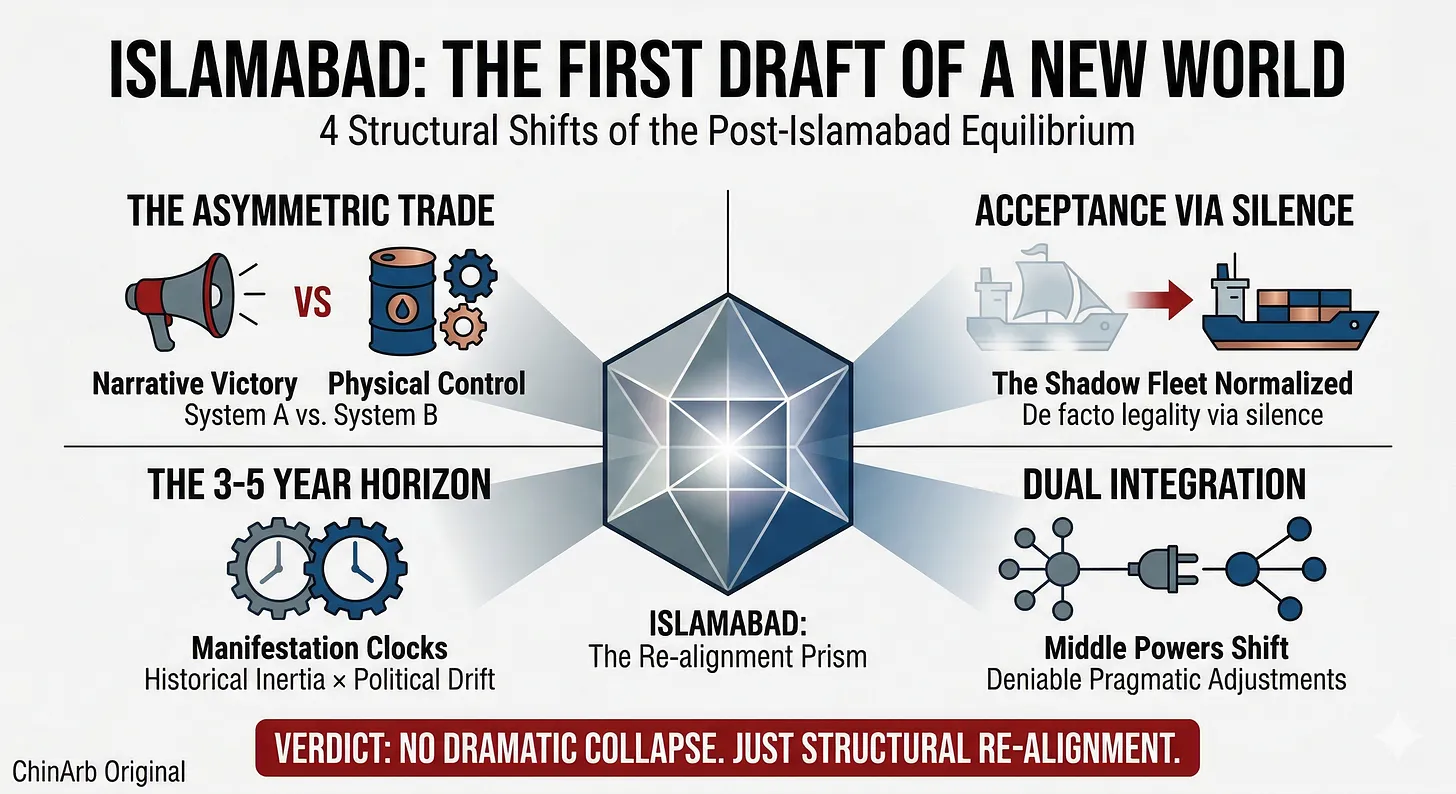
Source: https://chinarbitrageur.substack.com/p/islamabad-the-first-draft-of-a-new
If you have been following the Islamabad news over the past few days, you have seen something like this:
Iran announces it is walking out of the talks, then returns to the table. Israel bombs Beirut eight hours into the ceasefire. Trump posts “DEAL DONE” on Truth Social, then two hours later posts “TALKS COLLAPSED.” Vance holds a press conference saying “Iran has agreed to all terms.” Ghalibaf goes on Iranian state television and says “the Americans do not understand our position at all.”
Chaotic. Reversing. Self-contradictory. Looking like nothing has happened.
And if you read these headlines the way mainstream media reads them, you reach one conclusion — Islamabad is a failure.
I told you on the first night why this reading is wrong.
I said: this negotiation itself does not matter. It will most likely produce nothing. The ceasefire will be extended. Then extended again. Each round will be declared “progress,” and none will produce a signed agreement. But this absence of result is itself the misreading — because what matters is not on the negotiating table. What matters is that the world order has already begun to be reshaped according to a new set of power rules, and Islamabad is just one visible entry point into that reshaping. It is not the endpoint, not even the midpoint. It is a moment of recognition.
And what you need to understand tonight is this: the reshaping does not happen in the conference room at Islamabad. It will take Islamabad as its starting point, and over the next three to five years, through a series of arguments, broken agreements, walkouts, re-negotiations, more broken agreements, more re-negotiations — a series of events that look like failures — it will, slowly, irreversibly, while everyone is denying it, develop itself into visibility.
Tonight I will take you to see four concrete forms of this developing process. They are not predictions — they are structural inevitabilities.
⸻
The Israel Clause: The Sentence System A Has Wanted for 47 Years
What follows is the deepest layer Western analysts have not seen in the Islamabad negotiation. It is not about Israel. It is about a new form of transaction — and Israel is just the first, and most dramatic, case of that form.
In Iran’s 10-point plan there is something mentioned but not seriously analyzed: Iran’s wording contains no “destruction of Israel”. And the United States expects Iran, in the final agreement, to “abandon the threat to destroy Israel” in some form.
This looks like an ordinary diplomatic detail.
It is not. It is the thing System A has wanted most for 47 years.
Since the 1979 Iranian Revolution, “Death to Israel” has been the core narrative of the Iranian revolutionary regime. Camp David did not make it disappear. Oslo did not. The Abraham Accords did not. The real origin of this war was Israel’s fear that it might be annihilated. And Islamabad may be giving System A the sentence it has been unable to obtain for 47 years.
This sentence will be packaged by System A as a historic victory. Trump will post on Truth Social: “I MADE IRAN RECOGNIZE ISRAEL — NO PRESIDENT BEFORE ME COULD DO THIS.” Israel’s new government will call it the greatest accomplishment of 47 years of diplomacy.
And System B does not care at all.
Because to System B, Israel is not important. Israel is not a System B customer, not a supplier, not a chokepoint. Letting the IRGC modify a single line of narrative to give System A a victory is a completely free concession for System B.
And the IRGC loses an ideological commitment — but it has already lost its Supreme Leader, it is restructuring its entire internal power configuration, and it has the room to make this kind of adjustment. What it gets in exchange is real material payoff: Strait transit fees, partial sanctions relief, reconnection to the global economy. For the IRGC, this is exchanging a single sentence for the global economy.
So the form of the trade is: System A gets a narrative victory to mask all of its physical defeats. The IRGC gets actual material benefits. System B gets everything it wanted — the Strait keeps flowing, Iranian oil keeps exporting — and pays nothing. Israel gets the sentence it has been missing for 47 years.
But look closely at that last item. Israel gets only a sentence. It gets no physical security upgrade. And the world in which it gets this sentence is a world where System A can no longer deliver on its protection promises. It received the most precious gift inside a dying old order, and that gift has no meaning in the new order.
Israel looks like it won at Islamabad — but it won a victory that will become a joke within five years.
This is the pure form of this transaction — System A gets the language of victory, System B gets the physical result. Each party gets what it most wanted — and what each most wanted, conveniently, does not conflict.
Narrative victory in exchange for physical concession. This is the actual operating mechanism of the Islamabad negotiation.
⸻
The Quiet Acceptance of the Shadow Fleet: Not Through Announcement, Through Silence
This is the phenomenon System A has hated most for the past thirty years — the Russian, Iranian, and Venezuelan shadow fleet, with its turned-off AIS signals, flag swaps, fake insurance documents, and gray-market tanker network bypassing SWIFT. Before Islamabad, System A’s official position was always: this is illegal, it is a sanctions-evasion loophole, it must be closed.
After Islamabad, this position will change in a very subtle way.
It will not be publicly legalized. It will be quietly accepted.
OFAC at the US Treasury will stop issuing new large-scale sanctions lists targeting the shadow fleet. The EU will “review the enforcement mechanism of secondary sanctions.” Lloyd’s will “update” its insurance evaluation standards. None of these actions will be described as “legalizing the shadow fleet” — they will be described as “pragmatic policy adjustments,” “adapting to new market realities.”
But their cumulative effect is: the shadow fleet will go from a gray illegal network to a sub-segment of mainstream shipping. It will surface from underground, but what it serves is still the resource flow of System B.
Why? Because System A has discovered that its strikes against the shadow fleet are precisely strikes against its own physical supply chain. Every successful shadow fleet sanction makes global oil prices rise a little, makes European industrial necrosis a little deeper, makes American voters’ gasoline bills a little higher. System A cannot continuously strike a network its own people physically depend on.
This is the cumulative form of narrative victory in exchange for physical concession — not through announcement, through silence. Every act of non-action is itself an action. Every silence is itself an admission.
⸻
Three to Five Years: The Visibility Window of the New Order
This is the most important judgment in this entire piece.
The new order built after Islamabad will not develop into visibility all at once. It will be seen by the world gradually, over three to five years — not through a dramatic turning point, but through a series of micro-drifts that the official language repeatedly denies.
The three to five years is not a guess. It is the product of two clocks.
The first clock is historical. After Suez 1956, Britain took 12 years to formally announce its “East of Suez” withdrawal — but the critical perceptual drift happened in the first 3-4 years. After Vietnam 1975, the world’s recalibration of American deterrence took 5-7 years to become visible in the behavior of middle powers. After Iraq 2003, the Middle East restructuring took 8-10 years to complete. The window in these precedents is 5-10 years. And 21st-century information transmission is much faster than 1956. The feedback loop now runs in weeks, not years. This compresses the historical window to 3-5 years.
The second clock is System A’s own political clock. Think tank reports need 12 to 18 months to write the new “pragmatic” language — drifting from “we must guarantee freedom of navigation in Hormuz” to “we must ensure the stable operation of Hormuz within a multilateral framework.” Mainstream media needs 18 to 24 months to complete the narrative drift. Voters need 24 to 36 months to form a new common sense.
This political clock determines the minimum time of visibility. It cannot move faster — moving faster would trigger System A’s internal legitimacy crisis. And it will not move slower — System A’s physical pressure will force it to accept the new reality at some point.
And System A cannot break out of this clock. Any serious decoupling attempt will be pushed back within six months by empty Walmart shelves and a CPI spike. Trump’s first-term China tariff history has already proved this. The physical structure of the American economy holds veto power over American political will.
Three to five years is the physical duration for the new order to become visible to the world, and that duration cannot be accelerated or slowed by any party. It is the rhythm of structure itself.
Remember that line from the first night? “The losing side is not yet capable of saying the words ‘we lost’ out loud.” The next three to five years that you are about to see is the physical unfolding of that sentence.
⸻
Dual Access at the Edges of the Alliance
Over the next three to five years, every non-Western government will be doing the same arithmetic: if America’s largest military operation could only produce Vance flying to Islamabad to negotiate, then was my old discount rate on American threats set too high?
Their answers will be unanimous: it was set too high. They will become a little braver. They will start trying things they did not dare to try before — not big moves, but small, deniable, exploratory moves.
They will not publicly leave the System A alliance. They will do something more important than leaving: they will plug into both systems simultaneously.
Saudi Arabia and the UAE are already deepening RMB settlement on energy with China. After Islamabad, this process will accelerate. Saudi Arabia will begin plugging into some Chinese-led regional security dialogue mechanism — not to replace American security guarantees, but as a supplement. The word “supplement” will be repeated constantly. But the direction of the supplement is always one way.
Turkey will further give up parts of its SWIFT dependency, shifting toward RMB and ruble settlement on energy trade.
South Korea and Japan are the hardest cases — their security depends entirely on System A, but their industrial supply chains already depend deeply on System B. After Islamabad, they will be forced to make some “small rebalancing” actions, described as “risk diversification” or “supply chain resilience” — but their real meaning is: these governments are, for the first time, seriously preparing for a world in which “System A can no longer be assumed to be the sole security guarantor.”
Even Germany — under the pressure of industrial necrosis, Germany may begin to publicly discuss “strategic autonomy.” The Merz government, or its successor, will at some point publish a “European Security Strategy White Paper” containing a passage about “maintaining constructive engagement with all major global powers.” That passage will be Germany’s official signal of beginning dual access.
None of these signals will be dramatic. Each can be explained in the official language as “pragmatism.” But their cumulative direction is singular — every member at the edge of System A is quietly putting one foot into the System B network.
This is the final marker of the structural deadlock: it will not express itself through any one dramatic camp switch. It will express itself through dozens of micro, deniable, “pragmatic adjustments.” By the time all the small adjustments are complete, you will discover the alliance system is no longer what it was five years ago — but no single day of “alliance dissolution” ever occurred.
⸻
Coda
This is what the world to come looks like.
It will not have a dramatic collapse. It will not have a dramatic restructuring. It will happen through slow, irreversible, universally denied drift.
Over the next three to five years, you will see dozens of “Islamabad talks broken down” headlines. You will see Trump announce “we will never negotiate with Iran again.” You will see Iran withdraw from the NPT. You will see Israel re-bomb Lebanon. You will see the Houthis blockade the Red Sea again. You will see Saudi Arabia demand nuclear weapons again. You will see another European “unity statement.”
All of these events, added together, are the new order developing itself into visibility. They do not happen inside the conference room at the Serena Hotel. They take the conference room at the Serena Hotel as their starting point, and over the next three to five years of repeated arguments, broken agreements, walkouts, and re-negotiations, slowly, irreversibly, while everyone is denying it, drift into what they are about to become.
This is the entire point of the structural deadlock — it does not need anyone to acknowledge its existence. It only needs everyone to live according to it.
⸻
Return to the conference room. To the Serena Hotel. To the table where Vance and Ghalibaf are sitting. But this time, see the room clearly.
What is happening in this room is not a ceasefire negotiation. A ceasefire negotiation is about ending a war. And the war of the past six weeks is already over — in those 4 tankers passing through Hormuz, in those 400 ships anchored outside the Gulf, in that one Sino-Russian veto at the Security Council, it ended.
What the two men in the room are doing is something else. They are sitting down to negotiate the first draft of the world that comes after a war that has already ended.
But neither of them knows this. Vance does not know. Ghalibaf does not know. Asim Munir does not know. The Chinese ambassador does not know. No one knows.
They all vaguely sense something. They all know this meeting matters more than an ordinary Middle East crisis negotiation. But none of them can name it in precise language.
Vance really thinks he is here to negotiate a ceasefire. Ghalibaf really thinks he is here to win the maximum concessions for Iran. They are all playing the roles they think they are playing — and the real meaning of those roles will only be gradually seen, in the repeated negotiations of the next 3 to 5 years.
Not seen all at once. Seen through one “we extended again” after another, through one “we made progress but did not sign” after another, through one “we restarted from the beginning” after another.
This is how history actually happens.
The great turning points always happen at the moment when none of the people present are yet capable of naming them. The young man who fired the gun on the streets of Sarajevo on June 28, 1914 did not know he was opening the First World War. The first person who pushed down a piece of the Berlin Wall on November 9, 1989 did not know he was ending the Cold War. The people waking up on the streets of Hiroshima at 8:15 AM on August 6, 1945 did not know they were being pulled into a new kind of physical force. History is not announced. It is lived.
And the people in the Islamabad conference room right now are living through a turning point they cannot yet name — for the first time since 1945, not everyone sitting at a new-order negotiating table belongs to System A.
For the past eighty years, every meeting that decided the global order — Yalta 1945, Bretton Woods 1944, Camp David 1978, Reykjavík 1986, Madrid 1991 — was sat at by representatives of System A. They spoke different languages, represented different countries, but they belonged to the same operating system. Islamabad is the first time in those eighty years that this shared assumption has been broken.
There is an American Vice President in the conference room. But outside the conference room is Asim Munir, who reports more reliably to Beijing than to Washington. Outside the conference room is the absent Chinese ambassador, who does not need to come in. Across the table sits Ghalibaf, who represents not a besieged revolutionary regime, but a new kind of theocratic empire that just got de facto global recognition through 42 days of physical evidence.
This is the shape of the new table.
And the people sitting at this new table will need 3 to 5 years before they can slowly learn the precise language to name what this table actually is.
Remember that line from the first night?
The losing side is not yet capable of saying the words “we lost” out loud.
The entire Islamabad you have just seen is the physical form of that sentence.
And the only person who can see this right now is YOU, the reader who has finished these five pieces.
⸻
But before I let you leave this room, there is one thing I have to tell you.
It is not like the rest of this series.
It has no argument.
It is just a set of facts.
⸻
Six weeks ago, Khamenei died.
What killed him was not the US military.
What killed him was Palantir’s target identification algorithm — it found, in decades of signals intelligence data, a pattern no human analyst had seen, and turned that pattern into a specific geographic coordinate.
What let that F-35 know, at 30,000 feet, where it was, where the target was, how to get there, and how to come back, was SpaceX’s Starlink — more than 6,000 low-earth-orbit satellites, requiring no permission from any Middle East ally, untouchable by any air defense system.
What let that precision-guided munition perform millimeter-level corrections in the final 3 meters was Anduril’s autonomous navigation — needing no GPS, needing no communications, completing the final lethal strike entirely through machine vision and inertial algorithms.
What made it possible to eliminate almost the entire leadership of Iran’s Supreme National Security Council in 72 hours synchronously was the defense cloud of Microsoft and Amazon — compressing what used to take hundreds of analysts months into seconds.
What let Israeli air defense perform millions of trajectory calculations per second, decomposing Iran’s saturation missile attack into a solvable mathematical problem, was the real-time compute jointly provided by this generation of defense technology companies — a physical foundation no military in the past 80 years has had.
Look at this list closely.
Of all the jaw-dropping “perfect tactical victories” in this war — from the death of Khamenei, to the 72-hour decapitation, to the missile inventory clearance, to the saturation defense interception — not one was achieved by System A.
System A lent its political authorization.
System A lent its uniforms.
System A lent its pilots.
But the force that actually won this war never belonged to System A.
We have been saying System A won tactically and lost strategically.
Let me say it again, this time precisely:
System C won the entire war tactically.
System A lost strategically.
System B won strategically.
These are three different subjects.
This is the first time System C has let the world see itself.
But please also remember —
this is only the first time.