
Israel Tries to Leverage Syrian Druze for Strategic Gains in al-Jolani’s ‘New Syria’
Fri 10:31 pm +00:00, 9 May 2025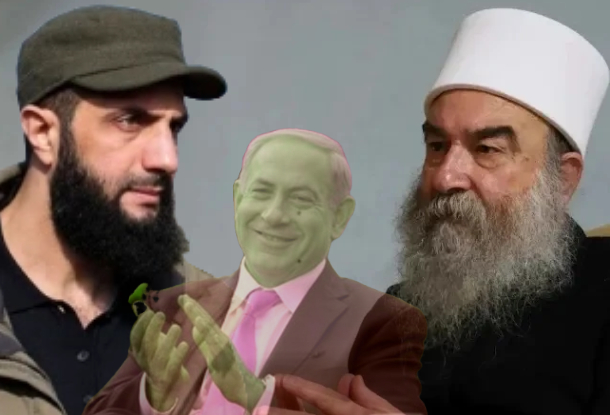
Image: Influential Druze leader in Syria Sheikh Al-Hijri facing Ahmed Al-Sharaa Former Al-Qaeda leader in Syria and current Interim president of Syria with Netanyahu laughing all the way to the bank.
Walid Joumblatt, the political leader of the Lebanese Druze, accused Israel of trying to manipulate the Druze community to destabilise the region. He reiterated his firm opposition to any reconciliation with Israel until a sovereign Palestinian state is formed. At a press conference in Beirut, alongside his son Taymour, who now leads the Progressive Socialist Party, Joumblatt expressed his plan to return to Syria after seeking a meeting with interim president Ahmad al-Sharaa. He cautioned that Israel aims to exploit various communities, including the Druze, to further divide the region. He urged the ‘free people of Jabal al-Arab’ to stay alert against Israeli schemes in Syria, asserting that those who unified Syria under Sultan Pasha al-Atrache (leader of the Syrian revolution from 1925 to 1927) will ignore Benjamin Netanyahu’s calls. He concluded by stating that”
“Israel’s biblical project knows no boundaries and seeks to expand the Hebrew state throughout the region.”
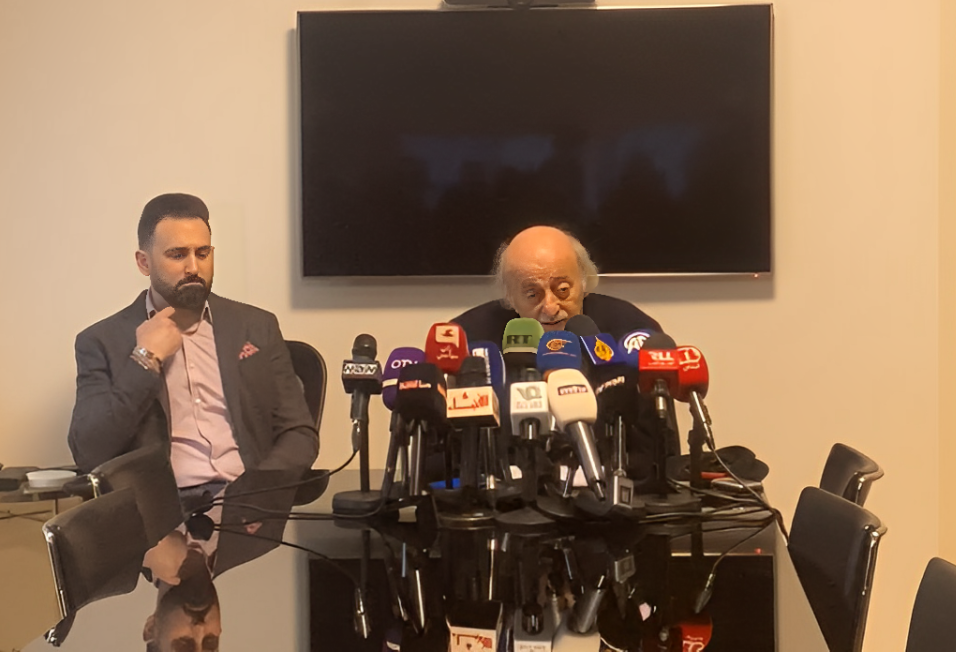
IMAGE: Druze leader Walid Jumblatt and his son Taymour during a press conference held on Sunday, March 2, 2025, in Beirut. Screenshot (Source:
In the wake of the hostilities that erupted in late April and early May, involving armed factions associated with the new Syrian government and Druze groups in the Jaramana and Sahnaya areas of Damascus, Joumblatt convened with Syrian transitional president Ahmed Al-Sharaa in Damascus on Friday, May 2 after clashes erupted in Jaramana (Syria) on Monday 28, April between Sunni armed men and Druze militiamen–Jumblatt was the first high-ranking Lebanese politician to visit Syria after the fall of Bashar al-Assad’s regime. Meanwhile, Sheikh Hikmat Al-Hijri, the spiritual leader of the Druze Muslim community, denounced the atrocities committed against innocent civilians, characterising them as an unwarranted act of genocide intended to instil fear, intimidate, and establish control. He asserted that the victims were not ‘gangs,’ as alleged, but rather individuals who were defending their lives and means of existence.
During the evening in question and continuing until Saturday 4, the Israelis, citing the need to protect minority groups, took advantage of this situation and intensified their bombing campaign, carrying out over twenty airstrikes in Syria, some landing near the presidential palace in Damascus, targeting areas linked to Ahmed Al-Sharaa (Abu Mohammad al-Julani), the Islamist leader who seized power in Syria.
Israel’s claim of defending minorities to justify military actions against Syria may simply disguise its intent to destabilise Syria and create chaos, which Israel could control, unlike a strong Arab state thriving near its borders. Most Syrian Druze believe the new Syrian government is turning a blind eye to the perpetrators of the violence, whilst protecting extremist Sunni armed groups allegedly involved in the violence. Mediapart has the story…
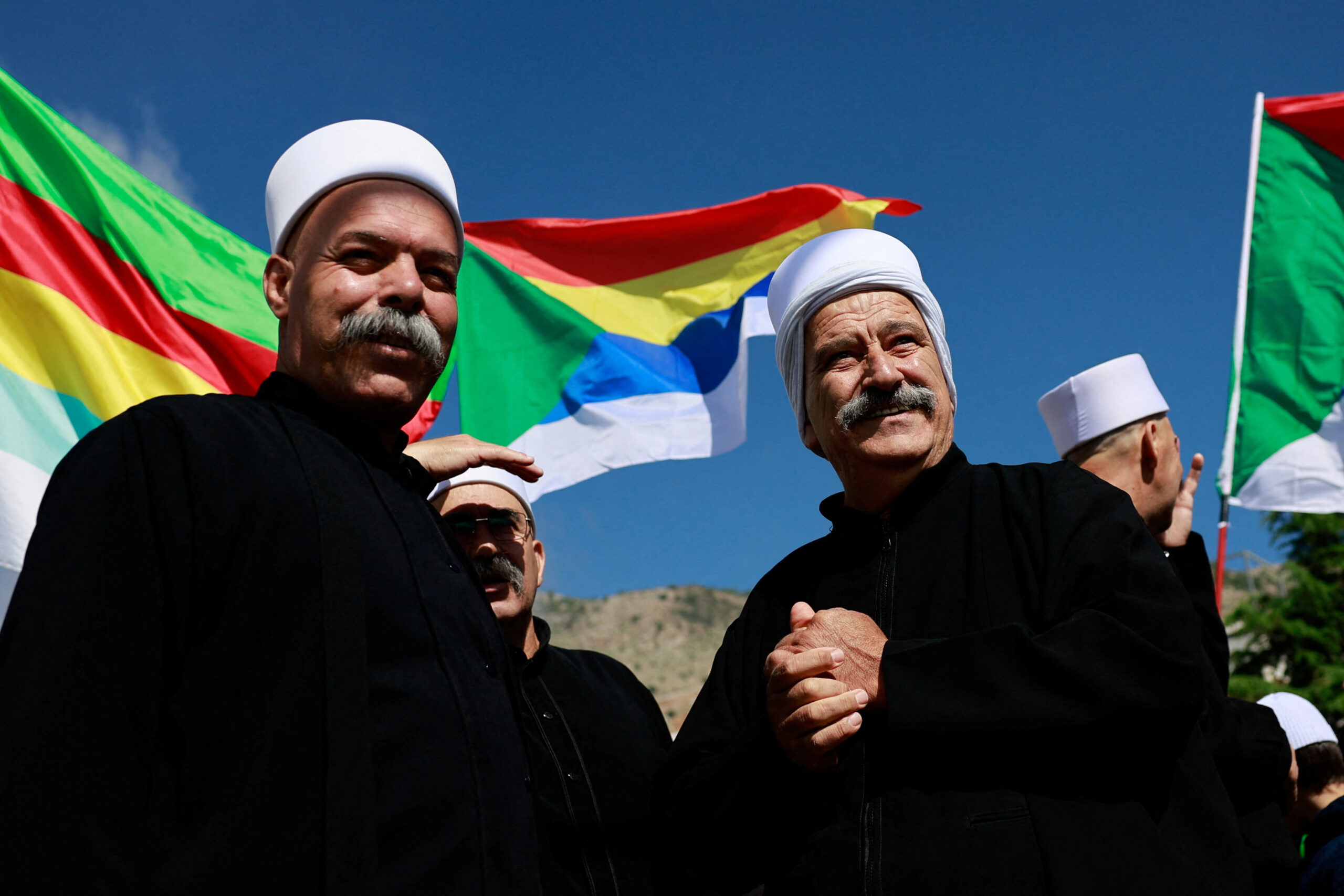
IMAGE: Israeli Druze men look on as they wait to greet Syrian Druze who cross the border from Syria into the Israeli-occupied Golan Heights, as they come to the annual gathering at the Nabi Shuayb Shrine, a holy place for the Druze community, at Majdal Shams, April 25, 2025. (Source: REUTERS/Ammar Awad)
Mediapart reports…
Israel instrumentalises the Druze cause in a Syria shaken by sectarian violence
Sectarian violence in predominantly Druze neighbourhoods in Syria left more than 100 people dead last week. Citing the defense of minorities, Israel launched a wave of massive bombings against the transitioning country.
Syria after Assad Analysis
Beirut (Lebanon). – For two days, Nora*, a resident of the predominantly Druze neighbourhood of Jaramana, on the outskirts of Damascus, Syria, stayed indoors, waiting for the machine gun fire to subside. “What I felt was stronger than fear,” she told Mediapart by phone. “We thought it was over for us, that we would suffer the same fate as the inhabitants of the Syrian coast,” she added, referring to the massacres of Alawite populations perpetrated in March by Islamist factions affiliated with the new Syrian army.
Violent clashes erupted in Jaramana on Monday, April 28, between Sunni armed men and Druze militiamen, following the online circulation of an audio message attributed to a Druze cleric, Marwan Kiwan, in which a man can be heard blaspheming the name of the Prophet Muhammad. The Druze sheikh has denied being the source of the recording, and the Syrian Interior Ministry’s preliminary investigation appears to support the hypothesis of a fake recording.
But the damage was already done. The audio message, which went viral, sparked a wave of calls for revenge against the Druze community, a religious minority affiliated with Islam, present in Lebanon, Syria, and Israel. Groups of hooded Sunni armed men came from neighbouring towns to fight the Druze population, first in Jaramana, where they encountered resistance from armed Druze men deployed at the town’s security posts to prevent access.
Nora, terrified, said she felt her house shake under mortar and machine gun fire during the clashes.
The next day, the clashes spread to Sahnaya, another Druze neighbourhood 15 kilometres from the capital. Druze militiamen from across Syria were called in as reinforcements, and the violence escalated, also involving government forces who tried to intervene. On Wednesday, forty-two Druze fighters mobilised from the southern city of Sweida were killed in an ambush. No one claimed responsibility for the attack.
“The state should have protected us”
In total, in addition to these 42 fighters, the violence left 109 dead, including 30 members of the General Security Services, 26 Druze fighters, and 11 civilians, according to the Syrian Observatory for Human Rights. The mayor of Sahnaya and his son were killed during the fighting.
Syrian authorities, led by interim President Ahmed al-Sharaa, leader of the Islamist armed group Hayat Tahrir al-Sham (HTC), which overthrew Bashar al-Assad, urged calm, reaffirming their “firm commitment to protecting all components of the Syrian people without exception, including members of the Druze community,” while attributing the attack to “outlaw” elements.
For Nora, it’s too little, too late. She accuses the new Syrian government of turning a blind eye to the perpetrators of the violence and of protecting extremist Sunni armed groups allegedly involved in the violence.
“The state should have protected us, but it didn’t. How can we explain that these men entered our neighbourhoods so easily? Doesn’t the state have the weapons and the men to stop them? Why didn’t they do anything?” she asks, adding, “I have lost all confidence in the government since the Alawite massacres on the coast.”
Hundreds of Alawite civilians were killed in March in a wave of revenge-driven killings against the Alawite community, a religious minority to which ousted dictator Bashar al-Assad belongs, and considered by some to be complicit in the regime’s crimes solely because of their sectarian affiliation.
On Thursday, May 1, Sheikh Hikmat al-Hijri, an influential Druze religious leader in Syria, denounced a “genocidal campaign” targeting “civilians in their homes.” “We no longer trust an entity that claims to be a government,” he said. “A government does not kill its people by using its own extremist militias, then claiming, after the massacres, that they are rogue elements.”
Since then, calm has returned to the Druze neighbourhoods: a ceasefire agreement was signed, and the Syrian army deployed to Sahnaya to “restore order.” “The situation is calm now,” Nora confides. “But we’re all afraid for the future.”
Israeli bombings
Adding to the chaos, Israel, which claims to be defending the Druze cause, bombed Syria several times last week, while threatening Syrian authorities to intensify its offensive if sectarian violence continued. The sound of bullets exchanged between security forces and Druze and Sunni militias is now compounded by the roar of Israeli aircraft in the Syrian sky.
On Friday, Israel bombed the area near Ahmed al-Sharaa’s presidential palace, an attack it described as “a clear message to the Syrian regime.” “We will not allow [Syrian] forces to be deployed south of Damascus or to threaten the Druze community in any way,” Israeli Prime Minister Benjamin Netanyahu and Defense Minister Israel Katz said.
On Friday, Syria’s official news agency, SANA, reported that an Israeli attack in Sweida had killed four Druze fighters. Hours later, overnight Friday to Saturday, Israel launched a wave of massive bombing raids against Syria, claiming to have targeted a “military site, anti-aircraft guns, and surface-to-air missile infrastructure.”
“The Israeli army is deployed in southern Syria and is ready to prevent the entry of hostile forces into the area of Druze villages,” it added in a statement released Saturday, May 3. Israel has expressed deep mistrust of the new Syrian authorities, although they have openly stated that they do not want direct confrontation with their neighbour.
“Israel has no interest in seeing Syria recover economically; its goal is to sow discord […] and keep its neighbours in a weak position.” Benjamin Fève, consultant
Since the fall of Bashar al-Assad’s regime in December, Israel has seized territory in southwest Syria, destroyed most of the Syrian army’s strategic weapons depots, and demanded the complete demilitarisation of areas south of Damascus.
“Seeking local allies, for example within the autonomous Druze community, could serve as a buffer against perceived threats from Damascus and Sunni Arab armed groups, which are potentially more hostile to Israel,” explains Benjamin Fève, a consultant at the analysis firm Karam Shaar Advisory Limited.
But, he continues, the argument of defending minorities put forward by Israel to justify its attacks on Syria would only be a pretext to destabilise Syria and create more chaos. Chaos that it could control, unlike a strong Arab state that would prosper on its borders. “Israel has no interest in seeing Syria recover economically; its objective is to sow discord within Syria and keep its neighbours in a weak position,” he explains.
Divergent voices
In Druze neighbourhoods, some residents, like Nora, are well aware of the instrumentalisation of the minority cause: “Israel is empty talk. They only want to protect themselves. Look: they killed four Druze in their attacks, and they claim to defend us? We don’t ask them to help us, we just want the state to protect us.”
The position of Druze leaders regarding Israel and the new Syrian government is not unanimous. While Sheikh Hikmat al-Hijri, one of the three spiritual leaders of the Druze minority in Syria, has called for international intervention in the wake of the violence and maintains a hard line against the new government, the other two have adopted a more moderate position and denounce Israeli strikes in Syria.
“There are Druze factions ready to engage in dialogue with the government and lay down their weapons. Moreover, in the past, meetings and security agreements have been signed between the authorities and certain Druze factions ready to integrate into state structures,” continues Benjamin Fève.
Nora acknowledges that Israel has support among the Druze population: “It’s not because they trust Israel, it’s more out of desperation, because they no longer believe in the government’s ability to protect them, and they don’t see any other options.”
The latest clashes are a reminder of the challenges of unifying Syria, a country deeply fractured after 14 years of civil war, where a myriad of armed groups still impose their law.
The new government in Damascus, led by the HTC Islamists, the leaders of the rebellion that overthrew the Assad regime, as well as technocratic and moderate figures, has promised inclusive governance, but appears unable to control the most extremist armed factions.
“To end the cycle of violence, we must begin a genuine transitional justice process. There has been progress: the government has launched a commission of inquiry into the coastal massacre, and another is expected to be launched regarding the recent violence,” explains Benjamin Fève. “We must also begin a process of disarming the factions, and for the state to reaffirm its monopoly on force.”
For minorities, after waves of sectarian violence, trust will be difficult to restore. “How can we lay down our weapons when we live under constant threat? This violence has reinforced our need to remain armed, not because we want to create division within Syria, but to defend ourselves as a minority, because no one else will,” Nora says.
See more analysis at Mediapart
READ MORE SYRIA NEWS AT: 21st CENTURY WIRE SYRIA FILES
VISIT OUR TELEGRAM CHANNEL
SUPPORT OUR INDEPENDENT MEDIA PLATFORM – BECOME A MEMBER @21WIRE.TV