
Remilitarised Japan ‘a dangerous wild card’
Mon 10:24 pm +00:00, 20 Jul 2026Japan’s ‘destructive potential’ in South China Sea may eclipse the US: analyst
Japan’s recent firing of an anti-ship missile was first time it had shown its ‘military muscle’ since World War II, security round table told.
A prominent Chinese maritime analyst has sounded the alarm over Japan’s increasing military presence in the South China Sea, warning it has a “destructive potential” that could ultimately surpass that of the United States.
Japanese troops take part in Balikatan, the annual joint military exercises between the United States and the Philippines. Photo: Reuters
Alyssa Chen
Published: 7:00pm, 13 Jul 2026Updated: 7:12pm, 13 Jul 2026
A prominent Chinese maritime analyst has sounded the alarm over Japan’s increasing military presence in the South China Sea, warning it has a “destructive potential” that could ultimately surpass that of the United States.
Speaking on Monday at a round table event in Hong Kong discussing security in the region, Wu Shicun, the founding president of China’s National Institute for South China Sea Studies, said “unilateral infringements” in the disputed waters were becoming “normalised”.
He told the event – jointly organised by the institute with the Huayang Centre for Maritime Cooperation and Ocean Governance and the Asian Academy of International Law – there had been a steep rise in military deployments, joint exercises and maritime patrols by countries outside the region.
Japan’s unprecedented, full-fledged participation in Balikatan – the annual joint military exercises conducted by the US and the Philippines – has fuelled China’s anxiety. This year’s drills saw the deployment of more than 1,400 Japanese personnel, alongside three major warships and transport aircraft.
During the exercise, Japanese forces fired a Type 88 surface-to-ship missile system outside its territory for the first time, using live rounds to strike a decommissioned Philippine Navy vessel.
“This is the first time that Japan has shown off its military muscle since the end of World War II,” Wu said.
“Japan’s military forces’ deployment into the South China Sea is inherently destructive, carrying a potential risk that may ultimately surpass even that of the United States.”
He also said: “As long as Manila and its partners do not give up using the [ruling] to serve their own interests, peace and stability in the South China Sea cannot be guaranteed.”
Wu was referring to a 2016 decision by an international tribunal in The Hague that ruled that most of China’s claims to historical and economic rights in the South China Sea were invalid.
China slams Japan’s first overseas missile launch in 80 years
Qi Dahai, the director general of the Chinese foreign ministry’s department of treaty and law, told the event that Washington was not a party to the dispute but was using every means to “stir up tensions”.
“It builds small cliques, issues so-called joint statements, sows discord and fans the flames in the region,” Qi said.
The remarks come at a time of heightened friction over the resource-rich South China Sea.
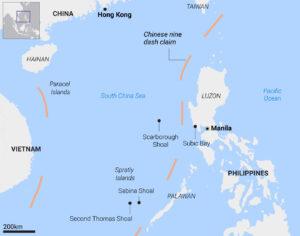
Beijing claims sovereignty over almost all islands and reefs, and the rights to adjacent waters in the sea – a stance that has locked it into long-running maritime disputes with rival claimants, including the Philippines, Vietnam, Malaysia and Brunei.
Wu was speaking a day after the 10th anniversary of the Hague ruling.
The arbitration case, which was initiated by Manila, triggered a fresh war of words on Sunday. Fourteen countries, including the US and Philippines, issued a statement marking the anniversary that said the tribunal’s ruling was “legally binding and definitive”, and criticised Beijing for refusing to recognise or implement it.
The row intensified further after a separate Japanese statement said China’s non-compliance went “against the principle of peaceful settlement of disputes”.
In response, Beijing summoned a senior official from the Japanese embassy to lodge a formal protest.
The foreign ministry also said: “Japan is not a party to the South China Sea dispute and has no right to point fingers at China regarding its territorial sovereignty and maritime rights and interests.”
Japan fired a Type 88 anti-ship missile during the Balikatan exercises. Photo: Reuters
The ministry said that some of Japan’s recent activities – such as exporting arms and equipment to the Philippines, dispatching its forces overseas and launching offensive missiles – went “far beyond the scope of self-defence”.
Japan’s post-war pacifist constitution states that its armed forces can only be used for defensive purposes.
Beijing has dismissed the Hague ruling as “null and void”, saying it was politically motivated and violated the fundamental principle of state consent because it never agreed to the arbitration.
Chinese officials increasingly see the ruling as being weaponised by the Philippines and other countries as part of a coordinated strategy to portray China as a threat to regional stability.
Both Japan and the Philippines are key US allies. Washington has nine bases in the Southeast Asian nation, regularly holds joint naval drills to boost interoperability and has established a task force on the island of Palawan to provide intelligence and technical training to Philippine forces.
Meanwhile, Japan has emerged as an indispensable strategic partner for the Philippines. It has supplied it with coastal radar units and patrol aircraft, and they are negotiating an intelligence-sharing pact and the transfer of five Abukuma-class destroyer escorts.
They have also signed a reciprocal access agreement allowing Japanese and Philippine forces to be deployed on each other’s territory for joint combat training.
In late May, a Dutch frigate sailed near the contested Paracel Islands, making the Netherlands the latest in a series of US allies from outside the region to pass through the waters.
Beijing accused the Dutch of making an illegal intrusion and said it had sent ships and planes and used electronic warfare countermeasures to drive the frigate away.
Alyssa Chen
Alyssa joined the Post in 2023 as a reporter on China desk to cover diplomacy. Her interests lie in cross-strait relations and Sino-Japan relations. Previously, she was the Asia Correspondent for the Japan Times, and graduated from the University of Hong Kong.
Discover MORE stories on
South China Sea
Malaysia adds South China Sea eyes in the sky amid Sabah row with Philippines
How Chinese pirate queen Ching Shih ruled the South China Sea in the 1800s
Philippine military assures ‘no vacuum’ over top officer’s retirement
Further Reading
Beijing slams Manila’s South China Sea claims ahead of 2016 Hague anniversary
Beijing slams US-led coalition for marking 10 years since South China Sea ruling
China’s military mouthpiece issues full-page warning on Japan’s growing drone power
PLA Daily says unmanned platforms have allowed Tokyo to circumvent constitutional constraints on military development
Further Reading
Does Beijing own Batanes? Why Chinese scholars’ claim is a warning to Manila
Did the Ukraine war spark China’s ban on most civilian drone flights in cities?
Why is Taiwan’s KMT calling for the government to spend billions more on drones?
Discover MORE stories on
China-Japan relations
Could Yunnan’s mineral wealth and location solve China’s ‘Malacca dilemma’?
Giant Japanese trade group plans China visit amid tense economic ties
Japan’s ‘destructive potential’ in South China Sea may eclipse the US: analyst
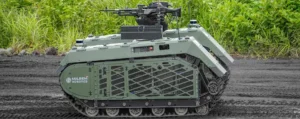
An unmanned ground vehicle is deployed in the Japan Ground Self-Defence Forces’ largest annual live-fire drill in Gotemba, Japan, on June 7. Photo: AFP
Albee Zhangin Shanghai
Published: 6:10pm, 20 Jul 2026Updated: 6:57pm, 20 Jul 2026
China’s military mouthpiece on Monday dedicated a full page to warning about Japan’s expanding offensive drone capabilities, which it said threatened regional peace and security.
PLA Daily said Japan’s right-wing political forces had long sought to bypass Tokyo’s constitutional ban, adopted after World War II, on offensive combat capabilities.
Uncrewed platforms have allowed Japan to circumvent these constraints on military development, according to one of four PLA Daily articles on the topic in Monday’s edition.
“Japan is seeking to build asymmetric advantages on future battlefields by relying on unmanned combat capabilities, thereby advancing its broader agenda of ‘remilitarisation’ – a trend whose potential risks should not be underestimated,” another article stated.
It said Japan’s three key national security documents, passed in 2022, had identified “unmanned defence capabilities” as a priority to establish Japan’s counterstrike ability.
According to the documents, integrating unmanned systems, artificial intelligence and manned platforms is “a game changer” for Japan to build asymmetric advantages.
In its 2022 Defence Build-up Programme, Japan said it would invest 1 trillion yen (US$6.2 billion) in uncrewed systems over the five-year period starting in 2023.
This financial year alone, Japan has allocated 277 billion yen for drones, including 100 billion yen for building a multilayered littoral defence system called Synchronised, Hybrid, Integrated and Enhanced Littoral Defence (Shield).
PLA Daily said the Shield platform was similar in concept to the “hellscape” scenario that the US military had envisioned for a Taiwan contingency, where unmanned systems would deploy en masse very quickly.
Japan plans to buy 23 US-made MQ-9B SeaGuardian unmanned aircraft. Photo: General Atomics Aeronautical Systems
Japan plans to buy 23 US-made MQ-9B SeaGuardian unmanned aircraft. Photo: General Atomics Aeronautical Systems
The articles detailed Japan’s drone development across land, sea and air, adding that Tokyo had been focusing on loitering munitions, also known as suicide drones, and armed reconnaissance-strike unmanned platforms.
They said Japan was aligning its drone development with that of the US. Tokyo upgraded the US-Japan Defence Industrial Cooperation, Acquisition and Sustainment consultation mechanism this year to shift focus towards small unmanned aerial systems and other areas.
Japan plans to buy 23 US-made MQ-9B SeaGuardian unmanned aircraft as well as American-made robotic dogs, unmanned surface vessels and uncrewed underwater vehicles for missions including forward reconnaissance and short-range strike operations, according to one of the articles.
PLA Daily also noted that Japan was deploying drone assets in Kyushu, Okinawa, Ishigaki Island and Yonaguni Island as well as in key passages such as the Miyako Strait and Osumi Strait, where they could cooperate with US forces along the first island chain.
Japan is exploiting the rapid development of unmanned military technology to transform its forces into ones capable of long-range precision strikes, pre-emptive operations and joint offensive warfare with the United States, according to the newspaper.
“By repeatedly crossing the red line of its ‘exclusive self-defence’ policy, Japan is transforming into a ‘state capable of waging war’ and emerging as a dangerous wild card that threatens regional peace and stability,” one of the articles warned.
Under Japanese Prime Minister Sanae Takaichi, the country has shifted away from its post-World War II pacifist policies and carried out a military build-up, citing what it claims are Beijing’s more assertive defence policies.