
So much for the Malthusians – World population on the brink of collapse
Tue 3:22 pm +00:00, 17 Feb 2026
Source: https://corbettreport.com/demographics-are-destiny/
What’s the biggest news story of the moment?
The kidnapping of Nancy Guthrie?
The LDP’s sweeping victory in last weekend’s Lower House elections in Japan?
The drought in Kenya?
Yes, depending on what part of the world you happen to reside in, one of these stories (or the local equivalent) will be dominating the headlines when you scroll through the newsfeed today.
But 100 years from now, what news from our era do you think your great-great-grandchildren will be reading about?
Do you think they’ll be learning about the Epstein files?
Do you think they’ll be preoccupied with the geoeconomic scramble for rare earths that presaged WWIII?
Do you think they’ll be scrutinizing New World Next Week Episode #619, in which James and James cover the Bezos ring camera surveillance fiasco?
Actually, that’s a trick question. Given the way birth rates are plummeting throughout the world, it’s quite likely you won’t even have great-great-grandchildren running around 100 years from now.
And, even if you beat the odds and actually do have progeny walking the earth a century hence, they’ll no doubt be more
In case you didn’t notice, we’ve already begun the descent into a shrinking world, and it’s already tearing the fabric of society apart at its seams. Indeed, the demographic crunch is perhaps the most consequential story in the history of humanity, and yet it’s scarcely ever talked about.
So today, let’s dive straight into the heart of the matter and see if we can answer two questions: how does population collapse lead to the collapse of civilization, and is there any way to avoid this demographic destiny?
DEMOGRAPHICS ARE POLITICS

Whatever corner of the globe you live in, it’s a safe bet you’ve already seen first-hand how demographic issues are driving politics in the twenty-first century. The specific issues may be different in each locale, but the overall theme is similar.
The US of A, for instance, is currently tearing itself apart over immigration enforcement and what should (or should not) be done about illegal immigration.
In “progressive” and “socialist” Europe, country after country is experiencing a rise in nationalist parties and anti-immigrant protests as people get angrier and angrier about the influx of migrants. Switzerland is even contemplating whether or not to legally cap their population at 10 million to stem the alien invasion.
Famously “polite” and “reserved” countries like Japan and Canada, meanwhile, are seeing tensions rise and massive political shifts taking place as these normally tolerant and peaceful societies are overwhelmed by a wave of migrants and tourists.
Yes, it seems like weaponized migration and The Great Replacement are in the forefront of everyone’s consciousness right now. And for good reason. The same cabal that planted the seeds for the “clash of civilizations” decades ago are not likely to stop egging on that clash until their long-prophesied calamity comes to fruition.
While the flood of third-world migrants into Western countries is an obvious way that demography inserts itself into the political theatre, there are, however, subtler—but no less important—ways that demographics are shaping our politics. In order to understand these subtle demographic factors influencing our politics, we first need to confront a grim reality: the human population is in the process of plunging off a demographic cliff.
Given the constant stream of news about plummeting fertility and birth rates in country after country after country after country after country after country across the entire world—yes, even sub-Saharan Africa—and given my own reporting on the underpopulation crisis and the demographic crunch and the underpopulation bomb, I trust that I don’t need to belabour the point.
Even the UN, which is wrong about everything, predicts that the world will enter population decline in the coming decades.
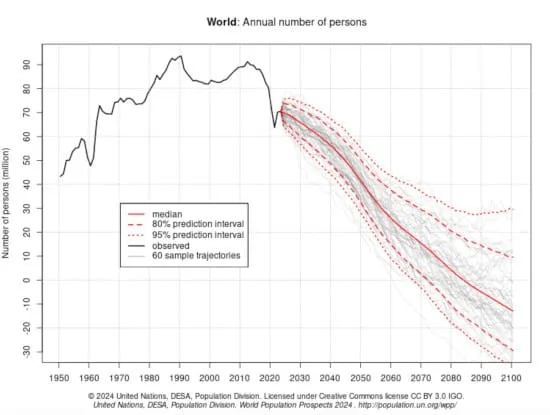
Did the UN finally get something right? No, even this admission of our grim demographic fate is flawed. In reality, the population decline will likely begin much sooner than the UN wonks believe, and the decline in population will be much sharper. Still, the overall point stands: for the first time in recorded history, humanity is on pace for a sustained decline in global population.
So, what are the political repercussions of this impending population crunch?
First, let’s consider the part demographics play in the geopolitical struggle between nations. The staggering size of China’s People’s Liberation Army (with over 2,000,000 active military personnel) compared to the US (with just over 1,300,000 active military personnel) is easily explained by the fact that China’s population is more than three times that of the US. But a corollary of this observation is that in a world plunging off the demographic cliff, disparities in birth rates will lead to relative advantages for those countries whose populations decline more slowly.
In their 2020 book, Empty Planet: The Shock of Global Population Decline, demographic researcher Darrell Bricker and journalist John Ibbitson point out how birth rates and immigration rates factor into America’s struggle with its global rivals.
The disparity between American, Chinese and Russian birth rates is another US asset. The United States’ fertility rate is 1.9; Russia’s is 1.5. Officially, the Chinese rate is 1.6, although as we have seen, it may in fact be much lower. The United States is reproducing more robustly than its largest geopolitical competitors. Thanks to immigration and a higher fertility rate, the US is far better placed than most major developed nations to sustain its population through the course of this century.
Next, let’s consider an even more surprising political result of a shrinking world: falling birth rates make for a more conservative population.
That, at least, is what data from demographic researcher Lyman Stone suggests. According to his research on US population trends, “[t]he blue-er [more liberal-leaning] the county, the more fertility has fallen in the last decade or two” because “[t]he [political] parties are realigning on fertility.”
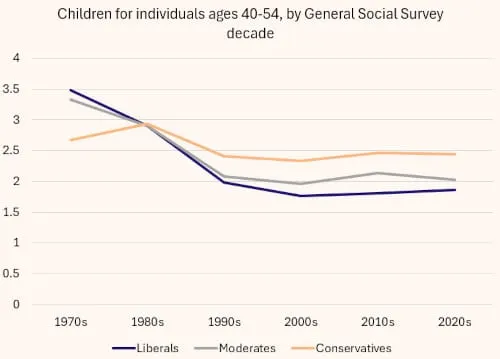
In a nutshell, women of liberal and progressive leanings had higher fertility (3.5 children among individuals between the ages of 40 and 54) than conservative women (2.6 children) in the 1970s. But that discrepancy has flipped in the last 40 years. Conservative women in the 40-to-54 age range report only a slight drop in children (to 2.5 children), whereas liberal women report a much sharper fall (to 1.9 children). This, Stone speculates, is a direct result of the latter having largely rejected the traditional family structure in recent decades.
Hmmm. So, one’s worldview has real-world consequences that manifest themselves demographically in the next generation, eh? Who knew!?
…If that’s the case, then what else are we doing today that will manifest itself demographically in future generations?
DEMOGRAPHICS ARE CIVILIZATION

Civilization and population are intertwined. A thriving civilization yields a thriving population.
…or does it? What if the causality is reversed? Perhaps a thriving population yields a thriving civilization.
This is the argument, after all, of Julian Simon, who, in making his point that The Ultimate Resource is human ingenuity, comes to the conclusion that the larger the population, the more likely it is that the next great inventor or scientist or poet or engineer or entrepreneur will be born, thus improving humanity’s lot.
But whether one believes that a thriving civilization leads to a growing population or, conversely, that a growing population leads to thriving civilization, there is one thing everyone can agree on: a shrinking population leads, at some point, to the collapse of civilization.
This should be an obvious point. Yet, since most adults on earth today have grown up during our era of neo-Malthusian fearmongering about overpopulation, they’ve never stopped to consider the dangers of underpopulation.
In their 2025 book on the declining human population, After the Spike: Population, Progress, and the Case for People, economists Dean Spears and Michael Geruso paint a vivid picture of what a world of decreasing population actually looks like and why modern civilization will become untenable below a certain population threshhold.
At some point you don’t have enough people to support modernity. Markets, factories, supply chains all require a certain minimum number of producers and consumers in order to work. A world with 1/100th of the current population would not have iPhones, Airbus jets, or Baldur’s Gate; there simply wouldn’t be enough consumers to support the production of those things. “Oh, but I don’t care about—!” Yes, well, shrink the population enough, and at some point it won’t be able to produce things you do care about, like laptop computers and publishing houses and cancer medication.
But don’t take it from me, and don’t take it from a couple of stodgy old economists, either. Take it from Elon Musk!
As the transhuman-promoting xAI overlord tweeted back in 2020:

Not to worry, though! Everyone’s favourite CIA-run venture capital firm, In-Q-Tel, has the solution!
Back in 2021, In-Q-Tel had a post about “Demography & Destiny“ on their blog, in which they argued:
Demography provides a lot of insight into the drivers and directions of technological innovation that are useful for entrepreneurs and VCs alike. Worries about ‘robots stealing our jobs’ appear to be misplaced in the long run, because as populations age and even shrink, there will be more tasks than human workers. Robots, artificial intelligence, and other technologies are key to maintaining our health, welfare, and prosperity in the face of inevitable demographic headwinds over the coming decades.
And so we arrive at the technocrats’ distinctly unsurprising, pre-determined “solution” to the demographic crisis: technocracy!
How to take care of the sick and elderly? Robot caregivers, of course!
How to replace the retiring workforce? AI, of course!
How to preserve the intricate, supply-chain-dependent, labour-intensive, consumption-based modern industrial economy as the population decline sets in: “other technologies,” of course.
This is the global Great Replacement that’s already being prepared for us by the would-be controllers of humanity. This global Great Replacment isn’t about replacing first-world populations with third-world immigrants. Rather, it’s about replacing humans with machines.
That is, at least, what In-Q-Tel and their fellow travellers are openly musing about. The only question that matters, then, is: can this demographic disaster be averted?
DEMOGRAPHICS ARE DESTINY?

As famed 19th-century French philosopher and mathematician Auguste Comte once observed: “demographics is destiny.”
(…Oh, OK, Comte definitely didn’t say that, despite all the online sources that claim he did. But it sounds better to attribute the quote to him than to Richard Scammon and Ben Wattenberg, so let’s say it was Comte!)
Despite being grammatically dubious, “demographics is destiny” is no doubt an evocative (and alliterative!) phrase. It even makes for a punchy bumper sticker slogan.
…But is it true? Are we destined to follow this path of declining fertility rates all the way to the doorstep of our demographically assured extinction?
Perhaps!
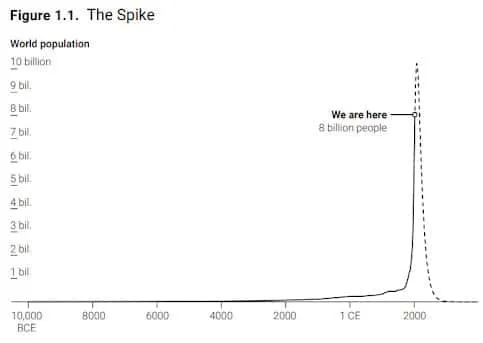
In After the Spike, Spears and Geruso argue quite convincingly that the least likely outcome of all, human population-wise, is that of humanity leveling off at some Goldilocks-like population number and magically stabilizing there. Hence the book’s eponymous “spike,” a reference to the distinct, sharp peak on the world population chart created by the industrial era explosion in human population and the subsequent population crunch created by our demographic winter.
It’s not uncommon to see trite, pat “solutions” for this demographic crisis being proffered by online punderati in the comments section of news articles or in discussions about shrinking populations in fora like Reddit. The answer is simple, they claim: governments concerned about citizens not having enough children should just raise wages and/or increase maternity and paternity leave and/or provide free daycare and/or provide greater subsidies for schooling and child-rearing, etc.
The only problem with such “solutions” is that all of these ideas have been tried. Repeatedly. In country after country and region after region all around the world. And they have never once succeeded in actually increasing birth rates.
Spears and Geruso, for instance, make the point that, since 1950, “there have been twenty-six countries among those with good enough statistics to know, where the number of births has ever fallen below 1.9 births in the average woman’s full childbearing lifetime.” Yet:
Never, in any one of those twenty-six countries, has the lifetime birth rate again risen to a level high enough to stabilize the population. Not in Canada, not in Japan, not in Scotland, not in Taiwan. Not for people born in any year. In some of these countries, governments believe they have policies to promote and support parenting. But all of them continue to have birth rates below two.
The co-authors go on to discuss the one blip on the radar that seems to actually go against this demographic rule: Romania. In Romania, the birth rate nearly doubled in one year, going from 1.9 children per woman in 1966 to 3.6 in 1967. This sharp rise was due to “Decree 770,” a directive that was personally sanctioned by Romanian dictator Nicolae Ceaușescu and that criminalized abortion and contraception. “For a few years,” Spears and Geruso write, “the abortion ban delivered the babies that the government wanted.”
But that was only a short-term effect. After immediately jumping above three for the first three years following the decree, Romania’s birth rate began falling again. Fast. By 1971, it had fallen halfway back to where it started in 1966. By the 1980s, Romania’s birth rate had fallen three-quarters of the way back to where it had started before the decree—and not because the government had backed off. In the 1980s, the Romanian government redoubled its efforts, not only banning abortions, but instituting mandatory pelvic exams for some women at work, all in service of compelling higher birth rates.
In the end, this entire scheme of brutal suppression of family planning—enforced by one of the harshest tyrannies in the world—resulted in nothing more than a tiny demographic blip. And today, Romania’s birth rate has joined the rest of Europe in a long, steady fall into sub-replacement territory.
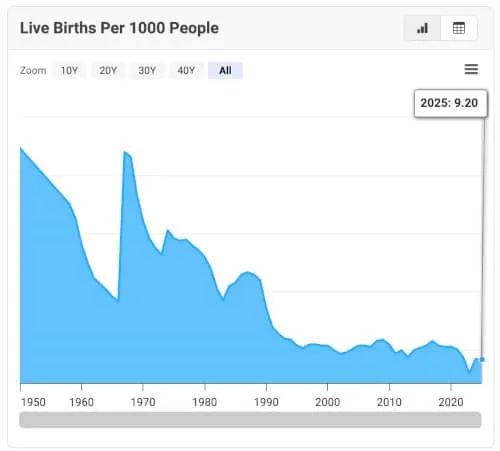
Bricker and Ibbiston’s Empty Planet uses the example of South Korea to further reinforce the point that glib “governments should do more” answers to the population crisis are not answers to the problem at all.
[In South Korea, t]here are government grants for couples seeking fertility treatments, paternity leave for fathers, and preferred admission to public child care facilities for parents with three or more children. The government in 2010 started turning off the lights in its buildings at 7:30 on the third Wednesday of every month in an effort to get workers to go home early—at least by Korea’s workaholic standards—to “help staff get dedicated to childbirth and upbringing.” But so far to no avail; there were five percent fewer births in 2015 than in the year before.
Meanwhile, the French government is taking the bold measure of…sending a letter to all 29-year-olds in the country pleading with them to have a baby before it’s too late. Good luck with that one, France!
No, the demographic crunch will not be solved by government decree.
In part, this is because the problem has a biological component. As I have highlighted in a number of reports over the years, human fertility has been under attack by the eugenics-obsessed elitists in their all-out inter-generational war against the masses. This biological warfare has included the introduction of BPA and other endocrine-disrupting chemicals and sterilizing agents into the environment in a deliberate attempt to reduce fertility.
And, as reproductive epidemiologist Shanna Swan documented in her 2021 book, Count Down: How Our Modern World Is Threatening Sperm Counts, Altering Male and Female Reproductive Development, and Imperiling the Future of the Human Race, this war seems to have been largely won by the would-be controllers of humanity:
In Western countries, sperm counts and men’s testosterone levels have declined dramatically over the last four decades, as my own research and that of others has found. Also, increasing numbers of girls are experiencing early puberty, and grown women are losing good-quality eggs at younger ages than expected; they’re also suffering more miscarriages. It’s no longer business as usual when it comes to human reproduction.
For those who are actively seeking to have children but who are finding it difficult to conceive, take heart! There are natural solutions available to counteract the ill effects of this biological assault, as Gavin Mounsey demonstrated in our Solutions Watch conversation on the topic and in the encyclopedic article he posted in conjunction with that podcast.
But here we reach the heart of this demographic quandary: what good are natural solutions to the fertility crisis if people do not want to have children in the first place?
In truth, it seems that the real basis of this population crunch has little to do with government policies and can only partly be blamed on biological warfare. As we can all attest from our own lives, more and more people today simply do not want to have children.
There are many reasons for this lack of interest in raising children. Economic stresses combined with certain lifestyle expectations (home ownership, college degrees, a stable job) do make the prospect of rearing a large brood of children less feasible in modern society. And the inward turn society has taken in recent decades—with more people spending time interacting via screens than engaging in face-to-face conversations—has, in conjunction with a general devaluing of the traditional family structure, made the long-term pair bonding necessary for raising a large family less attainable for many.
In the end, it comes down to an even more fundamental question: why have children at all?
Naturally, I wouldn’t presume to provide anyone else with an answer to such an intensely personal question. But I do think that until we start taking the answer to that question as seriously as the billionaire oligarchs do, and until we start caring about our family legacy to the same extent that they care about their family legacy, we will silently coast toward the real Great Replacement: the replacement of the human population with robots that will serve the elitists just as well (or even better) than the flesh-and-blood tax cattle on whom they have hitherto relied.