
The Dump Deception – Deep State masquerading as Populism
Tue 6:50 am +00:00, 1 Jul 2025 1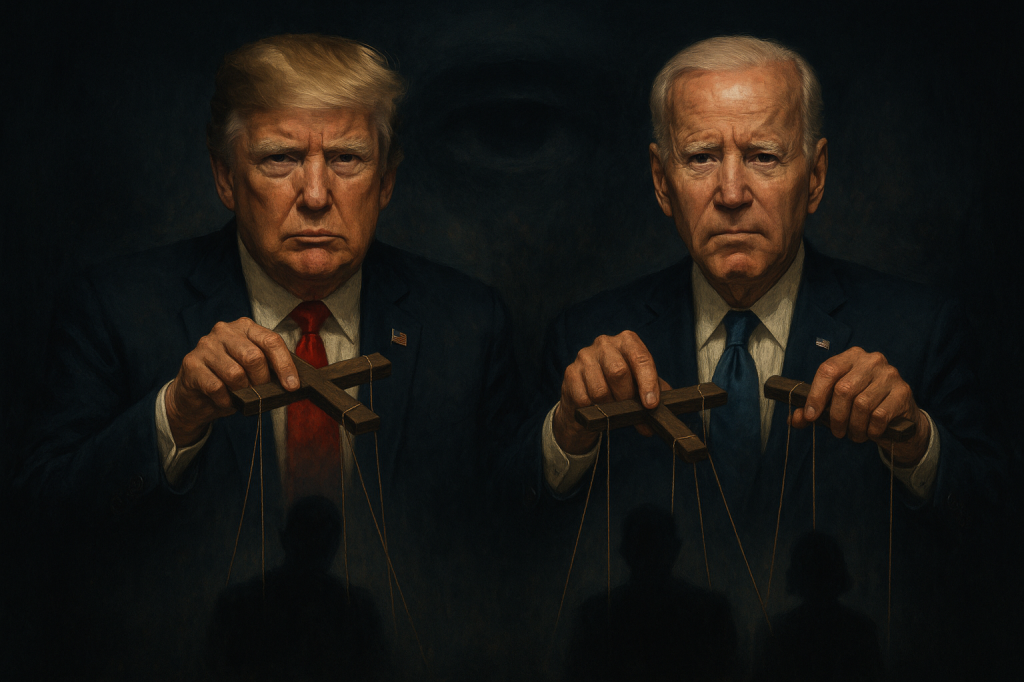
Source: https://earthlinggb.wordpress.com/2025/06/22/donald-j-trump-the-fake-president/
This post has the appearance and feel of AI to me
Certainly it’s far removed from the author’s usual personal and ranty style
Image is 180 degrees out too, shouldn’t the strings be up from Dump and Dummy’s shoulders?
I will ask the author and advise
================
Reverse Psychology and Rule by Decree: Executive Power, Manufactured Consent, and the American Illusion of Choice
1. Introduction: The Reverse Psychology Presidency
Back in 2016, I made the case that Donald Trump wasn’t the rogue savior the media spectacle made him out to be — but rather a carefully constructed populist decoy. He was sold as the anti-establishment wrecking ball, a man who would drain the swamp and restore the people’s voice. But from the very beginning, I argued that he was the swamp’s controlled demolition agent — a Trojan horse packaged for mass appeal through reverse psychology.
Think about it: the media hated him. The celebrities mocked him. The institutions “feared” him. Which, of course, is the universal sign of authenticity. After all, nothing screams ‘independent’ like being given a 24/7 spotlight by the very system you’re supposedly threatening.
That alone was enough to convince millions that Trump must be the real deal — because when all the right enemies scream in unison, surely that means you’re on the right track… right?
Wrong.
This wasn’t a grassroots insurgency. It was strategic branding, orchestrated to capture a disaffected public on the brink of total political disillusionment. Trump’s abrasive style, his outsider theatrics, his war on the press — all of it served to validate the illusion that he was fighting the very elite networks who, behind the curtain, were managing the next phase of control.
Viewed through the lens of Naomi Klein’s “shock doctrine”, Trump was not the resistance to the system. He was the reaction mechanism the system required — a man introduced at a time of crisis to justify unprecedented actions under the cover of populist chaos. The formula is simple: create or exploit a crisis, declare an emergency, and push through policies no one would otherwise accept.
Under Trump, surveillance powers expanded. Militarism was never meaningfully rolled back. Big Pharma was handed billions under Operation Warp Speed. The national debt exploded, while Wall Street feasted on the carcass of economic lockdowns. This wasn’t anti-globalism. It was the Great Reset in MAGA drag.
What we were witnessing was not the collapse of the establishment, but its metamorphosis — wearing the face of the very populist revolt that was rising to oppose it.
And many cheered it on.
2. Executive Orders: Beyond Trump, Beyond Party
Executive orders have become the invisible hand that wields real power in Washington, far beyond the theatrics of elections and political slogans. Under Trump, but also before and after him, these decrees have quietly reshaped the balance of power, often bypassing Congress and the Constitution altogether.
Take a look at the recent years: the cascade of executive orders wasn’t limited to pandemic lockdowns or border walls. Late in Trump’s term, emergency powers expanded to unprecedented levels. COVID-19 was weaponized as a speech act—a securitisation moment—declared an existential health crisis demanding war-time authority. Suddenly, the government could regulate everything from private businesses to personal health choices, under the guise of saving lives.
Then came Biden, who simply inherited this toolbox and added to it: executive orders funding endless conflict in Ukraine, laying the groundwork for digital currency infrastructure, expanding federal control over critical infrastructure, and ramping up cybersecurity powers. The emergency framing continued, whether it was climate change portrayed as a security threat or cyberattacks dubbed acts of war—each justifying a deeper consolidation of executive power.
This is the essence of securitisation theory: declare a crisis, suspend normal democratic processes, and push through sweeping policies with little debate. The emergency becomes a speech act that rewrites the rules.
But here’s where things get interesting—and troubling—in Trump’s presidency. He promised to end endless wars, to pull troops home, to reset foreign policy in America’s interest. Yet, in reality, his actions told a very different story. Take Iran, for example. Despite his rhetoric that he wouldn’t start new wars, Trump authorized bombing Iranian nuclear facilities. Even more damning is his dismissal of his own Director of National Intelligence’s assessment—Tulsi Gabbard’s DNI—who publicly stated earlier this year that Iran was not developing a nuclear warhead.
Trump said, “I don’t care what she said.” A touching moment of unity with the American tradition of ignoring intelligence when it’s inconvenient—or accurate.
That’s not just defiance—it’s a shocking rejection of the very intelligence apparatus designed to inform presidential decisions.
What we see here is a classic double game: aggressive war actions cloaked in populist peace talk, executive orders that expand militarism while rhetoric claims the opposite. The realpolitik is hidden behind a veil of staged rebellion and fake anti-war bravado.
So while Trump’s words promised peace, his deeds—and those executive orders—built a war machine that marched on.
3. The Endless Threat: Iran, Nuclear Warheads, and Manufactured Fear
For decades, Benjamin Netanyahu has warned that Iran is just weeks or months away from developing a nuclear warhead. Since 1992, this narrative has been repeated endlessly (It’s the nuclear equivalent of “Are we there yet?”—only the answer is always “Almost, just a few more weeks!”)—always imminent, always just out of reach. Yet, year after year, the feared bomb never materializes.
Sound familiar? It should. This is the exact same dynamic we see in the climate change discourse—a constantly deferred catastrophe used to keep public fear simmering and justify drastic government interventions.
Both cases illustrate a classic securitisation strategy: manufacture or sustain a looming existential threat, then declare it an emergency that demands extraordinary powers and suspensions of normal democratic processes. Whether it’s nuclear annihilation or climate collapse, these “speech acts” function to override debate and empower the executive branch through mechanisms like executive orders.
Consider Netanyahu’s push for regime change long before the 2003 invasion of Iraq. His “A Clean Break” paper argued for removing Saddam Hussein under the guise of securing regional stability—and he is saying precisely the same—“securing regional stability”—again when it comes to Iran. America and Israel (and the West more generally) are consistently taking aggressive actions against sovereign nations on the pretext that these nations pose a threat to Western democracy. They frequently cite terrorism against Western interests and highlight slogans like “Death to America” or “Death to Israel.” However, in the case of Iran, it has become clear that these expressions target the regimes themselves. But don’t worry—our media helpfully translates any nuanced geopolitical critique into cartoonish hatred of your freedoms, because nuance is for communists.
Frankly, I can’t blame them—these two regimes in particular have decimated entire nations in the Middle East for decades.
This manufactured fear operates in a continuous loop: scare the public, securitise the issue, enact emergency powers, and consolidate control—all while the actual “threat” remains perpetually just out of reach.
This is not just about Iran or climate. It’s a pattern of governance by fear, where democracy becomes the first casualty of the so-called emergency.
4. Trump’s Role in Manufacturing Consent
Let’s be clear: Trump was sold to the public as a revolutionary outsider, the ultimate anti-establishment figure. The border wall, the endless public feuds, the fiery populist rhetoric—all carefully staged theatre to give the illusion of resistance. But beneath the noise, the machinery of war marched on as usual.
Trump promised to end “endless wars,” yet the U.S. deepened its involvement in Ukraine and maintained aggressive postures in the Middle East. The Federal Reserve quietly handed out trillions in bailouts to Wall Street during his term, and his partnership with Big Pharma, exemplified by Operation Warp Speed, funneled billions into pharmaceutical corporations under the guise of pandemic response.
This wasn’t a disruption—it was a continuation of the centralized power structure dressed up in populist clothing. Like replacing your jailer’s uniform with a cowboy hat and calling it liberty.
Noam Chomsky’s concept of manufacturing consent provides a revealing lens here. Right-wing media portrayed Trump as the savior of the forgotten American, while left-wing media painted him as a cartoon villain—both narratives serving to reinforce, not challenge, the existing power hierarchy. The spectacle created two sides of the same coin, keeping the public divided, distracted, and ultimately complicit in their own governance.
The real resistance wasn’t in the tweets or the rallies; it was in the system’s ability to channel dissent into predictable, manageable outlets, preserving the status quo under the guise of upheaval.
5. Biden, Continuity, and the Post-COVID Emergency State
When Joe Biden took office, many of Trump’s executive orders remained fully intact. The toolbox of emergency powers, surveillance expansions, and expanded federal control didn’t vanish with the change in administration—they were inherited and added to. Biden signed new executive orders under the banners of climate emergency, cyber warfare, and AI safety, each framed as urgent securitisation speech acts demanding swift, extraordinary action.
This steady march towards growing centralisation—executive fiat overriding congressional oversight—is the hallmark of what some call a soft technocracy, where unelected experts and bureaucrats shape policy behind closed doors while elected officials become figureheads.
But here’s the uncomfortable truth: Biden himself showed clear signs of declining mental acuity, casting serious doubt on whether he was truly “running the country.” If not him, then who? The Easter Bunny? A rotating committee of pharmaceutical CEOs? Honestly, your guess is as good as his.
This question opens a larger, more troubling issue. It is widely acknowledged—even by many insiders—that a so-called deep state wields significant power behind the scenes. Yet the popular narrative around Trump presents him as the outsider who vanquished this entrenched bureaucracy and took full control.
How can that be? If the deep state was running Biden’s presidency, and Biden was clearly not the decision-maker, then who exactly replaced them during Trump’s term? Because the reality on the ground shows no obvious, visible dismantling of the deep state or the entrenched power structures—only a change in style and rhetoric. But he did shout at it very loudly on Truth Social, so that counts, right?
This contradiction forces us to reconsider the entire framing. Rather than Trump being the rebel hero, it’s far more likely he was—and remains—a component of the very system he purported to fight. The spectacle of division masks a continuity of power, where the deep state remains, shifting masks but never truly gone.
6. Conclusion: The False Binary of American Politics
Back in 2016, I argued that Trump wasn’t a revolution—he was a continuation of the very system he claimed to oppose. A rebranded delivery mechanism for the same authoritarian trajectory America had been on for decades. And today, nothing has changed.
The illusion that the battle is Democrat vs. Republican is exactly that—an illusion. The real axis of power lies between the executive state and the constitutional republic it has slowly cannibalised. Presidents come and go. Parties bicker and posture. But the machinery of control remains untouched: emergency declarations, executive orders, unelected agencies, and global corporate interests that operate far above the ballot box. Think of it as changing the wallpaper on a prison cell and calling it a renovation.
This isn’t governance. It’s managed perception. And the people have been conditioned—through fear, repetition, and carefully choreographed crises—to accept it.
Trump may have played the role of rebel, Biden the doddering caretaker. But in the end, both served the same agenda: expand state power under the guise of protecting democracy, while hollowing it out from within.
If there’s any hope of reclaiming true sovereignty, it begins with deprogramming ourselves from shock-induced obedience. The emergencies will never stop. There’s always another variant, another villain, another vote to “protect.” Crisis is the product, and you’re the consumer.
The fear will always be renewed. But the first step is seeing through the binary—and recognising that the system itself is the problem.










Earthlings reply to my questions about AI
You can see the whole conversation in the comments at the Source link
“Hi Pete,
Yes I remember. I actually thought you were still commenting up until recently from time to time.
As for this blogpost, you may have noticed that since from around 2023, I’ve been interacting with ChatGPT: Questioning and challenging it while also asking it to critique some of my older posts. During that time, I’ve found it helpful in some ways and bloody useless in others.
Helpful: You can use it as a foil to challenge your ideas and assertions due to its tendency to adopt a mainstream view of the world while, through further debate, you can break down that view and it then recognises – through logic – that ‘not everything appears quite what it seems’. It can reason with you to then arrive at a destination which is entirely different from its starting point. That also helps you to crystallise your thoughts better and more concisely.
It also can support you to edit and format your work but don’t ask it to actually write anything because, while it can reason with you, it doesn’t have ‘insight’ like a human so it cannot write anything which is outside of its ‘knowledge sphere’ and will simply regurgitate that (garbage in: garbage out) unless you painstakingly guide it (through the reasoning arguments again).
Useless: Insight. It has zero.
However, while I’ve written the blog for all these years in my ‘ranty way’, as you put it (and yes, that’s the right way of putting it), I’ve done so for the a couple of purposes: To stimulate a ‘living document’ through comments etc (although the blog is now seeing far less traffic than it used to) and because, from a conversational perspective, that’s how I wanted it to sound (and still will in the main).
Recently, however – over the past few months – I’ve been attempting to write a book which looks like it will take at least another 6 months to complete at my current rate (if I complete it at all). The book can’t be ranty and conversational so I’ve adopted a far more structured and ‘professional’ approach and, at the moment, I’m using ChatGPT to format and edit and that’s essentially what you’re seeing in this post. I’m trying it out here. It’s a little concerning that you read it and think it’s AI generated, however. Is it the structuring and just a lack of the ‘rantiness’ of it?
As for the pic. Yes I realised it would give that impression but what I was more trying to say in this specific instance was that the policies remained the same no matter which President was ‘running’ the show. So the ‘puppet strings’ are manoeuvring policy rather than people in this instance.2
“