
Living in China – The reality behind the myths, the lies and the distortions
Mon 1:24 pm +00:00, 28 Apr 2025
Source: https://www.unz.com/article/living-in-china/
Long article
I posted the start below, see link above for the full Monty
================
When you hear the name of the country “China”, what is your immediate reaction?
It’s an authoritarian, aggressive state that oppresses its citizens, perhaps.
If so, you are responding with a knee-jerk, ill-informed reaction, not really your fault, it’s the diet you have been fed, and the purpose of this article is first to try to persuade you to think otherwise, and then to describe what life is really like, from someone who actually lives there, experiencing it on a daily basis.
Well, where to begin?
Let’s start then with that (1) undemocratic state which (2) oppresses its citizens with its “social credit scores”, and is (3) an aggressive threat on the world stage.

Chinese democracy
I have to laugh when British people accuse China of being undemocratic. The UK has an unelected head of state (a king), an unelected upper chamber, and in the recent past had as prime minister an MP elected to the post by nobody (he was unopposed), and a foreign secretary a “lord” who wasn’t even elected as an MP at all. In recent years it has had a string of leaders each worse than the last, one of whom was forced to resign after 45 days having precipitated a financial crisis. The electoral system enabled the present ruling party to win a landslide with one vote from every five electors, so the vast majority of voters are completely unrepresented: clearly it has no democratic mandate whatsoever. The two major parties are like Tweedledum and Tweedledee, so the idea that there is some choice is pure fantasy. This, then is the benchmark against which I study the Chinese system.
How to organize a democracy in a population of 1.4 billion, some 20 times that of the UK? China does it by arranging successive layers of government, each one more or less selected by the layer below. I had a rough idea of how it works, but I asked Deepseek to give me a summary of how representation works in practice:
China’s Five Layers of Elected Representation
1. The National People’s Congress (NPC)
The highest tier: about 3,000 delegates elected by lower-level bodies, it meets annually to ratify laws/policies.
2. Provincial/Municipal People’s Congresses
Delegates are elected by city/county-level congresses.
3. City/County-Level people’s congresses’ delegates are nominally elected by township-level congresses or public votes.
4. Township/Town-Level People’s Congresses
Direct public elections take place.
5. Village Committees (Rural) / Neighborhood Committees (Urban)
They oversee local affairs. Village elections allow public voting too.
Key Notes on elections in China
No multiparty competition: all candidates are approved by the Communist Party of China (CPC) or its united front organisations. Indirect hierarchy: lower bodies elect higher ones, but the Party controls nominations at every level.
Symbolic vs. real power: The NPC and local congresses primarily endorse decisions made by the party’s Politburo Standing Committee (the PSC, China’s true ruling body).
Now it is becoming clearer. So I asked: how is the PSC chosen?
Deepseek started to reply and then abruptly stopped and asked me to turn to something else. So I had to use Firefox and Firefox referred me to the BBC. The PSC currently has seven members: Li Qiang, Zhao Leji, Wang Huning, Cai Qi, Ding Xuexiang, Li Xi, and Xi Jinping himself. All except Xi in their sixties.
And how is the PSC chosen? From the Politburo which consists of 24 members.
And how the Politburo is chosen is something of a mystery. So now we arrive at the heart of the matter: all power truly rests within the Party. Not very democratic: but this no different at all from the way affairs are run in the UK where:
1 The parties choose their candidates
2 The parties choose their leader
3 In the electorally successful party the leader becomes prime minister
4 The prime minister chooses his cabinet of ministers.
Same as China inasmuch as the public has no say in any of these matters.
Yet in the UK, at least they can change the party, you will say? Well, welcome to the new boss, same as the old boss. You are just evicting one set of snouts from the trough and letting in another, as Paul Foot once remarked. But finally it has to be said when considering their performances in recent decades that China’s governance demonstrably works, and the UK’s clearly doesn’t.
The CPC, it seems to me, is simply a continuation of the ancient dynastic self renewal system. It will govern while it has the “Mandate of Heaven”, a many thousand year old concept which signifies that the population is content (which it is), and it will cease when it loses their confidence. Democracy works pretty well at the local level, you can go to the local community office in China and try to sort out local issues, but, well like the UK and probably the rest of the world, the further up the chain you go it the murkier it gets. So in that respect I would say that Chinese democracy is in effect much the same as in the “democratic” world, no better, no worse.
Is Xi president for life? Not necessarily. Term limits were removed enabling him to take a third period (just what Trump is working up to, and FD Roosevelt had four).
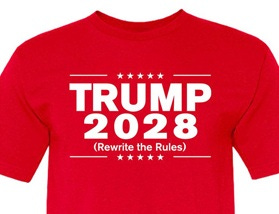
Xi will have to ask for approval for a fourth. If he’s still the best choice, why not?
PS on this topic. A remarkably stupid current posting on The Unz Review prompts me to explain that China is Communist in name only. The private sector is huge: half of GDP, 80% of urban workers, and 70% of industrial output. Communist, China is no longer. Socialism, yes. With Chinese characteristics!
Social credit scores
I don’t have a social credit score in China. That is because they do not exist. Creditworthiness scores no different from those in the west do exist. They are run by Sesame Credit, which is is part of Jack Ma’s online-shopping empire Alibaba. Sesame determines a credit-score ranking — from 350 to a theoretical 950 — dependent on “a thousand variables across five data sets,” according to the firm. I presume I don’t have one of those either because I have never bought here on credit.
As for the purported social credit score, Wikipedia can answer to that.
There has been a widespread misconception that China operates a nationwide and unitary social credit “score” based on individuals’ behavior, leading to punishments if the score is too low. Media reports in the West have sometimes exaggerated or inaccurately described this concept. In 2019, the central government voiced dissatisfaction with pilot cities experimenting with social credit scores. It issued guidelines clarifying that citizens could not be punished for having low scores and that punishments should only be limited to legally defined crimes and civil infractions. As a result, pilot cities either discontinued their point-based systems or restricted them to voluntary participation with no major consequences for having low scores. According to a February 2022 report by the Mercator Institute for China Studies, a social credit “score” is a myth as there is “no score that dictates citizen’s place in society”.
https://en.wikipedia.org/wiki/Social_Credit_System
Chinese aggression
China is constantly being accused by western nations – well let’s narrow it down a bit and say NATO (responsible for 80% of world military expenditure) – of being aggressive. That strikes me as a typical example of projection. Let’s consider some facts.
First we should note that China has been subjected to invasion and rule many times during the past thousand years: the Mongols (Yuan dynasty). Manchurians (Qing dynasty), a whole cavalcade of western nations in the 19th century and Japan in the 20th.
How about the reverse? Wikipedia has a useful page on the subject listing incursions since the accession of the CPC in 1949, so that’s what is relevant to the present argument. There are just two true invasions.
1950, China annexed Tibet. It considered it to be a lost province of China.
1979, in the Sino-Vietnamese war, China launched a brief offensive ostensibly in response to Vietnam’s invasion and occupation of Cambodia in 1978.
China also fought for North Korea, Burma and Vietnam against foreign aggressors. I just marched against the Vietnam war in London in 1968, suffering no injuries. The UK police then did not assault demonstrators.
All the rest are simply border arguments, not invasions, right up to the absurd current water pistol fight with the Philippines in the South China Sea, which the USA is determined to push into a serious confrontation. What gets little publicity is that the China/Philippine dispute is just one in a complex situation there involving six other nations too, but China gets all the condemnation.
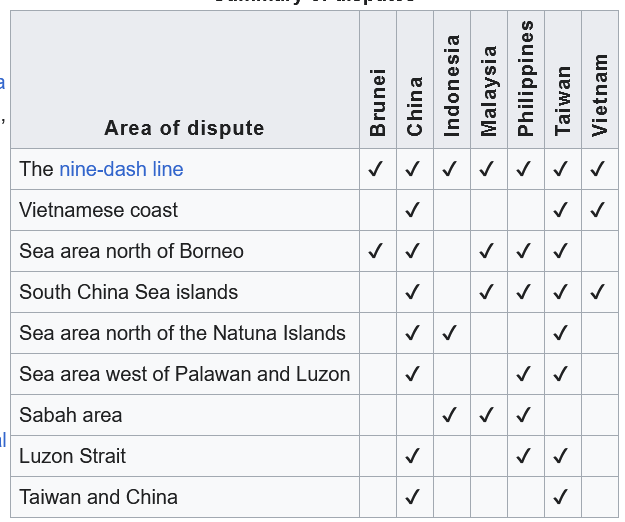
My own opinion is that that Chinese claim is a bit ambitious being a thousand or so kilometres off its southern land border, but it does then raise the question of the USA’s claim to Guam which is 9,800 kilometres from Los Angeles.
So what countries’ populations in the immediate region hold low opinions of China as a result of its “aggression”? Here are percentage opinions from Pew, those to the left.
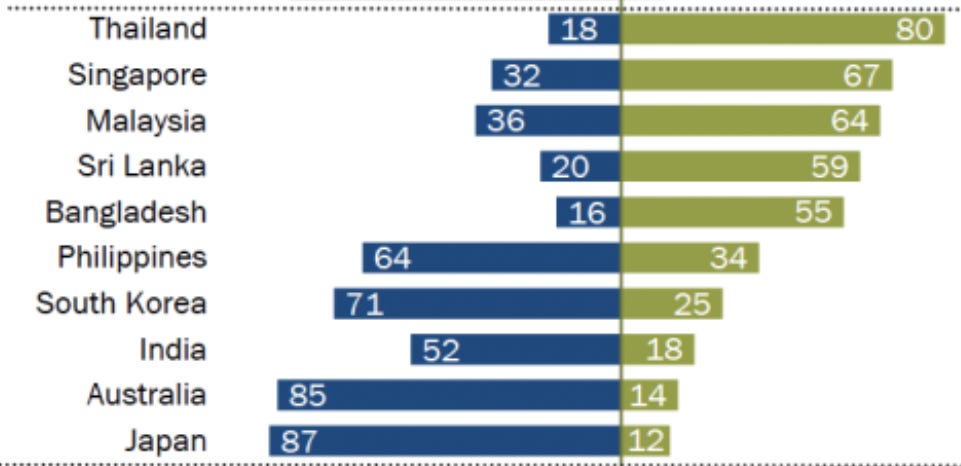
The bottom five, all below 50% approval, are all in the western orbit. Undoubtedly, they all have predominantly Sinophobic media. I have experience only of the Philippines, which has four main national dailies, of which one, Rappler, has received substantial funding from the CIA via NED. They all libel China every day. It’s a miracle that 34% have withstood the propaganda, this would be the Duterte faction (of which I am one). If Sara gets the presidency in 2028, hopefully things will change.
So I don’t think that the claim that China is aggressive holds water. It’s basically a peace loving nation which seeks win-win agreement in its foreign policy, and is very actively pursuing it worldwide. If you want a truly aggressive nation, how about this one, which has been at war for almost its entire life?
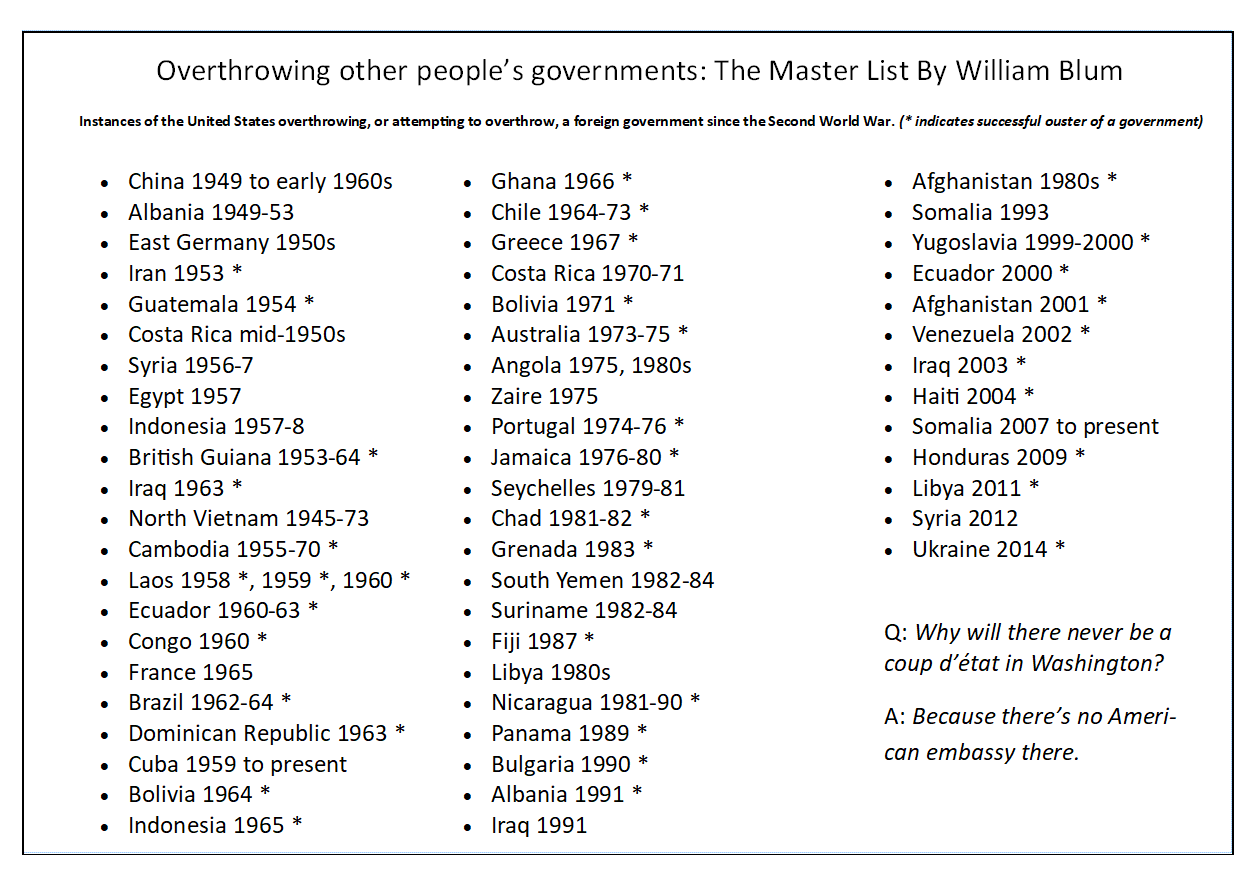
Blum has died but that interference by the US has continued since 2014. Here is a list of countries whose governments China has attempted to overthrow in the same period.
Now let’s take the next bit a step at a time as if unaware, it may come as a shock to you. First, how many military bases does China have off the US west coast, its Atlantic coast, or the Gulf of Mexico?
The answer, as I am sure you know, is none.
And how many does the USA have off the coast of China? Take a look.
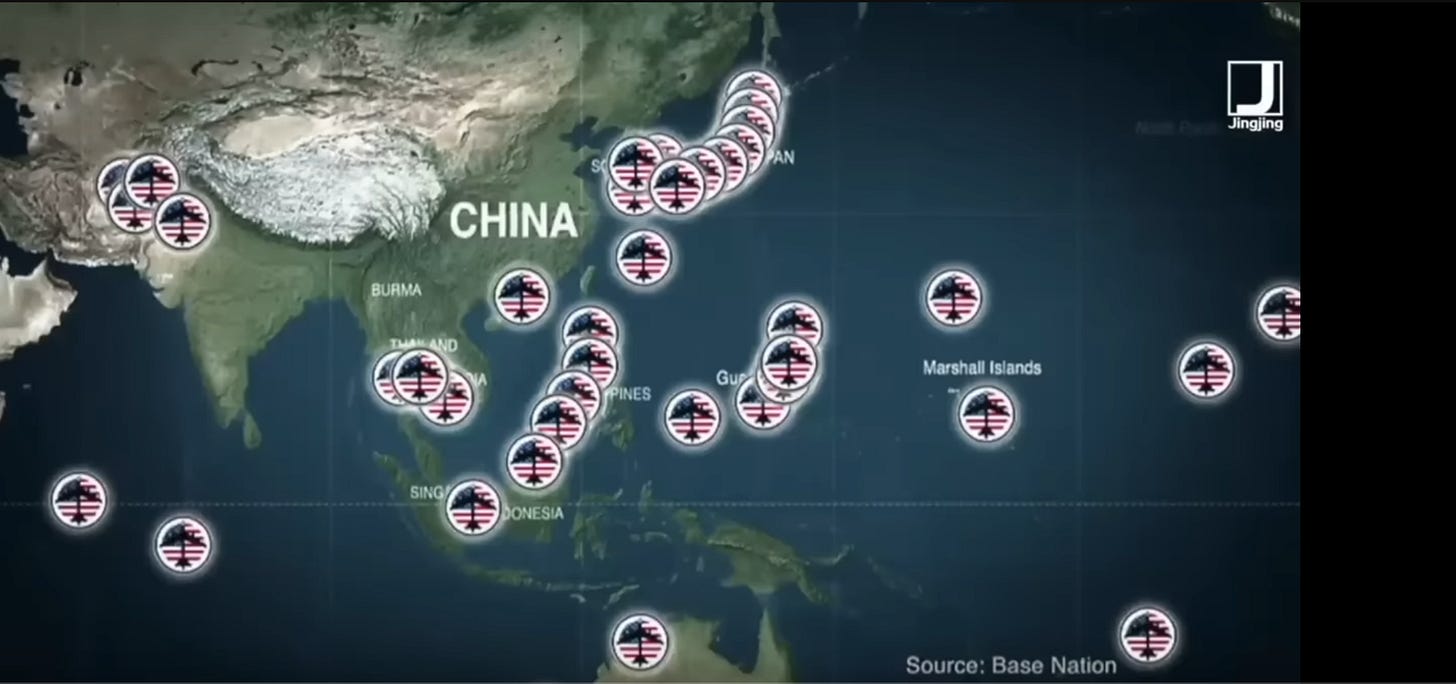
Add another four newly going into the Philippines, three in the north at the closest approach to Taiwan, and one on the western island of Palawan, to interfere in the Philippines dispute with China.
So how many military bases does China have outside its boundaries?
As far as I can determine it has one, at Djibouti, on the African coast at the southern entrance to the Red Sea.
And how many external military bases does the USA operate worldwide?
Estimates vary between 750 and 800. Paid for, of course, by the poor US taxpayers.
I don’t think we need say any more about “aggressive” China.
Now that we have dealt with those three main perennial false accusations we can move on to other lesser matters of disinformation.