
5G, Data Centers, and the 6G Panopticon
Thu 10:23 am +00:00, 19 Nov 2026The Great 5G Illusion
When mobile users saw that “5G” icon appear in 2019–2020, they weren’t experiencing a new generation of wireless tech—they were riding on an upgraded 4G backbone.


Why the 2019–2020 5G Rollout Was Actually a “4G++” Upgrade
When telecommunication companies started advertising “5G” to the world around 2019 and 2020, consumers were promised lightning-fast speeds and a revolutionary new digital era. However, beneath the marketing terminology, the technology deployed during those first years was technically a hybrid—closer to an advanced version of 4G (4G++) than a true, ground-up 5G network.
To understand why this happened, we need to look at how mobile standards are created by 3GPP, the specific timeline of network “Releases,” and how the technology was rolled out.
1. What Are 3GPP and the 3GPP Releases?
Before diving into network architecture, it helps to understand the governing body:
- 3GPP (3rd Generation Partnership Project): The global standardization organization where engineers, tech giants, and mobile operators meet to agree on universal mobile rules so that devices work across borders.
- Releases: 3GPP bundles new features, radio specs, and core network designs into major versions called Releases.
- Release 15 was the milestone generation that officially introduced 5G specifications to the world. Crucially, it was frozen in phases: the non-standalone (NSA) radio specs were completed first (frozen in late 2017 / early 2018), while the final specifications required for a fully independent, standalone 5G core network took longer to stabilize.
- Release 16 (frozen in July 2020) and Release 17 further expanded true 5G capabilities, adding industrial reliability, ultra-low latency, and advanced Standalone (SA) functionalities.
Because operators wanted to market “5G” immediately, they rushed out implementations based on early Release 15 milestones long before Release 16 fully solidified the ecosystem for independent core operations.

2. The Architectural Reality: 5G NSA vs. 5G SA Schematics
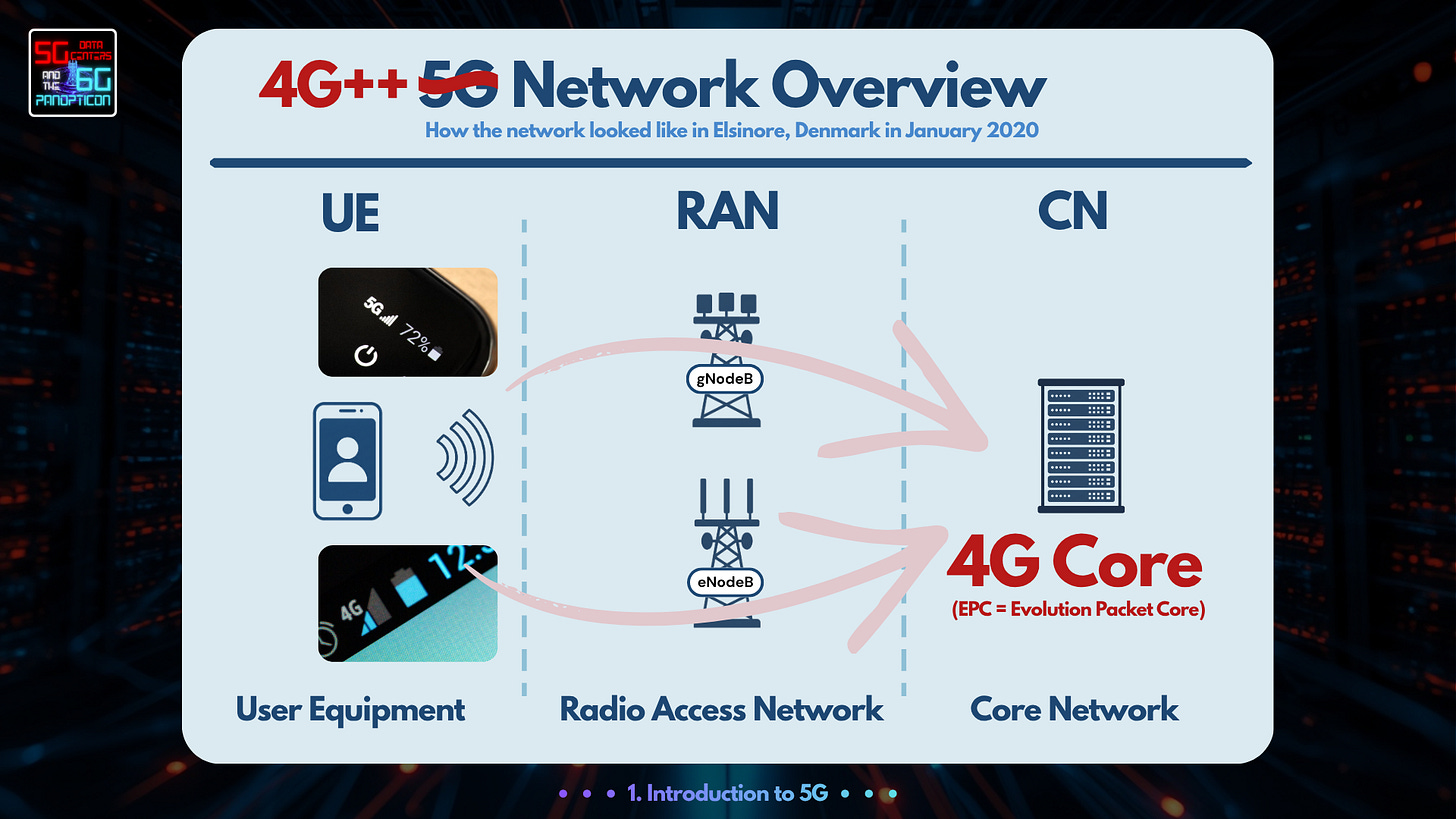
To understand why early rollouts were essentially 4G++, we look at the components: eNodeB (4G base stations), gNodeB (5G base stations), the 4G Core (EPC), and the 5G Core.
Section A: The 2019–2020 Hybrid Model — 5G NSA (”4G++”)
- Node Breakdown:
- eNodeB (Evolved Node B): The 4G base station acting as the master node, keeping the connection anchored to the legacy system and handling control signals.
- gNodeB (Next Generation Node B): The 5G base station acting as a secondary node, providing high-speed data pipes in the air via 5G NR (New Radio).
- The 4G Core (EPC): The legacy packet core processing all user data. Because the actual “brain” and control intelligence remained anchored in 4G infrastructure, the system functioned fundamentally as a 4G++ evolution.

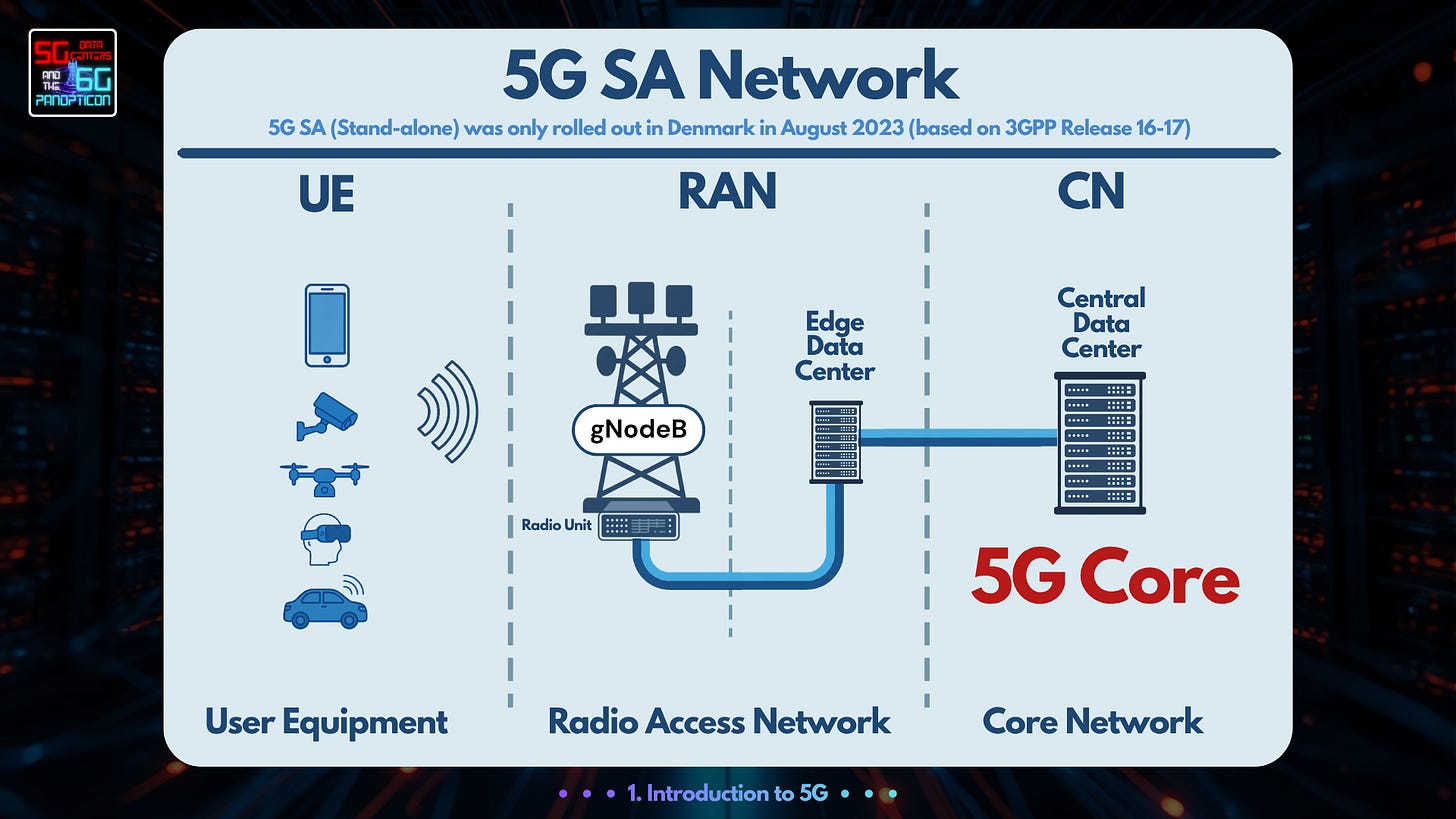
Section B: The True Target Architecture — 5G SA (Standalone)
5G SA stands for 5G ‘Standalone’, which means that it is no longer dependent on the 4G network (4G Core/EPC).
5G SA was in reality only rolled out in 2022/2023. Earlier rollouts (e.g. US, China and Korea) were very limited applications making 5G an unruggetized platform until 3GPP Release 15 and 16 were ‘frozen’. When 3GPP no longer make improvements to a certain release it is entered into state ‘frozen’ and the telecom infrastructure manufacturers can begin to sell equipment based on the frozen releases.
- Node Breakdown:
- gNodeB (Next Generation Node B): Operates completely independently as the sole radio access node, requiring no 4G anchor base station.
- The 5G Core: A completely redesigned, cloud-native core network introduced and matured across 3GPP Release 15 and Release 16 specifications.

Summary on the 4G++ Scam
When you used early “5G” between 2019 and 2020, you were utilizing 5G NR radios (gNodeB) strapped onto an eNodeB and 4G Core (EPC) using early Release 15 frameworks. Because the core engine running the network was still 4G, calling it a “4G++” upgrade accurately describes how the telecommunications industry bridged the gap before later 3GPP releases fully enabled true Standalone architecture.
It was not until 2022 that the telecom operators could roll out a reliant 5G standalone network. Below you can see a schematic showing the main difference from 4G to 5G:

Just as in most other countries, 5G was rolled out in Denmark based on deception. It has all the hallmarks of a conspiracy—but how did it actually happen?
But why the ‘conspiracy’?
Why would telecom vendors (like Ericsson and Huawei), telecom operators (like T-Mobile and Vodafone) and regulatory bodies (like 3GPP) and policy makers (governments around the world) agree to such a ‘conspiracy’?
The answer is foremost ‘money’ and secondarily that they all function in symbiose with each other (through the money)! Everything in modern societies in the 2020s is based on money and the promise of a future income on an investment.
These different entities (vendors, operator and official bodies) did not exactly understand the ‘conspiracy’ or that they were participating in it. They just did what everybody else did, namely talk about 5G as if it was the answer to everything from poor internet connections to climate change problems.
Telecom Vendors
From a telecom vendor perspective it is all about market share. Making money on investments is less important than the promise of making money in the future in a fastpaced industry that telecommunicaitons is.
Telecom Vendors, like Huawei, Ericsson and Nokia, is always focused on their roadmap and on being first to market (foremost to achieve new market shares). This allows them to look like a promising company that will produce a lot of revenue (in the future) and attract investments.
They will marketing their products as being edgecutting new ‘killer applications’ to make the telecom operators buy their technology, and the general public (seemingly) crave for the new functionality.
So for Telecom Vendors to brand the new 4G++ Phased-Arrays antennas as ‘5G’ would definitely not be the first time they play around with their naming of the technology.

Mobile Network Operators (MNOs)
For telecom operators (MNOs), money, money, and more money is the only game they play. Let’s look at Denmark as an example.
The biggest telecommunications company and infrastructure group in Denmark is TDC Group (historically Tele Danmark Communications), which has been split into two primary entities:
- TDC NET A/S: Owns and manages the physical infrastructure (the mobile network antennas, 4G/5G masts, and the nationwide copper/coax/fiber networks).
- Nuuday A/S (TDC Brands): Manages all consumer-facing services and brands—including YouSee (Denmark’s largest internet and TV provider), Telmore, and Hiper.
Who Owns TDC?
When looking at who holds the controlling share and ultimate decision-making power over Denmark’s primary telecom infrastructure (TDC Group/TDC NET), the picture shifted fundamentally with a major ownership buyout in 2025:
The Controlling Stake: Macquarie Asset Management
- Sole Control / Majority Ownership: Macquarie Asset Management (an Australian global infrastructure and investment giant) moved to take 100% full ownership of the TDC Group.
- The Transition: While TDC was originally bought out and delisted in 2018 through a joint 50/50 partnership between Macquarie and the Danish pension funds (ATP, PFA, and PKA), Macquarie reached an agreement to acquire the remaining 50% stake from the Danish pension funds.
- Implication: This transition placed complete managerial and financial control of Denmark’s foundational digital and mobile infrastructure directly in the hands of an international private equity-backed asset manager, ending the era of joint domestic pension fund stewardship.
Macquarie – The Vampire Kangaroo

From a telecom market analytical perspective, Macquarie’s full takeover of Denmark’s foundational infrastructure provider TDC mirrors its controversial playbook in other regulated utilities, such as Thames Water. Known critically in the UK media as the “vampire kangaroo” due to aggressive financial engineering, debt-loading, and heavy dividend extraction, the Australian asset manager introduces significant financial and systemic risks to critical digital infrastructure. (see link and link)
Telecom analysts and political stakeholders point out that shifting control from domestic pension funds to a private equity-backed global giant prioritizes short-term capitalization and highly leveraged corporate structures over the long-term, secure roll-out of high-capacity 5G and fiber networks demanded by society.
Macquarie Group – A typical owner of telecom infrastructure
Operating at the absolute ethical and legal fringe, Macquarie Group systematically exploits aggressive tax avoidance, debt-loading, and financial engineering to extract wealth from essential public infrastructure at the expense of long-term stability and public trust.
This is part of a widespread global pattern where private equity and infrastructure funds systematically buy up critical public assets to extract wealth through heavy debt-loading and aggressive financial engineering, repeating across the telecommunications and utility sectors worldwide.
Regulatory Bodies and Policy Makers
While telecom operators focus on extracting maximum profit, governments and regulatory bodies play a vital role by greenlighting the rollout and providing the official stamp of approval. Under the guise of public progress and national digital strategy, these policymakers systematically downplay safety concerns and ignore independent warnings regarding 5G deployment.
Official regulatory bodies—far from protecting the public—often function more as rubber-stamping mechanisms for corporate interests, aligning seamlessly with industry-backed standards bodies like the 3GPP. By rigidly enforcing state-sanctioned emission limits that ignore biological reality, they create the illusion of strict oversight while effectively safeguarding the multi-billion-dollar telecom rollout from public pushback.
If this isn’t a conspiracy, it’s the most coordinated corporate blueprint in modern history.
Misleading the public with disguised 4G++ and stealth 5G antennas is merely the tip of the iceberg in a gargantuan conspiracy to herd the population toward a 6G Panopticon.
And believe it or not, it gets much worse. Stay tuned.
About the author, Flemming Blicher
Revisionist writer. Former engineer in telecommunications, former management consulting professional. MBA from UCD Dublin. Publisher of The Danish Illusion/Economic Fiction podcast. “Freedom, freedom and freedom – That’s… what it’s all about!”