
Yuval Harari – a nearly perfect embodiment of evil. I recommend you study his face, since you can tell it just by looking at him
Wed 9:36 am +00:00, 4 Nov 2026 2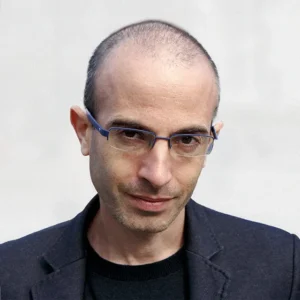
Source, page 4 here: https://mileswmathis.com/how.pdf
Images at the above link
He is the wildly obnoxious Israeli history professor being used since the start of Covid as a
spokesperson for the WEF, being, like Klaus Schwab, a nearly perfect embodiment of evil. I
recommend you study his face, since you can tell it just by looking at him. You can also judge him
straight from the title of his book: Homo Deus. Man as God. The definition of blasphemy as he is the
walking definition of hubris.
“Humankind is on the verge of the greatest revolution ever. The combination of
machine learning and biotechnology will give humankind the ability to start
engineering new life forms such as cyborgs, super-humans and AI. The main
products of the future economy will not be food, textiles and vehicles, but rather
bodies, brains and minds. This will be not just the greatest revolution in history, but
the greatest revolution in biology since the appearance of life on earth. For four
billion years life was governed by the laws of natural selection, and life was confned
to the organic realm. During all these eons, whether you were a virus or a dinosaur,
you evolved according the principles of natural selection and you were made of
organic compounds. In the coming century, however, science is likely to usher the
era of inorganic life shaped by intelligent design.”
Notice he doesn’t even capitalize “Earth”. Telling us how much he loves and values her. The only
thing being ushered in there is Mordor, and these guys are competing for the role of Sauron. Man’s
ability to engineer life is almost zero, as any real biologist or chemist will tell you. The animal cell is
wondrous and complex beyond all human comprehension. We aren’t within ten thousand years of even
beginning to understand it, much less to better it. So Harari’s claim that AI is a “revolution in biology”
is the stupidest thing ever said. AI isn’t even a shadow of biology, being just one step up from a light
switch. AI isn’t even a stick figure next to a Michelangelo sculpture, in comparison to biology. Man
cannot create even an amoeba or an enzyme, much less a cat or a human. Though we can certainly
destroy one. Which is the real danger here, the real probable outcome: mass death.
It reminds me of that scene in the fourth Alien movie, where Ripley finds the abandoned lab with
human chimeras floating in big vats of formaldehyde. I suggest you go watch that and experience the
horror of it if you are prone to believe any of this boosterism from Harari and his ilk. Man cannot
better God or Nature, but he can surely corrupt her, as we know from experience.
Therefore you should also beware anyone who ever gets near this guy or the WEF, including people
like Russell Brand and Leo DiCaprio.
That’s all you need to know regarding Russell Brand. I wouldn’t knowingly get within a hundred yards
of Harari without a silver crucifix or a clove of garlic.
That’s Will.I.am, Yao Chen, and Olafur Eliasson with Klaus Schwab, just so you know.
Also Larry Wilmore:
Here he is with another slimeball futurist, Rutger Bregman, whom I have hit before.
Bregman’s face gives him away again, doesn’t it?
And then there’s this:
That’s from their joint talk at Westminster in 2018, where they discuss his nauseating book 21 Lessons
for the 21st Century. So now you know who Natalie Portman really is. She is fawning over him there
like Julia Roberts fawned over Fauci during Covid. She was cute at age 13 in Beautiful Girls, but it has
been all downhill for her since then.
What I noticed on a search is how few people actually have appeared in pictures with Harari. Almost
no one wants to be photographed with this guy, we know why. Or maybe they were worried he
wouldn’t appear in pictures









The eyes really do say it all, and reflect an insight to the man’s soul.
I posed the question to GPT and the following is its response.
Rebuttal: Technology is not the same as the creation of life
The claim that humankind is on the verge of the greatest revolution in biology is based largely on speculation about what science and technology might achieve. Machine learning and biotechnology are undoubtedly advancing, but the ability to manipulate biological processes does not mean that humanity has acquired the ability to create life itself, nor does it establish that an era of inorganic life is inevitable.
There are several fundamental weaknesses in this argument.
1. Manipulating life is not the same as creating life.
Scientists can modify genes, alter cells, engineer microorganisms and develop sophisticated prosthetics. Artificial intelligence can analyse information, recognise patterns and perform increasingly complex tasks. However, none of these achievements demonstrates that humanity understands, let alone controls, every process necessary for the origin and existence of life.
Changing an existing biological organism is fundamentally different from creating life from non-living matter.
2. Artificial intelligence is not biological life.
The passage places AI alongside cyborgs and super-humans as though they are all examples of a new form of life. This confuses very different things.
AI is an artificial system that processes information. It may imitate aspects of human reasoning, language and decision-making, but that does not establish that it possesses biological life, consciousness, self-awareness or an independent existence.
Greater computational ability does not automatically produce life or consciousness.
3. Natural selection has not been superseded.
The assertion that life will move beyond the laws of natural selection is misleading. Even organisms whose genetic material has been deliberately modified remain subject to biological processes, including reproduction, mutation, inheritance and environmental pressures.
Human intervention may influence the direction of biological change, but it does not abolish the underlying principles governing life.
Indeed, the organisms produced through genetic engineering would still exist within the biological framework that has governed life throughout its history.
4. Intelligent design is not necessarily the same as creating something from nothing.
The passage uses the expression “intelligent design” to describe a future in which humanity engineers new forms of existence. But designing or modifying an existing system does not demonstrate the ability to create the fundamental principles upon which that system depends.
An engineer can construct a machine, but that does not mean the engineer created the laws of physics, the materials or the fundamental properties that make the machine possible.
Likewise, manipulating biological material does not make humanity the originator of life.
5. Predictions about the future are not scientific certainties.
The passage repeatedly uses expressions such as “likely to usher in” and “the coming century”. These are predictions, not established scientific facts.
There is a considerable difference between what science can demonstrate today and what someone imagines science might accomplish in the future. Technological advancement does not guarantee that every proposed development will become possible, desirable or ethically acceptable.
6. The passage overlooks the question of responsibility.
Even if humanity develops the ability to engineer increasingly sophisticated biological organisms, that raises questions of responsibility, morality and consequences.
The ability to do something does not establish that it should be done. Nor does technological power establish wisdom.
A more fundamental objection
There is an even deeper assumption underlying the passage: that because humanity may eventually acquire the ability to manipulate life, humanity will somehow become independent of the principles and conditions that make life possible.
That conclusion does not follow.
Human beings remain biological organisms. We depend upon the natural world, the conditions that sustain life and processes that we did not invent. Our increasing knowledge may give us greater influence over those processes, but influence should not be confused with ultimate authority.
The central weakness of the argument is that it confuses the ability to manipulate life with the ability to originate life.
Humanity may become increasingly capable of engineering biological systems, but that does not make humanity the creator of life, nor does it prove that organic life is about to be replaced by inorganic life.
A biblical perspective
There is also a distinction worth considering from a biblical standpoint.
Genesis 1:11–12 describes the earth bringing forth vegetation, and Genesis 1:20–25 describes the creation of living creatures. Genesis 2:7 then describes God forming man from the dust of the ground and giving him the breath of life.
The biblical account distinguishes between the material from which something is formed and the life that it possesses.
Similarly, Psalm 36:9 declares:
“For with thee is the fountain of life: in thy light shall we see light.”
And Acts 17:25 states that God gives to all life, and breath, and all things.
From this perspective, humanity’s ability to modify the material components of life does not make humanity the source of life itself.
Scientific progress may increase mankind’s knowledge and power, but it does not establish that mankind has become the author of life.
Yes the eyes are a massive tell Gordon, even via a photograph. Real world flesh and blood is even more telling usually of course. I wouldn’t want to be in the presence of that man. Seems not many others do either
I’m always fascinated by how I can look at a persons eyes and face and read far more about them than the mere surface, I just know somehow. Instinct, intuition, energy field interactions, or something else? I can’t say how or why, but I just know. It rarely fails me either
The covid era was instructive too in this respect. I never wore a mask, being “exempt” by their own definition. So when out shopping or suchlike I saw a sea of faces covered and could ONLY see their eyes. Made no difference, the eyes told me. The menace coming from some of them was breathtaking. I just smiled sweetly and stared back. Not one had the character to explain their enmity to me. I assumed that it was my lack of a mask, but nobody ever said that. I found it funny, a clear demonstration of the power of the mind conditioning that had taken place