
Iran: war to the death – the final clash between Empire and the rest of humanity
Tue 4:14 pm +00:00, 14 Apr 2026
Source: https://alexkrainer.substack.com/p/iran-war-to-the-death
In yesterday’s interview with the retired Colonel Lawrence Wilkerson, professor Glenn Diesen underscored the Mackinderian aspect of today’s Middle Eastern geopolitics (reference to one of the founding fathers of British geopolitics, Halford Mackinder).
Targeting China’s Belt and Road infrastructure
Col. Wilkerson, who previously served as the Chief of Staff to the U.S. State Secretary Colin Powell, agreed and stated the following about one of the priority targets of the U.S. – Israeli bombing campaign (abridged):
[16-min. mark] “We’re bombing the hell out of that railroad that China had finished, all the way to the Persian Gulf, and was going to come up to the belly of the Caucasus… They’re bombing it. They’re bombing the bejeezus out of it. Every day they’re bombing that railroad. … That’s because they know where that railroad is going.And that railroad … will take 60% of the commerce that China now generates, which is probably about 40% of the world’s commerce, off the seas, where America has domain, if you will – or thinks it still does – and put it on land. We don’t want that. We don’t want that at all…”
The railroad Wilkerson was referring to is the China-Iran Railway, also known as the China-Iran rail corridor or the Xi’an–Tehran rail link, part of China’s Belt and Road Initiative). The railroad was built by China as the key overland freight corridor (roughly 10,400 km / 6,500 miles total from Xi’an in China to the Aprin dry port near Tehran) funded and heavily supported by China.
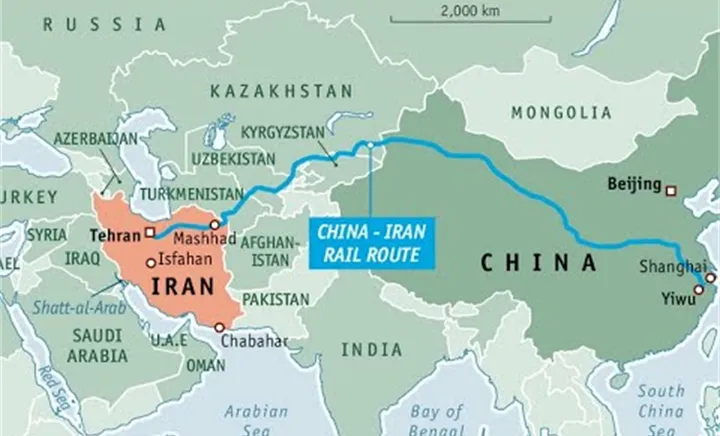
The rail line opened in June 2025 and was designed to transport Iranian oil, goods, and freight to China and beyond much faster than sea routes, cutting some 15 to 20 days off shipping times, while bypassing chokepoints like the Strait of Hormuz and Malacca Strait. Earlier this month [April 2026], the U.S. and Israel conducted airstrikes on multiple segments and bridges along this railroad as part of a wider campaign, hitting 8 to 10 railway bridges and lines (e.g., Yahya Abad railway bridge in Kashan/Isfahan province, segments near Karaj, Tabriz-Zanjan, Aminabad, Qom, and others).
All about Eurasian hegemony
To understand the importance of why the empire should be so anxious about the China-Iran railway, we have to examine Western empire’s long-term geopolitical imperatives. The war against Iran is only the last episode in more than two decades of permanent imperial wars in the region. We can safely disregard the tall tales demonizing the Iranian regime, along with any illusions that the conflict has anything to do with democracy and freedom, Iran’s nuclear program, ballistic missiles, women’s rights, or any other acceptable pretext.
The real strategic objective of the empire’s war against Iran are the same as the war against Russia in Ukraine, the looming conflict over Taiwan and multiple other conflicts smouldering across Asia and Africa: it is the imperative of preserving the empire’s hegemony over the Eurasian continent. This geopolitical strategy was the brainchild of the British Empire, which has been adopted by its American reincarnation.
Mackinderian geopolitics
In 1904, following an extensive study of world history and geography, British scholar and statesman Sir Halford Mackinder published a seminal paper titled, “The Geographical Pivot of History,” in which he argued that the British Empire’s exclusive focus on sea power was misguided and that the destiny of the world would be shaped by a land power.
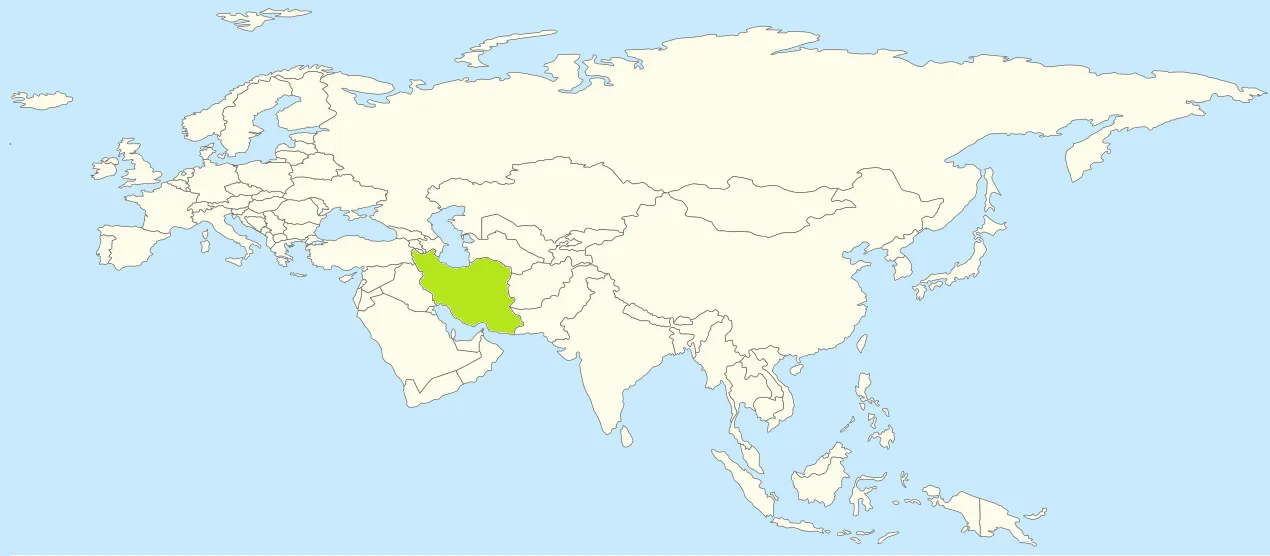
He hypothesized that the long-term viability of states critically depended on their geographical space and location and concluded that in those terms, optimum conditions were only to be found in the inner regions of Eurasia which he named the Pivot Area: a large expanse roughly encompassing Russia, the Caucasus region, Kazakhstan, Iran, and Afghanistan.
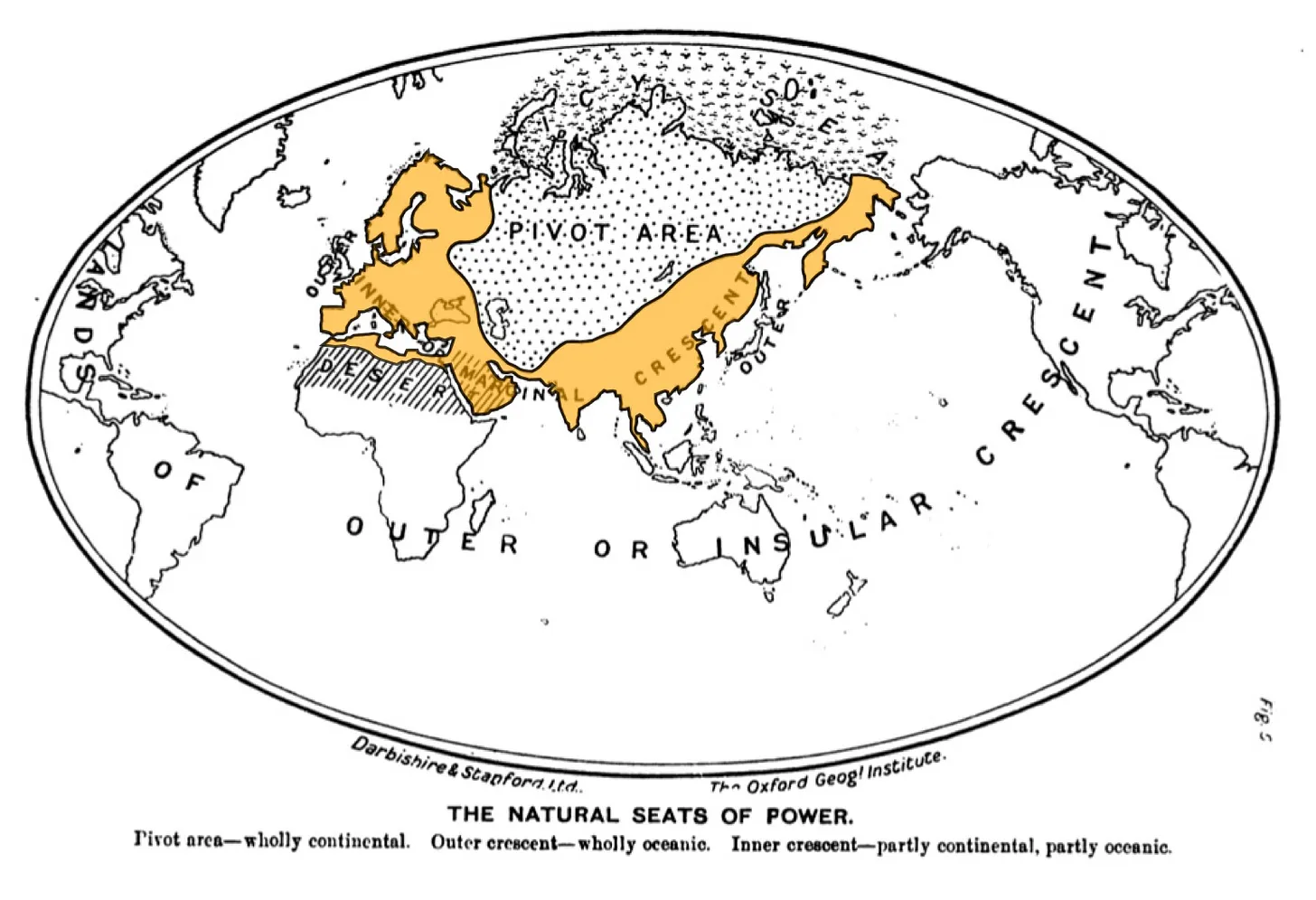
In Mackinder’s framework, the Pivot Area is surrounded by the Inner or Marginal Crescent which includes Europe, Northern Africa, Asia Minor, the Arabian Peninsula, India, China and Japan, while the lands of the Outer, or Insular Crescent include the rest of the world.
What made the Pivot Area strategic was that it could emerge as an independently viable economic power, capable of spawning a rival empire, especially with improvements in its internal communications and transport that were then being introduced with the Trans-Siberian railway. The nation that was seen as best positioned to emerge as that pivot land power was Russia:
“The spaces within the Russian empire and Mongolia are so vast, and their potentialities in population, wheat, cotton, fuel, and metals so incalculably great, that it is inevitable that a vast economic world, more or less apart, will develop inaccessible to oceanic commerce … In the world at large, [Russia] occupies the central strategical position held by Germany in Europe. She can strike on all sides, save the north.
The full development of her modern railway mobility is merely a matter of time… The oversetting of the balance of power in favor of the pivot state, resulting in its expansion over the marginal lands of Euro-Asia, would permit of the use of vast continental resources for fleet-building, and the empire of the world would then be in sight. This might happen if Germany were to ally herself with Russia.”
This was seen as an existential threat to the empire, which needed to be neutralized and destroyed. Wrote Mackinder:
“It appears to me, that in the present decade we are for the first time in a position to attempt… a correlation between the larger geographical and the larger historical generalizations… and may seek a formula which shall express certain aspects, at any rate, of geographical causation in universal history… setting into perspective some of the competing forces in current international politics.”
What formula was he referring to, and what did he mean by “setting into perspective some of the competing forces in current international politics?” Mackinder’s oracular language foreshadowed today’s geopolitics:
“The threat of such an event should, therefore, throw France into alliance with the over-sea powers, and France, Italy, Egypt, India and Korea would become so many bridgeheads where the outside navies would support armies to compel the pivot allies to deploy land forces and prevent them from concentrating their whole strength on fleets.”
In plain English, Mackinder suggested surrounding the Pivot Area with a crescent of crisis flashpoints and inducing nations like Italy, Egypt, India and Korea to bait the pivot power into an unending series of exhausting, crippling quagmires. Over the ensuing decades, the geography of the designated flashpoints evolved with changing geopolitical opportunities (with creation of new nations like Israel, Syria, Jordan, Ukraine, Pakistan, Bangladesh…) and Mackinder’s language evolved accordingly.
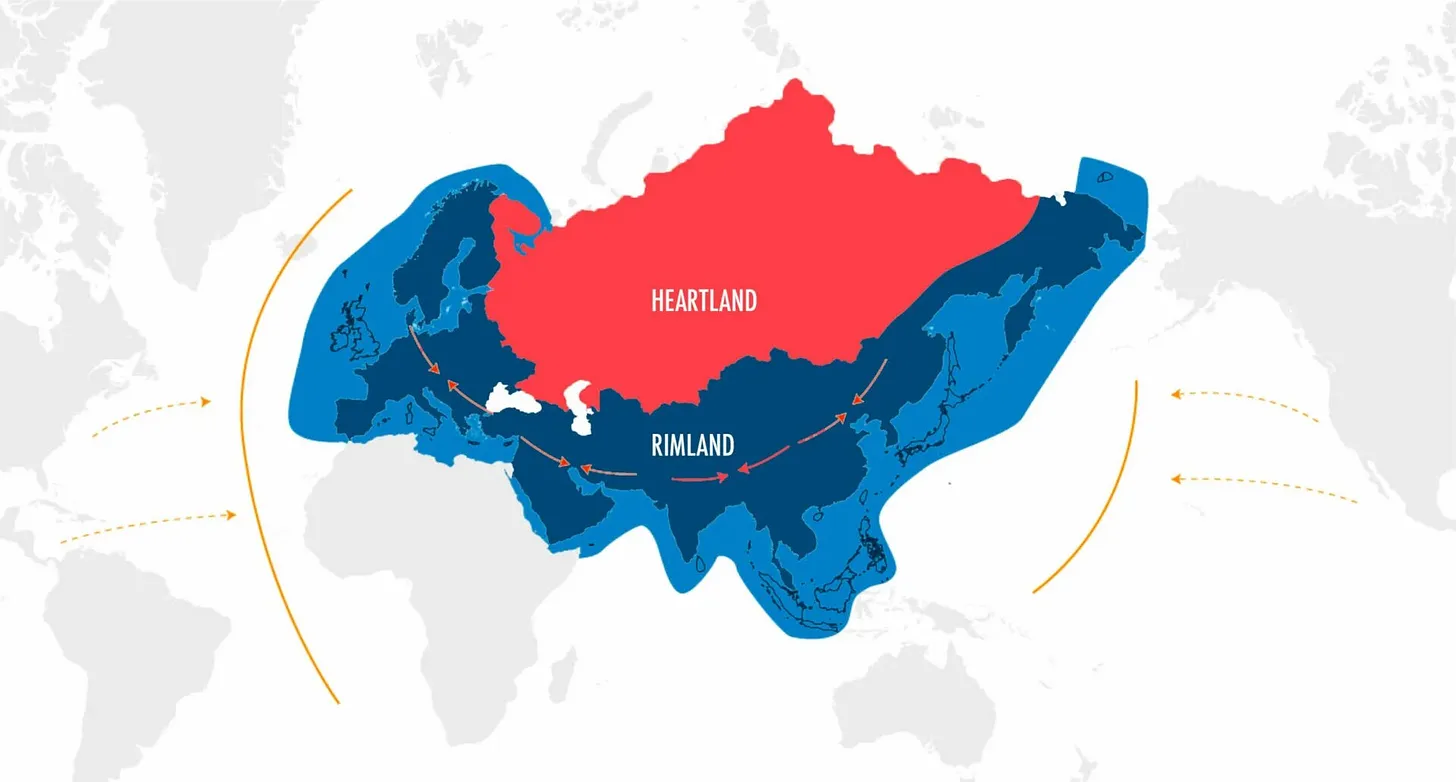
In 1919 he published “Democratic Ideals and Reality,” in which he renamed the Pivot Area as “the Heartland,” and spelled out its significance in more blunt and less oracular terms: “Who rules East Europe commands the Heartland; who rules the Heartland commands the World-island; who rules the World-island controls the world.“ By World-island, Mackinder was referring to the Eurasian landmass. Dominating this landmass remained the Empire’s undying obsession. In 1943, Mackinder wrote as follows:
“I have described afresh my concept of the Heartland, which I have no hesitation in saying is more valid and useful today than it was either twenty or forty years ago.”
Imperial parasite switches hosts
By the end of World War I, when the empire had exhausted its British host, the parasitic cabal moved to infiltrate a new host: the United States. As they did so, they brought their designs for world domination along and made their own policy objectives America’s objectives.
One of Mackinder’s disciples was Henry Kissinger. Together with his protégé Zbigniew Brzezinski, Kissinger founded the Trilateral Commission, one of the most powerful foreign policy think-tanks in the world. Brzezinski himself would become an influential policy advisor to many presidential administrations including those of John F. Kennedy, Lyndon Johnson, Ronald Reagan and Jimmy Carter.

Kissinger and Brzezinski were instrumental in grafting British geopolitics onto the American foreign policy. In his 1997 book, “The Grand Chessboard” Brzezinski wrote that, “For America, the chief geopolitical prize is Eurasia…” In the same text, he demystifies the reasons behind the empire’s Eurasian obsession:
“Eurasia is the globe’s largest continent and is geopolitically axial. A power that dominates Eurasia would control two of the world’s three most advanced and economically productive regions. … About 75% of the world’s people live in Eurasia and most of the world’s physical wealth is there as well, both in its enterprises and underneath its soil. Eurasia accounts for 60% of the world’s GDP and about 3/4ths of the world’s known energy resources.”
Empire’s comforting tales
Of course, all those energy resources, physical assets and labor power necessitate Western export-grade democracy and freedom whether they like it or not. Today, that democracy is being exported with the same sincerity as Christianity was when the Spaniards plundered Central and South America, and civilization of savages was when Britain, France, Belgium and other colonial powers of Europe plundered Africa, India, China and elsewhere.
The ultimate incentive behind imperial wars is, and always has been, the quest for collateral (resource wealth and slave labor). All the talk about Russia bad, China bad, Iranian mullahs, war on terra, women and girls or WMDs, are just a set of tall tales contrived to secure the acquiescence of domestic audiences for war. One of them has also been the tale about “the only democracy in the Middle East.”
The hill-citadel of Jerusalem
When Mackinder wrote about “so many bridgeheads,” that could surround and suffocate the Heartland, he mentioned France, Italy, Egypt, India and Korea. But more effective bridgeheads have been set up since then, and perhaps the most important one has been the state of Israel. The comforting tale about the democratical homeland for the long suffering Jewish people has served the same cynical purpose as all other comforting tales, enabling the Empire to get away with countless atrocities because democracy, holocaust, victimhood, etc.
The cold reality of the whole Zionist project is far more sinister: the creation of Israel in 1948 has been little more than British Empire’s geopolitical gambit. Long before the holocaust took place in Nazi Germany, Sir Arthur Balfour issued his famous memo to Lord Walter Rothschild, which is for some reason accepted as a valid legal basis for the creation of a whole new country. The real agenda was spelled out by Mackinder:
“If the world-island be inevitably the principal seat of humanity on this globe, and if Arabia, as the passage-land from Europe to the Indies and from the northern to the southern heartland, be central to the world-island, then the hill-citadel of Jerusalem has a strategical position with reference to world realities not different … from its ideal position in the perspective of the middle ages, or its strategical position between ancient Babylon and Egypt.”
These musings were corroborated by the alumni of Alfred Milner’s Round Table in a November 1915 article published by the Manchester Guardian. They explained that “the whole future of the British Empire as a Sea Empire” depended upon Palestine becoming a buffer state inhabited “by an intensely patriotic race.” Note, this was before World War II and even before the very important Balfour memo. With regards to that piece of paper, Mackinder stated the following:
“The Jewish national seat in Palestine will be one of the most important outcomes of the war. That is a subject on which we can now afford to speak the truth [note, it is exceedingly rare that British imperial cabal ever felt they could afford to speak the truth]… A national home at the physical and historical center of the world, should make the Jew ‘range’ himself…”
Well, the plan seems to have worked, and “the Jew,” did indeed “range himself.” Today, we can appreciate how well that worked out for “the Jew,” who has become the most prominent perpetrator and victim of the empire’s forever wars, permanently expected to wage wars against any power “between ancient Babylon and Egypt” that could challenge the empire’s hegemony in the region. Sadly, very few among Israel’s “intensely patriotic race,” appreciate the depraved cynicism with which they have been lured them into that role.
The fight is to the death
The considerations laid out above all but guarantee that the war against Iran (and against Russia) will continue and escalate to the death of one or the other side. We must appreciate that the fault lines in this conflict lie, as George Soros and others have explained, “between two systems of governance.” On the one side is the Western empire fighting for its own hegemony. On the other side lie the powers that wish to remain independent and that refuse to become the empire’s colonies.

I believe this reality is well understood today, imposing a stark choice on all independent-minded nations: either they’ll unite in their resistance, or they’ll be picked off one by one by the imperial forces and their proxies. Iran therefore can’t afford to yield, and neither can Russia or China. For the empire, access to new collateral is existential and it will never cease to pursue it at any cost. Until, that is, its own complete destruction.