
Russian government judo-chops internet & cows Russians want to know why. There are several theories
Sun 11:00 am +00:00, 5 Apr 2026 3
Source: https://edwardslavsquat.substack.com/p/russian-government-judo-chops-internet
Over the past several weeks, the Russian government has made a series of decisions so thoroughly perplexing that some Russians now believe they are witnessing a conscious and deliberate effort to detonate their country from within. (Probably your own government is behaving similarly. See? We aren’t so different after all. Why can’t we all just get along?)
Today I would like to share with you a sampling of Russian-language commentaries on this subject.
But first: Some brief background.
The first major event that is causing extreme trepidation within Russian society is the government’s campaign to block Telegram and limit and restrict internet access while forcing everyone to use Russia’s new FSB messenger, MAX. As part of this campaign, the Federal Service for Supervision of Communications, Information Technology, and Mass Media (Roskomnadzor) is also waging all-out war on VPNs, which have basically become mandatory if you want to use the internet in Russia.
Meanwhile, the entire country is experiencing periodic mobile internet outages. In some areas, mobile internet completely stopped working months ago. The government has created a “white list” of “approved” websites and apps that can be accessed during these outages. (They have reportedly even started testing this “white list” on home WiFi networks around Rostov-on-Don). The official explanation for these restrictions is that they are necessary to combat drone attacks. The last few weeks have seen some of the largest and most destructive drone attacks against Russia since the start of the SMO, so the official explanation might not be the most compelling one, as is so often the case.
Roskomnadzor is still a long way off from completely blocking Telegram (it typically works with a VPN), and the attack on “unapproved” web traffic has already resulted in some disastrous friendly fire incidents. For example, the government agency reportedly blocked IP addresses that are used to process bankcard payments, resulting in an hours-long shutdown of digital payment services in Moscow.
Then there is the Siberian Cow Slaughter.
To make a long (and ongoing) story short, authorities are killing the livestock of small farms in several regions of Siberia, purportedly to stop the spread of diseases (without bothering to test any of the animals before killing them). The farmers have been compensated with paltry sums that are only a fraction of the actual market value of their animals. Many are unable to purchase new animals and are now financially ruined.
When farmers began to share videos of their cows being slaughtered for no reason, authorities resorted to traditional terror and intimidation tactics.
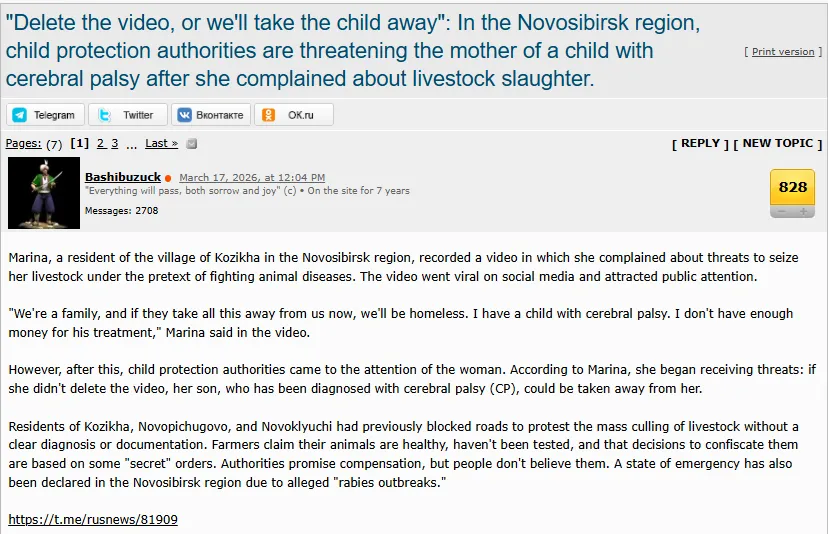
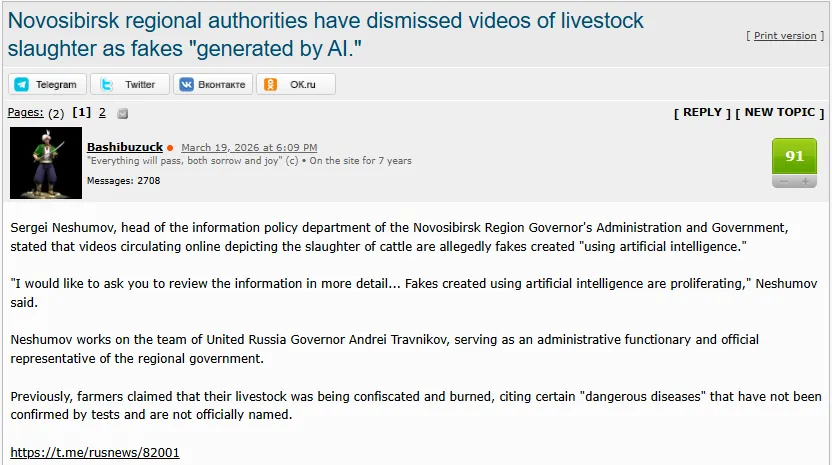
When that didn’t work, the regional government claimed videos documenting the insane cow-slaughter were AI-generated fakes.
Meanwhile, the livestock of large and politically well-connected corporate farming operations in the area have remained untouched.
All of the above begs the question: Why is the Russian government doing all of these very destructive and foolish things?
Russian-language news outlets and Telegram channels have been sharing various theories that might help answer this question.
Let’s begin with a commentary published at the end of March by Channel Stalingrad, an excellent independent outlet edited by “like-minded individuals who reject the liberal capitalism imposed on Russia after the collapse of the USSR”:
Telegram is de facto blocked, Putin’s authorities make no secret of their plans to restrict internet access through a system of “whitelisted sites,” and mobile internet has begun to be shut down under the pretext of combating drones. Along with this, a bill has been introduced in the State Duma that would effectively ban criticism and accusations of anyone in the media until a guilty verdict is finalized. It has outraged even those completely loyal to the Kremlin.
This is a blow to everyone, especially those who make money online and on social media by promoting their goods and services. It also simply creates everyday inconvenience for absolutely all Russian citizens. But the Kremlin seems to have lost its mind. The reason is most likely their conviction in the firmness of their power and the silence of the people.
But it is impossible to ignore the fact that the “tsar’s” lawlessness has reached cosmic proportions. What is Vladimir Vladimirovich planning? What is he preparing his “vertical” for? Mobilization? War with NATO? Logically speaking (if the concept of logic applies to the “vertical”), the Ozero cooperative [the group of oligarchs who support Putin] needs a completely controlled information space to nip any “surprises” in the bud. Combined with war fatigue, all this creates, at the very least, a basis for protest. And this isn’t just information noise. […]
But the main thing currently shaking the Tsar’s throne is the lawlessness in Novosibirsk, the [“anti-epidemic” measures] that have deprived a huge number of people of their sources of income without any justification, not even legal ones. The farmers surveyed don’t believe the diagnoses of pasteurellosis and rabies: those who have been raising livestock for a long time would easily recognize the symptoms. […]
In addition to the Novosibirsk region, livestock genocide has also been perpetrated in the Altai and Transbaikal territories, Buryatia, and the Altai Republic. […]
Novosibirsk Region Governor Andrei Travnikov called the mass slaughter of livestock “a strict but necessary veterinary measure.” This is par for the course for Russia’s “leaders.” Putin’s officials are not accustomed to admitting responsibility. We will never hear the truth from them. Because the fairy tales about slaughtering cattle due to pasteurellosis don’t hold up to scrutiny.
Schizophrenia is off the charts. They don’t even remember their own decisions. On October 31, 2022, the Ministry of Agriculture, by its Order No. 770, approved veterinary regulations for the implementation of preventive, diagnostic, therapeutic, restrictive, and other measures, the establishment and lifting of quarantines and other restrictions aimed at preventing the spread and eliminating outbreaks of various types of pasteurellosis. This regulation is completely inconsistent with the lawlessness currently unfolding in the Novosibirsk Region and other regions.
The uproar on Telegam, which will soon be blocked, or has already been blocked, partially helped draw attention to the situation. Still, the only thing this publicity has achieved is control over the procedure itself and at least some regulations for compensation payments. But this is far from certain.
What is happening is complete lawlessness and legal chaos. A logical question: for what purpose? Perhaps some of the Kremlin’s elite are using these informational outlets to fight their competitors. Moreover, they do so without regard for the consequences. As happened, for example, in 2023, when the desire to remove Shoigu from the Russian Ministry of Defense through wholesale criticism of the army command and the promotion of Wagner sparked Prigozhin’s rebellion. Incidentally, criticism of the closure of Telegram is often interpreted as a struggle between the “Kremlin towers.” One of them is lobbying for “de-Telegramization,” while others are trying to stir up a rebellion against it. Consequently, farmers in the Novosibirsk region could very well have fallen victim to the games of Putin’s “vertical,” which is extremely distant from the region, from livestock farming, and from the aspirations of the ordinary people under its control.
If this is indeed the case, Putin has lost control of the state. And this could very well end in disaster. Quite soon.
Our next commentary comes from Yandex’s blogging platform, which is sort of like Russian Substack:
According to the agenda, our country is on the verge of a monumental leap. True, the nature of this leap raises questions among those accustomed to measuring progress in factories built, rockets launched, or technologies implemented. But this is apparently an outdated approach. Modern Russian management has discovered a simpler and more effective path—development by subtraction.
Imagine a gardener who wants to grow a giant pumpkin. A normal gardener fertilizes the soil, waters the beds, and protects the seedlings from frost. Our strategic gardener, however, believes otherwise: the pumpkin will grow to enormous proportions if weeds are prevented from growing, if clouds are prevented from flying past the pumpkin without drenching it with rain, if frosts are prevented from appearing prematurely…
In short, a new word in agricultural technology—you just need to think carefully about what to prohibit, compile an extensive and comprehensive list of prohibitions, and impose it on the pumpkin: grow, you bastard!
In the digital realm, we live in a harsh asceticism. The internet is sometimes shut down, sometimes left in place, but with conditions. VPNs are sometimes banned, sometimes allowed, but by subscription, like premium access to freedom, and for a fee. YouTube, social media, Roblox—everything reminiscent of a global world is being crushed by the digital sovereignty steamroller. The logic is simple: if you remove everything incomprehensible and alien, something native will inevitably flourish. True, so far only the market for workarounds is flourishing, but these are details. […]
It’s as if the government has decided that national development isn’t about creating something new, but about completely erasing the old. If you ban everything bad, it will automatically become good. If you take away people’s internet access, they’ll start watching Skabeeva and Solovyov on TV [government propaganda]. If you ban vaping, everyone will quit smoking. If you increase fines, everyone will become law-abiding.
But history teaches us otherwise: bans don’t create the future. They only preserve the present. You can ban English words, but without modern technology, the language will still deteriorate. You can ban travel, but without knowledge sharing, science will wither. You can force people to have children, but without security for the future, families will not be happy.
The result is a paradox. The list of what’s “not allowed” no longer fits on one page. And the list of what’s “allowed” remains frighteningly short.
The government offers us a fortress-state, safe, quiet, and forbidden. But a fortress is a place for defense, not for living. Life requires roads, not barriers. We need factories, not fines. We need ideas, not bans.
For now, the only sector that’s truly developing and showing steady growth in the country is the industry of restrictions. And if things continue this way, we risk becoming the most developed country in the world in terms of the number of restrictions. But living in this “developed” world will become absolutely impossible.
Finally, I would like to share two texts I came across while browsing Yaplakal, a popular Russian news and discussion forum.
Both texts are essentially conspiracy theories, but they illustrate the rampant disillusionment and distrust in the government that is entirely ignored by Very Important and Serious Russia Experts With Direct and Indirect Ties to the Russian Government.
The first text:
I came to see my dad today and started whining over a glass of tea.
My dad is already at the age where he doesn’t need this internet. But after listening to me for a while, he abruptly said, “Stop. You’re telling me about prohibition and the collapse of the [Soviet] Union. Look at how it happened.”
He loves conspiracy theories.
“To destroy the Union, they started an unpopular war. It lasted a long time. During this time, the budget was depleted and people became disillusioned with the army.”
“Then they started passing weird laws. They tightened the screws for parasitism, any manifestation of dissent, etc. This was to create disillusionment with the government. And finally, they finished it all off with prohibition. They ruined an entire industry where people worked and, most importantly, killed people’s ability to relax normally. People didn’t drink less after that, but they started drinking whatever they could, and on the sly. They started giving prison sentences for selling alcohol. People started going blind from counterfeit alcohol. Well, it’s just like in your VPN, where people are willing to trust who knows who just to get around the restrictions.”
“And then, when distrust of the government reached its peak, when neither the people nor the army wanted such a government anymore, and anyone but them would rather have it, a coup happened. And mind you, it was almost bloodless. How much do they have to annoy everyone so that no one will stand up for the country?”
“And most importantly, all this was always done with the message that everything was being done for the people and the country. Mind you, it’s still the same. All to protect people from the corrupting influence of Western vodka. You’ll see, they already did it once, now they’re just repeating it.”
Of course, I laughed. Well, yes, there are a lot of coincidences. The long-standing scam, the empty budget, the idiotic laws and restrictions, the people’s disillusionment. There are a lot of coincidences, of course, but it’s just a coincidence.
Or is it? ((
The second text:
Conspiracy Theory:
Observing Roskomnadzor’s persistence in blocking Telegram and tightening control over messaging apps, I come to the conclusion that we’re misinterpreting what’s happening. The average person sees this as a fight against the opposition or spies. The opposition interprets it as a pre-election crackdown.
But what if this is part of a larger plan? A global rebranding of power, initiated by those who will soon leave the political arena.
Let’s consider the mechanism of a low barrier to entry for the future government. The scheme, although cynical, is quite effective.
Stage: Creating Problems. The current elite passes extremely unpopular laws.
We see this now—laws on blocking, mandatory biometrics, VPN bans, three-year data retention.
The old regime acts as an authoritarian controller, depriving citizens of their familiar tools.
The result is mass discontent. People previously apolitical begin to perceive the state as a source of problems. A grandmother, deprived of contact with her grandson, experiences negativity. Businesses losing customers due to restrictions are ready to support any changes.
The old regime, consciously or not, is generating hundreds of thousands of “silent protesters.”
Formation of a critical mass of irritation: When instant messaging apps are finally blocked, society will be divided into: 15% of tech-savvy users capable of bypassing the blockages (for them, the situation is not critical); 85% of the population, who will find themselves cut off from their usual communication channels.
For these 85%, any future government that declares, “We’re canceling this absurdity. Here’s the ‘Enable Telegram’ button,” will automatically become a savior. A low barrier to entry is achieved not by building something new, but by eliminating the negative consequences of previous policies.
An analogy with the 1990s: Gorbachev’s “dry law” generated hatred. Yeltsin, by figuratively legalizing alcohol, gained the people’s love. It doesn’t matter that this had its downsides. Allowing the banned became the key to high ratings.
The Savior stage: The arrival of a new government with a simple solution. Imagine: the year is 2026. Telegram is down, WhatsApp is unavailable. Communication has returned to 2005 levels. Discontent is skyrocketing. And then a “Technocrat” appears (his origin is irrelevant). His program consists of two points:
- Repeal all laws blocking instant messaging apps within 24 hours.
- Pay bonuses to telecom operators for restoring traffic.
What’s going on? The entire country, which until recently hated the “regime,” greets him with applause. The threshold for entering power is minimal. He doesn’t need to understand complex issues. He simply lifted the ban.
This is precisely the technology of power change with a low threshold for legitimization. The old regime has so exhausted the people with senseless restrictions that anyone who lifts them will be perceived as a benefactor.
What are the motives of the old regime? Why are they playing the role of the “bad guy”? The most pressing question. Don’t they understand that they are working for the successor? They do. But they have limited choices:
- Either they tighten control, losing ratings but buying time.
- Or they don’t tighten it, and they will be swept away in the near future, since instant messengers are used to coordinate protests.
They choose the lesser evil. And at the same time, they create the perfect “safety cushion” for their successor. The successor has probably already been chosen. He is waiting. He already has a decree ready on the “abolition of digital oppression.”
We’re outraged by the bans imposed by Roskomnadzor and the parliamentarians. But perhaps they’re simply fulfilling their role, laying the groundwork for the next political cycle.
The new government in Russia will get an easy start not because of its own merits, but because of the actions of the previous one. All it will take is a promise to “restore everything as it was,” and the people will give it their full support.
So, this opinion has taken hold, should I go to the nuthouse, or is there some truth to it?
Maybe?










I equate Slavsquat with CIA. Pure propaganda and unlikely to be true. Maybe there are other sources to confirm and prove my view wrong? Jacob Nordangard’s The Pharos Chronicles is realistic about Putin’s taking part in world government technocratic programmes. Do you follow him?
Fair enough, most of them are agents of one sort or another aren’t they
I don’t know Nordangard or Pharos but I do find it very hard to believe that Putin, Xi etc are really “opposition” to the global hegemony. We’ve seen more than one Putin over the years haven’t we
I guess Russia will see what happens in Iran and continue working to stop the growth of the US Zionists in the Middle East. The top echelon are not necessarily all permanent friends, and are capable of betraying each other.