First condolences are in order for the Iranians on their tragic loss. Fortunately, the team framework of their governance system will ensure continuity. IMO, a very poor decision resulted in the crash.
What to make of deranged “leaders” divorced from reality? The phenomenon is far wider than many realize, although the well informed would say such behavior is a feature not a bug. It’s likely a feature related to the polarization happening within the so-called Liberal world of the West plus Occupied Palestine, although the latter is somewhat different. And yes, there are a few exceptions that prove the rule in West where most governments are NOT working to advance their national interests and instead work to advance the Outlaw US Empire’s interests.
The division within the Zionist camp wasn’t just revealed by Gantz’s proposal as it was ongoing well prior to 7 October with the Judicial/political schism that was front-and-center. The division that caused has deepened with the Zionist’s inability to complete their fundamental Project that was launched in 1948—the cleansing of Palestine for a 100% Zionist “homeland.” The entire West has never ever acknowledged the genuine Zionist goal despite its being said over and over after the Zionist terrorists were able to somehow blind the world to their reality. What’s happening today is the righting of that historical wrong, although many again are blind to that reality. Fortunately, there are some who aren’t blinded and are able to get their views published. In Alastair Crooke’s SCF essay, he cites one such writer at length to show the degree of Zionist polarization/division which lurks behind Gantz’s proposal. But his title suggests such division isn’t restricted to Occupied Palestine, “Why are Israel and the West unravelling in tandem?”
Alon Pinkas, a former senior Israeli diplomat (well plugged in at the White House), says aloud the ‘reality’ about Israel which he underlinescannot be hidden further:
“[There are now] two [Jewish] states – with contrasting visions of what the nation should be. There is an elephant in the Israeli room – and ‘no’: it’s not occupation, though that is its main cause”.
“The elephant in the room is Israel gradually but inexorably being divided [into a high-tech, secular, liberal state] … and a Jewish-supremacist, ultranationalist theocracy with messianic, antidemocratic tendencies that encourage isolation”.
“Zionism … has morphed and mutated through the settler movement and extreme right-wing zealots into a Masada-like political culture, based on the concept of the redemption of the ancient kingdom in the ancestral land. (Masada was a Sicarii cult in CE 73)”.
Pinkas continues:
“[I]n essence, there is a civil war raging in Israel. It has not reached Gettysburg levels, but the deep and wide schism is becoming glaringly evident. The two political value systems are just not reconcilable. “We are fighting the Arabs (or Iran) for our existence” remains the only common thread, but it is weakening. That is a negative definition of national identity: a common enemy and threat, but very little of what unites us in terms of the type of society and country we want to be”.
“Even the most fundamental common narrative, the Declaration of Independence, is now being questioned with some of its basic tenets and guiding principles a source of political contention”.
Of course, one can see from which side of the divide Pinkas views his world – yet “above and beyond pondering 7 October, there is a growing realization that ‘unity’, ‘one destiny’ and ‘we have no choice and no other country’ have become meaningless and hollow clichés. Instead, more and more Israelis on both sides of the divide see their country as essentially split into two distinct (non-reconcilable) entities”.
Does this sound familiar, albeit in another context?
It should. For it is a metaphor for the inexorable divide in the West, too. The war in Gaza has precipitated and sharpened the latent schisms within in the West. It too can be hidden no longer. On the one hand, there is an (illiberal) social engineering project posing as liberalism. And on the other, a project to recover the ‘eternal’ values (however imperfect) that once lay behind European civilisation.
The conflict in the Middle East has thrown the parallels between the two spheres in the West into clarity.
Again, the parallels and similarities are discomforting: As Pinkas says:
“the divide is real, widening and becoming unbridgeable. The political, cultural and economic gaps and rifts are growing, accompanied by toxic vitriol that masquerades as political discourse. Even the most fundamental common narrative, the Declaration of Independence, is now being questioned with some of its basic tenets and guiding principles a source of political contention”.
He is referring to Israel, but the same is true in the U.S., where the basic tenets and guiding principles of the Constitution (i.e. free speech) are a source of political contention. He talks also of the Right’s claim that Tel Aviv ‘is a bubble’, but adds: “As for the bubble claim, they’re right – but New York is a bubble, Paris and London are bubbles” – geographical, as well as ideological bubbles. Yet Pinkas does not ‘get’ the paradox he creates: Is not that the core of the problem? The ‘Techie-obsessed’ Metro-Élites of America versus the Rest (i.e. ‘flyover America’)? The bubbles are the problem, not something to be brushed aside.
Today, tens of thousands of students in the West are protesting the on-going massacre of Palestinians, whilst the institutional place-holders fully support the annihilation of Hamas and any ‘complicit’ civilians (which is extended by some to include all who live in Gaza).
The two worldviews share no common perception. They represent contrasting visions for the future – and of the essence of their nations. October 7 exploded the simulacra of the ‘status quo’ in Israel – and at the same time, unravelled the political order in the West – as in Israel.
What is important to understand is that both polar visions – that of disputed national ‘history’, and secondly of a common future – are authentic to each community. The visions have their separate legitimacy. This means that simple political fixes won’t liquify calcified zeitgeists. Each party must first accept the legitimacy of ‘the other’ (whilst remaining in disagreement) for politics to become possible.
Pinkas – as metaphor – has a wider application: Having said that “there is an elephant in the Israeli room – and no, it’s not occupation – though that is its main cause”, Pinkas adds later in his piece that “Israel is not only occupying territory but approximately 5 million Palestinians. In effect, for 57 years Israel has been living in a recurring loop of the seventh day of the Six-Day War. That reality, which in the 1970s was termed “protracted temporariness,” has become a permanent feature of Israel’s political and geopolitical ecosystem”.
It is a framework that has become Israel’s trap.
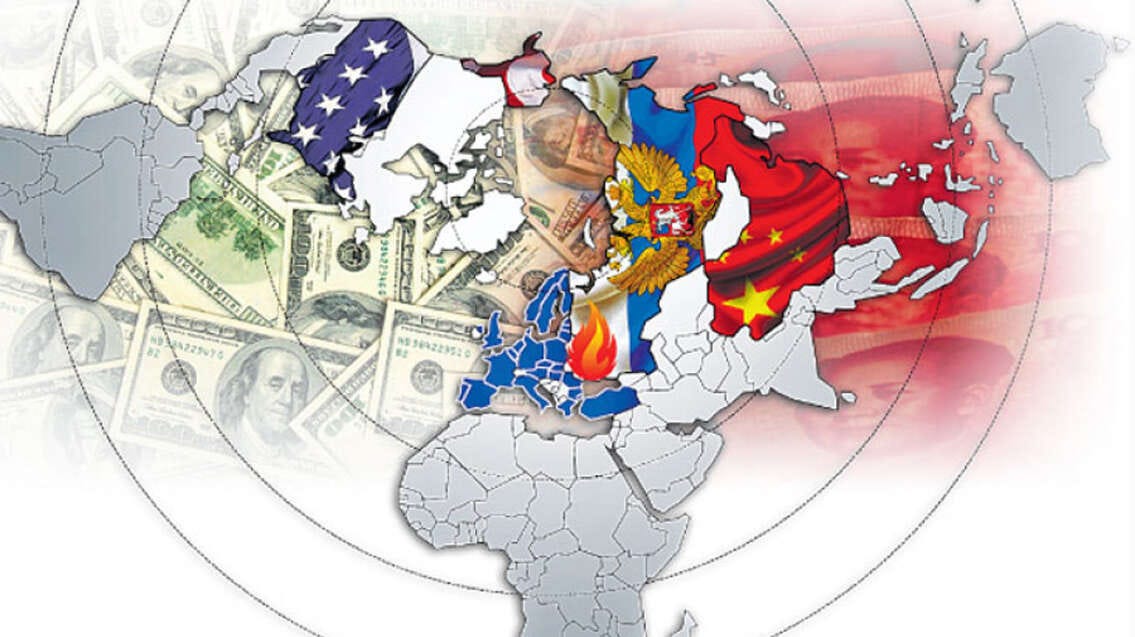
So why are Israel and the West unravelling in tandem? Well, it is firstly because they have become so inter-connected at the level of power structures (in both U.S. and Europe) to a point that it is difficult to know who has more heft within these power and media structures: Tel Aviv or the White House.
This means interdependency in terms of each’s international standing, and by extension, vulnerability to any collapse in Global standing.
So, whilst the West today ostensibly eschews literal settler colonialism (other than that practiced by Israel), it nonetheless has pursued a form of rent-seeking, financialised colonialism since WW2. That process also has become a permanent framework to the western political and geopolitical ecosystem.
The consequence is that as settler colonialism in Gaza moves starkly and darkly into view, the global majority sees both Israel and the West as explicitly colonial. No distinction is made – the Rules-Based Order is seen as just another iteration of the colonial eco-system. Thus, events in Gaza, amongst other things, have sparked a new wave of anti-colonial sentiment across the globe.
It constitutes a dynamic which, in finding a strong resonance amongst western student protestors (and amongst many of their elders), is fracturing western leadership structures – threatening the carefully curated lead-in to the November U.S. Presidential elections.
Finally, the close integration of the two linked ‘structures’ has overflowed into the West’s foreign policy zeitgeist: Just as Israel’s answer to the October 7 has been to lash out at ‘Hamas’ and Gaza, so the West, viewing its own ‘hegemony ecosystem’ challenged by Russia and China, emulates Israel in seeing military force as the key to its own deterrence and global primacy.
President Putin – foreshadowing the present tensions with the West – criticised in Munich in 2007 in a pivotal speech what he called the United States’ monopolistic dominance in global relations, and its “almost uncontained hyper use of force in international relations”.
He could have said the same about Israel in the regional context. [My Emphasis]
IMO, he’s correct on the Big Picture with the Zionists being a microcosm of the West’s much large and longer Age of Plunder that’s now in its final stage of Super Imperialism that’s beginning to unravel. There was some further exploration and information revealed during the chat between Crooke and Judge Napolitano today, most of that coming after the 18-minute mark since the first half was spent discussing breaking news. One very brief utterance was made in reference to the latest “Russia/China Manifesto” which of course is just an update of their 4 February 2022 Joint Declaration that was ignored by so many. And the update on the Saudi situation again showcases the lack of reality in Western policy making. In both Gaza and Ukraine, the Zionists are losing, as the West’s Zionists are responsible for the Ukraine debacle. Their policy in support of both conflicts goes against the wishes of their publics and thus the polarizing divide widens and reveals the totalitarian aspects of their being which are clear for the whole world to see.