It was blindingly obvious that the Kremlin was completely and thoroughly infiltrated by the end of the first six months of the SMO. The Americans knew everything that Russia was planning to do weeks and months before Russia did it, and all of the Kremlin’s plans were thwarted either through jaw-dropping incompetence, internal sabotage, treason at the highest level or some mixture of both. Once that became clear, and no one got fired, the war becoming a farce was a foregone conclusion.
In hindsight, at least.
Now we are starting to get stories emerging about how exactly Washington supposedly infiltrated the Kremlin. I think that this is, of course, a kind of clever misdirection. By blaming everything on a leaker or mole or two, they can both explain their prescient foreknowledge and also absolve Putin somewhat by portraying him as an honest opponent, who simply lost because he was playing checkers while they were playing chess. No one can be allowed to know that Washington put Putin and his cabal into power and that this entire bloodletting has been fought against one of their own puppets (like Saddam) and therefore entirely unnecessary.
I’ve explained before that my belief is that Putin and his government were simply calling the Americans and letting them know of their plans beforehand, asking for permission like Saddam did before he invaded Kuwait. And that Putin was given permission to invade Ukraine and thereby led into a deliberate trap. Putin now is simply in shock and denial about how easily he got baited into the SMO, and he keeps trying to hold up that worthless Istanbul Accord between himself and his executioners, as if it were a shield.
This account is based on interviews conducted over the past year with more than 100 intelligence, military, diplomatic and political insiders in Ukraine, Russia, the US and Europe. Many spoke without attribution to discuss events that are still sensitive or classified; those quoted by name are referred to by their job titles at that time.
It is the story of a spectacular intelligence success, but also one of several intelligence failures. First, for the CIA and MI6, who got the invasion scenario right but failed to accurately predict the outcome, assuming a swift Russian takeover was a foregone conclusion. More profoundly, for European services, who refused to believe a full-scale war in Europe was possible in the 21st century. They remembered the dubious intelligence case presented to justify the invasion of Iraq two decades previously, and were wary of trusting the Americans on what seemed like a fantastical prediction.
Yeah, isn’t it a miracle that Putin somehow fucked up the SMO so clownishly and spectacularly?
Let us recall what he accomplished in just the first six months. He:
Failed to take out any strategic UAF assets; literally didn’t take out their ammo depots, their planes, their helicopters, their generals, their political leadership, ABSOLUTELY NOTHING!
Didn’t cripple the military industrial infrastructure — bridges, factories, power plants you name it, all intact … STILL!
RETREATED HIS ENTIRE ARMY BACK TO THE EAST FOR NO DISCERNIBLE REASON AFTER LOSING HUNDREDS OF MEN IN HIS SLAP-DASH RUSH TO REACH KIEV IN THE FIRST PLACE!!!
He even left behind an entire 10 km column of military equipment abandoned around Kiev, as a show of goodwill, I suppose.
Proceeded to refuse to mobilize or in any way prepare the Russian army for war, while Kiev openly and brazenly mobilized an entire army and armed them with NATO weaponry.
Within a year of the SMO, about 60% of Russia’s gains had been rolled back with almost no real resistance.
The Black Sea Fleet was then systematically destroyed, the blockade lifted, strategic islands abandoned, etc.
…
But he did achieve a great Christian Anti-Nazi Morality victory, and people often forget that. When was the last time you heard ZAnon crowing about Putins’ latest moral victories over Satan. Their faith appears to be flagging!
We continue:
Most crucially, the Ukrainian government was thoroughly unprepared for the oncoming assault, with President Volodymyr Zelenskyy spending months dismissing increasingly urgent American warnings as scaremongering, and quashing last-minute concerns among his own military and intelligence elite, who eventually made limited attempts to prepare behind his back.
“In the final weeks, the intelligence leaders were starting to get it, the mood was different. But the political leadership just refused to accept it until right at the end,” said one US intelligence official.
Four years on, there are many lessons to be drawn from these events about how intelligence is collected and analysed. Perhaps the most pertinent, as the world appears more unpredictable than at any time in recent history, is that it is dangerous to dismiss a scenario because it seems to fit outside the realm of what is rational or possible.
“I felt the evidence we presented to them was overwhelming. It’s not like we held back something that, if only they had seen it, would have made all the difference,” said Jake Sullivan, Biden’s national security adviser, on why European allies did not believe the Americans. “They were just seized with the conviction that this simply made no sense.”
I recall Lavrov getting up in front of the world’s camera’s and microphones to declare that any rumors of Putin’s invasion of Ukraine were nonsense, and that only a “terrorist country” would behave in such a manner. Turns out that Lavrov is a total nobody in the Kremlin, and he was not informed of the plans.
The CIA, however, was.
The CIA discovered an awful lot about Putin’s plans to invade Ukraine, but one thing they never worked out for sure is when he first made up his mind to go all-in. Sifting through the evidence later, like detectives at a crime scene, some of the agency’s analysts pinpointed the first half of 2020 as the most likely moment.
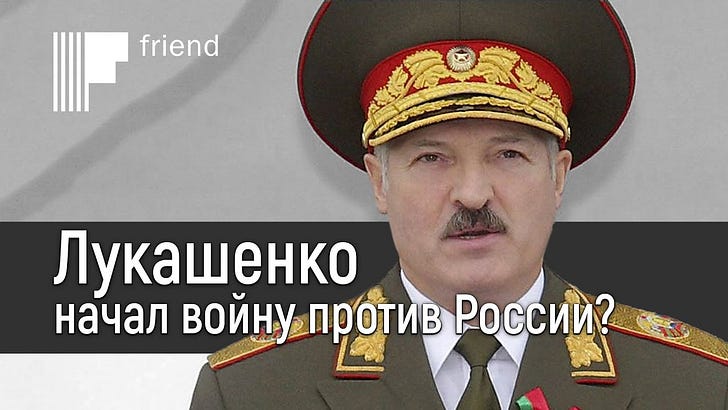
During those months, Putin passed constitutional amendments to ensure he could stay in power beyond 2024. Then, locked away in isolation for months during Covid, he devoured books on Russian history and pondered his own place in it. Over the summer, the violent crushing of a protest movement in neighbouring Belarus left President Alexander Lukashenko weaker and more reliant on the Kremlin than ever. It opened up the possibility of forcing Lukashenko to allow the use of Belarusian territory as an invasion launchpad.
Nah.
Moscow had ordered a coup against Lukashenko, using Wagner, ironically. Lukashenko moved first and arrested their operatives in Belarus and made a big stink about it in the media, accusing the Kremlin of trying to topple him.
We’re going to skip ahead in our investigation to the very end, to make things more fun and to spice things up. Last time we spoke about Luka’s early ambitions and how he was elevated to power by the KGB, Gorbachev’s government, his close friendship with Yeltsin and the poisonous ideology that he has embraced for his fledgeling statelet to sew the seeds of anti-Russian sentiment in Belarussians for generations to come.
Read full story
Lukashenko then turned to the West for help. But the West then tried to do a coup against him too. Flummoxed, he ran back to Moscow for help again.
As for the reason for Putin’s invasion, I believe it was the arrest of Putin’s personal friend, Medvedchuk, an oligarch from Donbass, and the confiscation of his assets. That’s been my thesis for four years and nothing has changed to make me question it yet.
Around the same time, a team of FSB poisoners slipped novichok nerve agent into the underpants of Alexei Navalny, the one opposition politician with the potential to command mass public support, sending him into a coma. Back then, these all seemed like discrete events. Later, they started to look like Putin getting his ducks in a row before implementing the big Ukraine gambit he felt would cement his role in history as a great Russian leader.
For someone who got poisoned by a nerve agent, Navalny showed no signs of any nerve damage and no one on the plane got nerve damage either, despite breathing the same recirculated air as him. I’ve also never believed that Navalny was anything more than a political art project by the exiled oligarchs in London, and the idea that he had popular support among Russians is silly. He was also the spitting image of Boris Yeltsin, the most hated figure in Russian political history.
So he had literally ZERO chance of gaining any popular support.
Coming from within my own family, I had always heard the following two characterizations of Boris Yeltsin: Russian swine-man or Yiddish traitor. The men went with the latter and the women would shriek in alarm when the men would whisper these conspiracy theories to me. In my mind then, as I learned to discern which gender was capable of truth-telling, Yeltsin became a non-Russian entity, and that’s the assumption that I had about him for a long while as a result.
Read full story
Moving on.
Hints of that plan first came into focus in the spring of 2021, when Russian troops began building up along Ukraine’s borders and in occupied Crimea, supposedly for training exercises. The US received intelligence suggesting Putin could use an annual set-piece speech, due on 21 April, to lay out the case for military action in Ukraine. When Biden was briefed on the intelligence, a week before the speech, he was so alarmed he called Putin directly. “He raised concerns about the buildup and called for a de-escalation, as well as proposing a summit in the coming months, which we knew would be of interest to Putin,” said Avril Haines, Biden’s director of national intelligence.
When Putin gave the speech, it was much less bellicose than expected, and a day later the Russian army announced its military exercises at the border were over. It seemed the summit offer had successfully defused the threat, and when the two leaders met in Geneva in June, Putin hardly mentioned Ukraine.
It was only in hindsight that it became clear why: he had already decided on a non-diplomatic solution.
Putin was thrilled when Zelensky won. We know that the FSB was providing support to him and his team to get them into power. Putin has always supported Russian-speaking diaspora ethnic globalists in FSU territories.
That’s literally his standard MO.
Putin is to Blame For Zelensky Because His FSB Literally Put Him Into Power
Four weeks after the Geneva summit, Putin published a lengthy, rambling essay about the history of Ukraine, in which he went back as far as the ninth century to make the argument that “true sovereignty of Ukraine is possible only in partnership with Russia”.
The screed raised eyebrows, but attention in London and Washington was soon diverted by the chaotic withdrawal from Afghanistan.In September, Russian troops began another buildup along Ukraine’s borders; within a month it had reached a mass that was hard to ignore. Washington collected new intelligence about Russian plans, more detailed and much more shocking than in spring. Back then, the assumption had been that Russia could attempt a formal annexation of the Donbas region, or in a maximalist scenario, might try to hack a land corridor through southern Ukraine, linking Donbas to occupied Crimea. Now, it looked as if Putin could be planning something bigger.
He wanted Kyiv.
… and that’s why he abandoned Kiev after getting a worthless piece of paper signed by Zelensky and his team, right? That’s why he brought a paltry force of less than, what, 30 thousand men to take Kiev, a megacity?
More than likely, the withdrawal from Afghanistan proves that Washington knew about the plans to invade Ukraine and began to redeploy their military assets in preparation for this.
So, the real timeline is the house arrest of Medvedchuk in May 2021 followed by the American flash-withdrawal from Afghanistan in August 2021 followed by the SMO in February 2022. Between May and August, something must have happened to make up Putin’s mind and to let Washington know what was coming next (the opportunity of a lifetime). By mid August, they already had learned what was coming, and had begun to prepare by snatching away resources from Afghanistan. What that something may have been, we will revisit in the near future.
Skipping ahead:
Zelenskyy had been elected in 2019 on a platform of pursuing peace negotiations to end the conflict Russia had launched in eastern Ukraine in 2014. He no longer believed he could do a deal with Putin, but he feared that public talk of an even bigger war would prompt panic in Ukraine. This could lead to an economic and political crisis, collapsing the country without Russia needing to send a single soldier across the border. This, he suspected, was Putin’s plan all along. He grew increasingly irritated at the Americans and British, who alongside the private warnings were starting to talk about the invasion threat in public. In November, he dispatched one of his most senior security officials on a top-secret mission to a European capital to deliver a message to political leaders via intelligence channels: the war scare is fake, and is all about the US trying to leverage pressure on Russia.
Few in Ukraine believed a full-scale invasion was likely, but the country’s intelligence agencies had been picking up worrying signs of increasing Russian activity. Ivan Bakanov, the head of the SBU domestic agency, recalled that while Russian spy services had traditionally focused on trying to recruit high-level Ukrainian sources, in the year prior to the invasion “they were going after everyone”, including chauffeurs and low-level functionaries. Often, these pitches were “false flag”: the Russian recruiters would pretend to be from one of Ukraine’s own intelligence agencies.
The SBU also tracked clandestine meetings between officers from Russia’s FSB and Ukrainian civil servants or politicians. These meetings often took place in luxury hotels in Turkey or Egypt, where the Ukrainians travelled under the guise of tourism. Russia hoped these people, motivated variously by ideology, ego or money, would act as a fifth column inside Ukraine when the time came.
Yeah, that was obviously the plan with the SMO. I wrote about this for the entire first year of the conflict. Clearly, the FSB’s plan was to get assets to turn traitor and hand over key cities and so on to Russia’s special police. Or, alternatively, it was the GRU that did this, and the FSB sabotaged them. Unclear at this time. What is clear is that, apart from in Kherson, this approach failed everywhere in Ukraine.
Can I At Least ASK The Question? Who Planned the Special Military Operation?
Let’s go back in time and remember what was happening and being discussed not so many months ago.
Read full story
We continue:
The veteran journalist Bob Woodward, in his book War, referenced a “human source in the Kremlin”, without giving further detail. This is certainly possible – back in 2017, the CIA had exfiltrated a long-standing source who worked for Putin’s foreign policy chief and had been passing the agency secrets for years. There may be others still in place.
But Putin went to great lengths to hide his intentions even from most of his inner circle, and only a handful of people in the Russian system knew of the invasion plans until a couple of weeks before it began.
Yes, it wasn’t Lavrov, because Lavrov didn’t know about the SMO and was left with an egg on his face and is clearly a nobody in the Kremlin hierarchy. He’s not a former racketeer or KGB royal, so he will always be an outsider in Moscow.
It could be that the CIA or MI6 had recruited a super-mole right by the president’s side, but it seems more likely that human sources in Russia provided tangential or corroborating evidence, rather than the core details. Much of the key intelligence could be sourced to satellite imagery, or to intercepts collected by the NSA and GCHQ – the US and British signals intelligence agencies – said people who saw it. “No human source detected,” said one.
Or, it was Putin asking for permission from his handlers in Langley and getting it, which then had to be explained, somehow, without giving up the game entirely to the EU’s clueless puppet-leaders.
Yes, it is well past time to consider this possibility!
Even Poland, traditionally hawkish on Russia, was not convinced by the idea of a full-scale invasion. “We assumed that the SVR and GRU [intelligence agencies] would tell Putin that Ukrainians will not welcome the Russians with flowers and freshly baked cakes,” said Piotr Krawczyk, the head of Poland’s foreign intelligence service. The Polish service had good insight into neighbouring Belarus, where the forces who could descend on Kyiv from the north were stationed, and these seemed to be the weakest troops of all. “They were mostly newly drafted recruits … they lacked ammunition, fuel, leadership and training,” said Krawczyk. It looked like a distraction mechanism to draw Ukrainian attention and firepower away from a limited incursion in the Donbas, not a serious fighting force that could hold an occupation of most of the country.
Yeah, actually, Comrade Zeiger’s account of how he, a SWAT cop, essentially, was sent barreling into Kiev from Belarus with no supplies, no food even, and no permission to engage the enemy unless engaged with first.
This squares well with the Polish intelligence assessment.
We left Comrade Krieger last time 37 km from Kiev proper, freezing in a sniper nest on the roof of an abandoned shopping center.
Read full story
Some more:
In the first part of January, the Americans got hold of more detailed information about the plans: Russian troops would invade Ukraine from several directions, including from Belarus, airborne forces would land at Hostomel airport outside Kyiv to set up the capture of the capital, and there was a plan afoot to assassinate Zelenskyy. Preparations for the post-invasion ground game were also under way, with lists being compiled of “problematic” pro-Ukrainian figures who would be interned or executed, and pro-Russian figures who would be tapped to run Ukraine.
Yeah, that’s why the UAF almost annihilated the paratroopers that were landed at Hostomel airport. Crazy that the Kremlin had already told Langley, one way or the other, about this six weeks out.
Burns flew to Kyiv to brief the Ukrainian president in person on what the CIA feared was about to happen, but the response was not what he might have hoped for. A week later, Zelenskyy released a video appeal to Ukrainians telling them not to listen to those predicting conflict. Come summer, Ukrainians would be grilling meat on their barbecues as normal, he said, insisting that he “sincerely believed” there would be no major war in 2022. “Breathe deeply, calm down, and don’t go running to stock up on food and matches,” he told the population. It was catastrophic advice, given many thousands of people would soon be trapped in an active conflict zone or under Russian occupation.
To be fair to Zelensky, try to see things from his perspective. He was literally put into power by Putin’s buddies in Moscow and Donbass. Sure, Medvedchuk had been arrested, but to start a war over that slimeball’s network of stolen assets in Donbass that have been laundered in his wife’s name?
Surely, no one could be that deranged and stupid?
Zelensky, we must be fair, literally did NOTHING to prepare for this SMO.
Zelenskyy was still worried, not without cause, that a war panic could crash the economy. The authorities did facilitate military training courses, and thousands of Ukrainians who were spooked by the war scare signed up. But it seems that, deep down, Zelenskyy simply did not believe the Americans. This was partly because the west was not speaking with one voice. The French and German leaders, Emmanuel Macron and Olaf Scholz, still believed a war could be averted through negotiating with Putin. “The Brits and Americans were saying it was going to happen,” said one senior Ukrainian official. “But the French and Germans were telling him: ‘Don’t listen to this, it’s all nonsense.’”
Three days after Zelenskyy’s video appeal on 22 January, the British Foreign Office released a statement claiming London had intelligence that Russia wanted to install the former Ukrainian MP Yevhen Murayev, a marginal figure with little public profile, as a post-invasion prime minister. To many, it sounded absurd beyond belief.
I have no trouble believing it, actually.
Yevhen (Evgeniy) is a Russian-speaking Jew from Kharkov who made a career in helping Eastern oligarchs launder their money in Eastern Ukraine. He even looks like a cheaper, more pliable copy of Zelensky himself and ran the political operations for the top Donbass oligarchs in Ukraine for near a decade.
If you know anything about the RF’s foreign policy influence operations in the FSU, they amount to simply helping Russian-speaking Jews run opposition parties that cater to Soviet nostalgia among older voters. Nothing more.
“When Britain announced that, I became even more sceptical,” said a European intelligence official. “It didn’t make any sense. Surely the Russians weren’t that stupid?”
Even I believe that Putin isn’t that stupid. Furthermore, his natural timidity, which is why he earned himself the nickname “Grey Moth” in the KGB and his being on the autism spectrum, don’t lend themselves to a scenario in which Putin decided to be a bold great man of history all of a sudden.
The main fear that right-of-Kremlin patriots have expressed over the years prior to and during the Not-War is that Putin will surrender to the West either outright or slightly more subtly but no less significantly. I’ve written about this position many times and explained why I think that Putin won’t be
Read full story
No, again, I think he was given reassurances, like Saddam was, and he blundered into a trap, just like Saddam did too.
The Americans continued to interpret Moscow’s signals very differently. In Biden’s last phone conversation with Putin on 12 February, he found the Russian leader steely, determined and utterly uninterested in any offers of negotiations. When he put down the phone, Biden told his aides it was time to prepare for the worst. War was inevitable, and the invasion could happen any day.
In calls between Biden and Zelenskyy, the tone sometimes became strained as the US president stated bluntly that the Russians were coming for Kyiv. Frustrated with the failure to get Zelenskyy and his team to listen, Sullivan had decided the focus should be on Ukrainian intelligence agencies and the military, hoping they would raise the alarm from below.
“At every meeting, they told me it’s happening for sure,” said a Ukrainian intelligence official stationed in Washington, recounting numerous encounters with CIA counterparts. “When I looked into their eyes I could see there was no doubt. And every time, they asked me: ‘Where are you going to take the president? What’s the plan B?’” He told them there was no plan B.
In contrast, Z-propaganda claims that the SMO was launched to thwart the maniacal invasion plans of Zelensky by creating a brilliant “feint” or “diversion” on Kiev, that forced him to abandon his imminent genocide attack on Donbass.
Several Ukrainian sources said they believed Zelenskyy was adamant that a major invasion was unthinkable because he had been convinced of it by Andriy Yermak, his chief of staff and closest confidant. Russia operated in the grey, deniable zone of hybrid warfare, Yermak believed, and would not go in for a big, dramatic invasion that would sever relations with the west irrevocably.
Yes, curiously, Yermak, a Russian-speaking Jew, was also once a friend of Moscow and considered a man that they could do business with.
One of the ol’ shtetl boys, as it were.
Yermak, who declined an interview request for this story, was one of the few Ukrainian officials to have regular contact with Russian counterparts. He spoke often to Putin’s deputy chief of staff, Dmitry Kozak, as part of long-deadlocked negotiations over the Donbas region.
If Kozak helped to reassure Yermak that the US invasion scare was ludicrous, it was most likely because he believed so himself. The CIA estimated that just a handful of non-military officials knew about the detail of Putin’s plans until very late in the game. Kozak was kept in the dark, along with the foreign minister, Sergei Lavrov, and Putin’s longstanding spokesperson, Dmitry Peskov, said two well-connected Russian sources.
…
Things started to become clearer on 21 February when Putin gathered his security council in one of the Kremlin’s grand, marbled halls. He sat alone at a desk with his courtiers assembled on chairs across the room, awkwardly far away from him. Putin ordered them, one by one, to a podium to offer their support. Ostensibly, the council was debating whether to formally recognise the Donetsk and Luhansk “people’s republics”, which Russia had de facto occupied since 2014, as independent states. But the subtext was clear. This was a war committee.
Many of the elite appeared dumbstruck as Putin called on them to give their consent. Sergei Naryshkin, the foreign intelligence chief, looked terrified and fluffed his lines, stammering through a confused answer that prompted Putin to chuckle disdainfully before eventually securing agreement.
About that. In the subsequent months, Naryshkin would declare that, actually, the Russian intelligence services had no reliable information coming out of Ukraine, seeing as they had abandoned Ukraine as a sphere of influence in 1991.
I covered this baffling statement from Naryshkin when it came out:
I still don’t know what to make of such a confession.
Surely, it can’t be true?
… maybe it is.
One Russian insider said the mood in the meeting was reminiscent of historical accounts of the atmosphere in the Kremlin in spring 1941, when Stalin’s intelligence bosses tried to warn the leader that Nazi Germany was about to invade the Soviet Union, but were afraid to push too hard given the leader’s firm conviction it wouldn’t happen. “Naryshkin had information about Ukraine which did not match what everyone else was saying,” said the source. “But he is weak and indecisive, and Putin wanted to make sure everyone was seen to be part of this decision. So that’s why you saw the behaviour you saw.”
Off camera, there was another startling interaction. Kozak, Putin’s Ukraine point man, had a reputation in Washington as a hardliner, but privately he was horrified by the idea of an invasion, which he only fully realised was in the works on the day of the Kremlin meeting, said a source close to him.
Kozak, who had known Putin for decades, was the only person in the room brave enough to speak up. Arguing from a strategic rather than a moral point of view, he told the president that invading Ukraine would be a disaster, though like most of the elite he still did not know whether Putin’s plan was for limited military action in Donbas or a full-scale war. After the meeting ended, he continued to debate with Putin one on one in the large hall, said the source.
The millions of Russians watching on television did not get to see any of that. Instead, they heard Putin ask: “Are there any other points of view or special opinions on this matter?”
The question was met with silence.
Kozak had replaced Surkov in the wake of the Sochi Olympics, who had previously been charged with running ops in Ukraine. We see the results of this now.
On 22 February, the day after Putin’s theatrical performance, Ukraine’s own security council met in Kyiv. As the bigwigs assembled outside the hall before the meeting, Zaluzhnyi tried to canvass support for the introduction of martial law, which would finally allow him to begin moving troops. In the room, he was supported by Reznikov, the defence minister. But Zelenskyy was still worried about sowing panic, and the council rejected martial law, voting for the lesser measure of introducing a state of emergency.
Now we come to the matter of why Zelensky, personally, wants Putin dead.
A few hours later, the security council chief, Oleksiy Danilov, handed Zelenskyy a red folder containing a top-secret intelligence report about a “direct physical threat” to the president. In other words, assassination teams were on the way. Zelenskyy seemed to brush it off, but the information apparently made an impression. The next day, in a sombre meeting with the Polish and Lithuanian presidents inside the grand Mariinsky palace in Kyiv, Zelenskyy told them it could be the last time they saw him alive. As soon as the meeting was over, Polish intelligence officers hurried the two visiting presidents into a motorcade that headed west at top speed.
You will recall that the Kremlin quickly issued a statement assuring Israel that Zelensky’s assassination was never even being contemplated and that he was safe. I have a hard time believing Zelensky was ever in danger, but I think it makes sense that he thinks he was, because that would explain, at least partially, some of his personal ire at Putin, and the otherwise random provocations like the drones being sent at the Kremlin’s towers.
Zelensky at the UN, looking even more Jewish than usual.
We continue:
Ukraine’s military intelligence agency, HUR, was also continuing quiet preparations. On 18 February, its head, Kyrylo Budanov, had received a three-hour briefing from a western official who laid out in detail the Russian plans for seizing Hostomel airfield. The information helped with setting up some last-minute defensive plans, although the Ukrainian victory at Hostomel in the first days of the war would be a chaotic and close-run thing.
On the eve of the invasion, Budanov met Denys Kireev, a Ukrainianbanker[with an Israeli passport, if you catch my meaning] with contacts deep in the Russian elite, who had agreed some months earlier to feed HUR information he picked up from his contacts in Russia. Now Kireev told Budanov that the decision to invade had been taken, and gave him information about the timing and vector of the Russian attack.
(The SBU believed that Kireev was a triple agent, ultimately working for Moscow, and he was shot dead as the SBU tried to detain him a few days after the invasion.)
As for Zelenskyy, his musing to the Polish and Lithuanian presidents that they might not see him alive again suggested that, at the very last moment, he had accepted the gravity of what was coming. Later that day, he tried to call Putin, but was rebuffed. Instead, he recorded a video message to Russian citizens, calling on them to prevent their leadership from starting a war. He also told them: “If you attack, you will see our faces. Not our backs, but our faces.” It was a complete change of tone from his earlier messages.
Nevertheless, Zelenskyy and his wife, Olena, went to bed as normal that night, she said. She had not even packed an emergency suitcase, something she would do hurriedly the next day while listening to explosions in the distance as she evacuated to an undisclosed location amid assassination threats with the couple’s two children. The invasion also caught most of the Ukrainian cabinet by surprise, including Reznikov, the defence minister. He went to bed with an alarm set for 6am: he was due to take a military plane to the contact line in the Donbas with Baltic foreign ministers, a show of defiance in the face of the heightened threat. Instead, he was woken at 4am by Zaluzhnyi calling him with news that the war was about to start.
So, Putin basically had a free hand in Ukraine. All these Russian-speaking Jews that he had helped put into power had essentially left the country completely unprepared and wide open. Somehow, amazingly, despite all these advantages, Putin still ends up fumbling the SMO.
This remains a great mystery.
One Ukrainian official who knew what was coming was the foreign minister, Dmytro Kuleba. He had travelled to Washington for meetings on 22 February and intelligence officials there showed him the exact locations where Russian tanks were warming their engines and waiting to cross the border. Afterwards, he was ushered into an unscheduled meeting with Biden. The sombre discussion felt like a “doctor-patient conversation”, he recalled, and the diagnosis was apparently terminal.
[Three guesses as to what ethnicity this former Minister of Foreign Affairs really is.]
“When I left the Oval Office, I had the feeling that Biden was bidding farewell, both to me and to the people of Ukraine,” said Kuleba.
A few more paragraphs to sift through before we are done.
Around the same time as Zelenskyy was changing outfits in Kyiv, Putin welcomed the Pakistani prime minister, Imran Khan, to the Kremlin. The visit had been planned months in advance, and Khan landed in Moscow just as Russian tanks were crossing the border into Ukraine. Surprisingly, Putin kept the appointment. On a momentous day that changed the course of European history, as shocked members of his elite swapped horrified text messages, he spent more than two hours with Khan discussing the minutiae of Moscow and Islamabad’s bilateral relations. Putin came across as “chilled” during the talks, said a source close to Khan. Afterwards, he invited his guest to stay for an unscheduled, lavish Kremlin lunch. At one point, Khan asked about the elephant in the room: the war that Putin had unleashed a few hours earlier.
“Don’t worry about that,” Putin told him. “It’ll be over in a few weeks.”
So much for “strategic feint to lure NATO into a 5 yearSlavic meatgrinder in the Donbass” thesis.
I can’t believe they’re repeating that tired old line, still, to this day.
And their hundred thousand strong audience never seems to tire of it or ask any questions about it.
But whatever they got right, London and Washington underestimated Ukrainian resistance and overestimated Russian power, just as Putin had. They had concluded that the task after the invasion would be to help a partisan movement against successful Russian occupiers, with the Ukrainian government operating from exile, or ruling over a rump state in the west of the country.
“All the way up to the day of the race, there had been an assumption that this is not going to last very long,” said the official from British defence intelligence. “We thought they’re going to be west of Kyiv really quickly, at which point they’re going to say: ‘Job done, we’ve got this lot, someone else can take care of that lot, thanks for watching.’”
The Americans had a similar view. “We thought the Russians would be more effective initially – take Kyiv in a couple of weeks, and then the Ukrainians would regroup,” said Haines.
OR!
Or!
Or!
They simply called Putin up on the phone, made some threats, Putin choked and fled Kiev in disarray to wait for further instructions. Meanwhile, NATO jumped in and began to mobilize Ukraine over the next 6 months. Putin sat around, twiddling his thumbs in disbelief repeating, “but I’ve been a good boy, but I’ve been a good boy!” as the UAF materialized out of thin air like some revenant and then steamrolled past the mall cops left behind by Putin.
The European services that had been so hopelessly wrong about the possibility of the invasion used this discrepancy as their explanation: “We didn’t believe it would happen, because we thought the idea that they would be able to walk into Kyiv and just install a puppet government was completely insane,” said one European intelligence official. “As it turned out, it was indeed completely insane.”
Unclear why exactly it was “insane”.
Had Putin actually gone ahead and done that instead of insisting on that worthless Istanbul Accord, maybe we would be in a different world now. Something happened in the first two weeks of the SMO, and it wasn’t Ukrainians with water balloons full of kerosene that got Putin to balk, as NAFO narrative shills would have you believe.
No, someone yanked Putin’s chain!
Part of the problem for the British and Americans was that while there was great insight into the planning, there was too much reliance on Russia’s own estimates of its force capabilities. “The system encourages them to make things sound better than they are,” said a US intelligence official. “We didn’t have a Russian general on the payroll who could say: ‘I haven’t written an honest report in my entire career.’”
I think we were all shocked by the non-existence of the Russian army. What crossed the border really was a force comprised of a few remaining intact divisions, carelessly thrown away for no discernible reason, and a cobbled together neo-feudal force of SWAT cops, mercenaries, mall cops, private regional warlord armies and then, later, prisoner battalions.
For decades, Putin had made it his top priority to gut the Russian military, and so, as a result, high-ranking officers started dying in droves through mysterious circumstances over the twenty-some years of Putinism and several Jewish defense ministers ended up getting fabulously wealthy as well.
Pure cohencidence though, I’m sure.
Does Anyone Work For Putin Who Isn’t a Western Asset?
To answer the question posed in the title: maybe the janitors working at the Kremlin aren’t reporting to their masters in the West.
Read full story
Almost done:
Putin’s tiny planning circle also played a role, creating a hopelessly cocky plan that had not been subjected to a rigorous critique by intelligence professionals versed in Ukrainian realities. Russian troops entered Ukraine expecting a surgical regime change operation with little resistance, rather than the bitter battles that awaited them. Moscow did not bother with many actions that western military analysts had assumed would accompany the invasion, such as taking out Ukraine’s power and communications networks. The Russian army assumed they would control most of the country in a matter of days, so decided to make the subsequent occupation easier by keeping the infrastructure intact. Instead, the working mobile networks and ready power supply proved crucial for the coordination of Ukraine’s hastily assembled defence forces.
“Half of it is we overestimated Russian military performance and underestimated the Ukrainian military,” said Michael Kofman, an analyst at the Carnegie Endowment in Washington. “But the other half is the Russians didn’t execute the operation remotely how many anticipated it might go, or in a way that made sense.”
Zelenskyy’s defiant stand in the days after the invasion was another unexpected factor. Washington, like Moscow, had assumed he would either be killed or flee as soon as the missiles started flying. Biden urged him to leave the capital, or even the country, to ensure he remained safe. But Zelenskyy stayed, and his inspiring performance as a wartime leader during the crucial first weeks of the invasion helped rally Ukrainian society in its fight against the invaders. It also buried questions about his abject failure to heed the US warnings in the buildup.
Zelensky’s brave stand reminds me of Churchill’s historically documented bravery as well.
If you don’t know that story, Churchill was told by his intelligence that a German bombing raid on central London was inbound. He quickly and quietly slipped out of 10 Downing Street in his private car, leaving his staff and everyone else to be bombed to bits. Then, he was intercepted with a communique that specified that the bombing would occur in the north instead. So, he turned the car around and told everyone that a bombing of London was inbound, but that he wouldn’t cower, and would lead by defiant example.
I would bet any amount of money that Zelensky got the same sort of private communique or assurances from Israel in those crucial hours and days, which enabled him to be so unusually brave and self-sacrificing, a trait that his tribe is usually not well-known for, it must be admitted. Selflessless and courage are not part of the 613 Holy Rules of Acquisition of the Ferengi people, after all.
In contrast, “insider trading” and nepotism and backroom dealings are their strength.
And that’s about all that the Guardian recounted that was of value to our investigation.
We are left with a few questions:
what happened between May and August of 2021 to convince Putin to SMO?
what happened in the early days and weeks of the SMO to convince Putin to give up?
In the near future, I believe that I might be able to shed some light on the first question with my speculations.
…
I’ve been rather distracted by other news items recently, even though I haven’t been commenting on them. Not sure what to make out of all the news coming out of America of late. Half of it seems fake, but fun regardless. The memes are great at least.
In this new series of videos Pierre Sabak takes a deep dive into Alien Abductions, Language and Memory.
Descendant of a Cog - Deep Dive
Get Instant Access
To access the please choose the duration, click the BUY NOW button on the video player and purchase a ticket. Once you have made your purchase, you will be sent an automatic email confirmation with your access code details. This will give you unlimited access 24/7 to the recordings during your viewing period. You can watch the presentations on this page.
Important: Please check your spam folder after your purchase, as sometimes the confirmations go to spam. If you don't receive your code within 15 mins, please contact us.
You can access the video as soon as you receive your access code, which typically arrives in minutes. If you have any problems or questions about entering your password and accessing the videos, we have a help page.
Secure Payment: Payment is taken securely by Stripe or PayPal. If you experience problems, please contact Pierre.
The Tap is and independent blog managed by Alternative View Media; a UK based events production group dedicated to discovering the truth about the world we live in and the experience of reality we all share. www.alternativeview.co.uk
Support the Tap
Ads and Supporters
Newsletter
Ads and Supporters
WordPress and Opencart
We offer WordPress setup, development, fixing and support plus remote online WordPress coaching. We are also specialists in Ecommerce and Shopping Cart systems. Get online today and get your business or venture known.
We also have a priority support service for offline websites.
We provide WordPress setup, development, fixing and support plus remote online WordPress coaching. We are also specialists in Ecommerce and Shopping Cart systems.