
How an ex Beatle became Andy Warhol – just like that
Thu 6:42 pm +00:00, 26 Feb 2026 6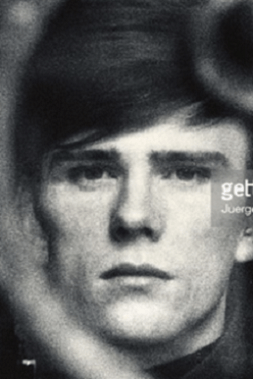
Stu Sutcliffe
Source: https://pieceofmindful.com/2026/02/25/stu-sutcliffeandy-warhol-reviewed/#more-61967
[Note: This is a re-viewing of a 2017 piece I wrote … I have changed hardly a thing, and left the comments from then intact.]
IPart 1: The nature of the Beatles (reference The Beatles Never Existed (TBNE))
 My assertion is that Stu Sutcliffe was an Intelligence asset who faked his death in 1961, and was reassigned the role of artist Andy Warhol. To understand this is useful to understand the context of both the Beatles, with whom Sutcliffe was supposedly the first bass player, and the art scene of that era, which was infiltrated by Intelligence to remove meaningful content from it.
I know now of at least five Beatles, that is, the “McCartney” twins, John, George and Ringo. TBNE [a website at that time suggesting two groups of Beatles, each comprised of four body doubles or twins] insists on more than one George and Ringo as well. We’ve not done any research here on the matter, but I have spotted two Paul’s and a few body doubles too. Since I have tied this to their photographs as children, we think the evidence strong. (Note: I do not assume with any of these people, the Beatles or Sutcliffe, that we know their real names.)
Now take it back to Hamburg, when Stu Sutcliffe was a Beatle too. The group trained in Hamburg for 29 months, from August of 1960 to December of 1962. He was not just a guy trying to make a rock band with some other guys. Something much larger was in play. The people who formed this group, according to some, can be called “Tavistock,” but that has that undefined “Illuminati” sound to it, faceless people operating to control our lives without our knowledge. It is, in my view, unduly mysterious. There is such an institute as Tavistock, but it is claimed to be merely a group that studies group and organizational behavior. I will let others worry about that.
I prefer to keep things a little simpler. The Beatles were a planned phenomenon, in my view. Their early “fans” were girls hired to act for cameras, to get the ball rolling. Their music, (supposedly) written by John and Paul, was catchy. Of course, we don’t know which Paul, if either, actually penned those tunes. In Hamburg and before, when the group formed in Liverpool, we are told they merely met and decided to play together, but knowing as I do now that there was a set of twins involved (possibly two), some larger game was surely afoot. Otherwise, why the secret?
What was their purpose? We cannot know, of course, as such secrets are tightly guarded. We can only speculate based on their actual impact.
- They changed music. Their simple 4/4 beat was easily to emulate, and soon every kid in the U.S. and Great Britain wanted to be a Beatle. Their songs were melodic and easy to learn and play using guitars, among the easiest of instruments to use. These boys, after having played them several thousand times, actually sounded pretty good.
- They changed dress and hair styles. They had long hair, and had a large part in feminizing boys of that time. Their boots were like high heels, their collarless jackets, more like women’s apparel.
- They were un-masculine. They were never seen doing anything athletic, and all smoked heavily. Coupling that with girlish dress and hair styles, one might speculate that the Beatles set out to make men more effeminate, like them.
- They used drugs, or at least appeared to do so. In those days both folk and rockers were pushing various drugs, notably pot and LSD. John Lennon’s assertion that Lucy in the Sky With Diamonds was not about LSD was probably done on legal advice, as any kid who was harmed by LSD might sue the group for promoting it. But don’t kid – the song was meant to promote LSD, as was McCartney’s 1967 statement that he had used LSD on several occasions. It was no accident, it was meant to promote LSD. (It was “Mike” McCartney by that time, by the way, who made that statement.)
- They caused a huge release of sexual tension in the youthful female population. It was mass hysteria, a strange thing to witness. I don’t know how they generated such a reaction, but judging from the looks on their faces I have to imagine the young screaming girls were orgasmic. Someone else ought to study that.
Where did Stu fit in? I don’t think he did. These boys were all intelligence assets, all had future assignments, and it was decided (by whom we cannot know) that Sutcliffe, an art student, was better suited for an art destruction program that had been going on since the end of World War II, if not before. According to Frances Stonor Saunders in her book The Cultural Cold War,
“During the height of the Cold War, the US government committed vast resources to a secret programme of cultural propaganda in western Europe. … It was managed, in great secret, by America’s espionage arm, the Central Intelligence Agency. …Its achievements … were considerable. At its peak, [it] had offices in thirty-five countries, employed dozens of personnel, published over twenty-five prestige magazines, and rewarded musicians and artists with prizes and public performances.” (Saunders, Introduction)
 I am making a connection here because later in this article I will see very strong evidence that Stu Sutcliffe became avant-garde artist Andy Warhol. He became famous – remember, he had those 25 prestigious magazines to promote him.
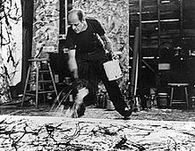
The apparent purpose of the attack on culture from the Intelligence sector was to degrade both art and music, to neutralize the ability of artists to define culture, to resist power, to define tyranny. Both the Beatles and Warhol played a part in this. Warhol, who supposedly died in 1987, was not a great artist, not even a good one. But he was famous, and his work became valuable for that reason. CIA did indeed change the nature of art. (See photo to left.)
Warhol also made movies … really crappy movies. As long as he is spoiling one medium, why not others? From Wikipedia:
…he was a highly prolific filmmaker. Between 1963 and 1968, he made more than 60 films,[83] plus some 500 short black-and-white “screen test” portraits of Factory visitors.[84] One of his most famous films, Sleep, monitors poet John Giorno sleeping for six hours. The 35-minute film Blow Job is one continuous shot of the face of DeVeren Bookwalter supposedly receiving oral sex from filmmaker Willard Maas, although the camera never tilts down to see this. Another, Empire (1964), consists of eight hours of footage of the Empire State Building in New York City at dusk. The film Eat consists of a man eating a mushroom for 45 minutes. Warhol attended the 1962 premiere of the static composition by LaMonte Young called Trio for Strings and subsequently created his famous series of static films including Kiss, Eat, and Sleep (for which Young initially was commissioned to provide music). Uwe Husslein cites filmmaker Jonas Mekas, who accompanied Warhol to the Trio premiere, and who claims Warhol’s static films were directly inspired by the performance.[85]
I watched (part of) a Warhol movie one time, imagining by his reputation that he must be quite good. This, despite the warning from a movie guide that it was a turkey. It involved a buff young actor, maybe Bookwalter … memories are blurred – he was in an apartment, spent a lot of time in his underpants. I was bored. It was awful. I never saw another Warhol film.
Part 2: Why fake death, and why Stu?
Many are put off by the notion that a person can fake his or her death and reappear as someone else. Don’t we have investigative journalists? Wouldn’t someone notice? Wouldn’t someone talk?
We don’t have investigation journalism, unless you call a blog like this and others doing non-conventional work “investigators”. There are far more incurious “journalists” than real ones, the latter having a hard time finding employment. Secrets are well-guarded in our culture, and the news media, far from trying to uncover them, is part of the cover-up operation. In my list of Zombies, you’ll find ten to be prominent in the news business, and others, like Bill Maher and Dr. Phil McGraw, occupying prominent positions on television. Former CIA Director William Colby is said to have said
“The CIA owns everyone of any significance in the major media.”
That’s a widely attributed quote, and of course the debunkers say it is not accurate, but CIA runs debunking operations too, like Snopes. The idea is that in our society, no matter where you turn for information, that information is filtered and edited by Intel.
So yes, fake deaths are not going to be investigated by the media, especially by a media infiltrated with people who faked their own deaths and assumed new identifies.
By all that aside, why fake someone’s death? We cannot know, but the easiest explanation from the outside looking in is that these are Intelligence agents, and when their assignments are over, they are reassigned to new work, their old identities erased and a new ones invented. I also suspect that fake death, at age 53 and later, is a retirement benefit. John Denver, for example, lived his entire life in the spotlight pretending to be someone he wasn’t and believing things he did not. That’s a tough life for a person with a conscience. His fake death (at age 53) was probably a reward for a job well done.
Part 3: What was Warhol’s assignment?
In the Intelligence world, the goal is to control greater society through control of media – our thoughts, ambitions, habits, purchases, attitudes, political beliefs – everything. But Intel is far too smart to bludgeon us with their ideas. They know we might react in a negative manner. Instead, they are patient. They nudge us in the direction they want us to go. It has taken them decades to construct our society as it exists today, with its faux-education and emphasis on sports, consumerism, with a striking absence of critical thinking skills in the population. Just a push here and there over the decades, and now they own our minds and lives. Look at us!
Warhol’s job was to steal art from us. Art, like music, introduces a private world of thought, and is seen as dangerous by our overlords. For that reason they set out to rob it of content. The means by which they did this was to fund bad (“modern”) art and artists, and use their clout in owning all those prestigious magazines in promoting them. By power of suggestion, people began (and still do) imagine that crap is actually the result of talented artists, rather than poseurs. Look around for attractive art, look for beauty anywhere. Report back.
Down through the years the CIA, via the Congress for Cultural Freedom, funded scores of artists, among them Georgia O’Keefe, Adolph Gottlieb, Arshile Gorky, Jackson Pollock, and many others, including I assume, Andy Warhol (not mentioned in Saunders’ book). The Museum of Modern Art, founded by Nelson Rockefeller, was founded to promote bad art and give it an elite image.
In so doing, and in Orwellian fashion, art lost its ability to express rebellion (or even beauty) and ceased to be a counter-cultural force. And that, I believe was the objective. Warhol was just a small cog, a small tool in a large toolbox of fakes and poseurs. I am only writing about him here because I stumbled on his original identity of Sutcliffe.
Part 4: The timeline problem
In identifying fake deaths, it is important to pay attention to timelines. Keep in mind that each death is accompanied by a full biography supplied for the new person. This biography will have birthplace, parents and siblings, schools attended and even an early life story or two.
Since Intelligence is in charge on of the people both before and after fake death, it can supply birth dates. I am told I have a large problem with the Sutcliffe/Warhol matter because Warhol was born in 1928, while Sutcliffe was born 12 years later in 1940. But this is only a problem if the gap is so wide that it cannot be bridged. Suppose, for example, that the photo below, said to be Warhol at age 38, while the one on the right is said to be Sutcliffe – surely before age 23, as he died at 22 – or so we are told.


I can easily see Warhol being six years younger that 38. His complexion is fresh, like that of a youth. He’s developed no age lines. Sutcliffe, on the other hand, could easily be six years older in that photo. The point is, that just by looking at them we cannot necessarily see twelve years difference.
So while timeline appears to be an issue, it is not necessarily. Intelligence is in control of all information, and can paint any picture they want. Perhaps the story line called for Warhol to die at a certain time in the program – it would be helpful to make him older to make the death seem more believable. But who knows.
Intelligence also supplies youth photos for its assigns. I noticed that with Jim Morrison, for example, we were supplied real photos of “Jim,” but that his family was fake. They pasted him in to a whole bunch of photos.
With Andy Warhol I found four photographs of him as a youth.


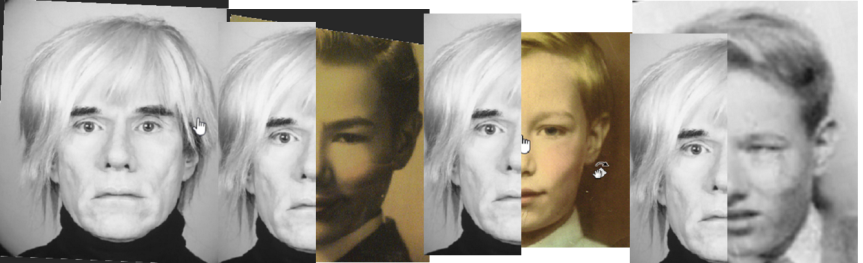
Aside from the two boys seated on mother’s lap, these might the same boy. They are not Andy Warhol. It is, at best, inconclusive.
So while the timeline presents a problem, I have to answer the question: Why not use real youth photos of Andy Warhol? Why present us with an impostor? The answer, of course, if that there was no youth by that name, so that had to use an impostor. (One might ask why they didn’t just grab some youth photos of Sutcliffe and call them Warhol. They could have, but they did not. They probably didn’t think anyone would look that closely. (Intel does not have great respect for our intelligence, and does not fear nonexistent investigative reporting.)
By the way, face chops there very clearly show two people, even if one only looks at the ears in chop three, where head angle is relatively the same. But face chops are only evidence, are not going to be my main thrust. The photo analysis to follow will be much more precise, and will, I hope, make my case.
Part 5: Photo Comparisons – moles, face chops, layers, silhouettes
Below is a photo as shown above of Andy Warhol, said to have been taken in 1966 when Warhol would have been 38 years old.
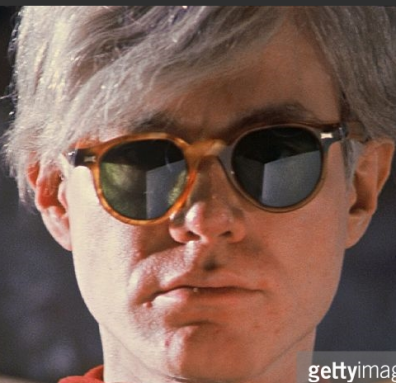
Note the presence of three moles and perhaps a canker sore on his lip. The moles are circled in the image below.

Note how in later photographs the moles are gone, either airbrushed out of the photos, or surgically removed.
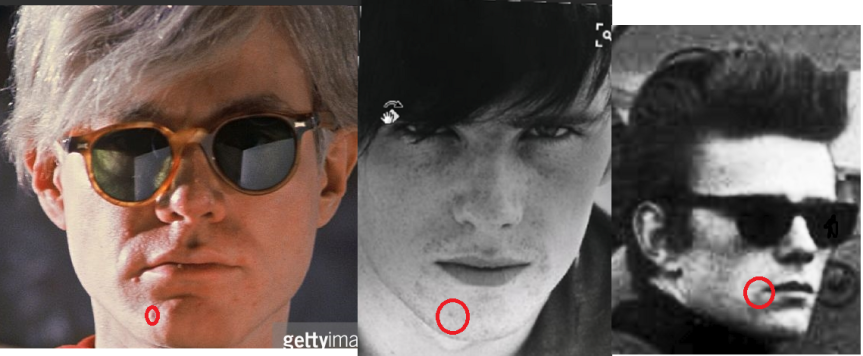
Note how in the middle photo Sutcliffe has what appears to be a blemish in exactly the same place as the apparent mole on Warhol. In the shot on the right, Sutcliffe has some sort of blemish in the same spot as Warhol’s mole on the lower right of his lip. That photo of Sutcliffe is very grainy.
Speculation here is that Warhol, when first making the identify change, had some facial blemishes that were later removed. Sutcliffe shows signs of these very same blemishes, though the photographic evidence is not conclusive .
Here is better evidence. Below are two left profile shots of Sutcliffe and Warhol:


Here is a “gif” of the two superimposed on one another:
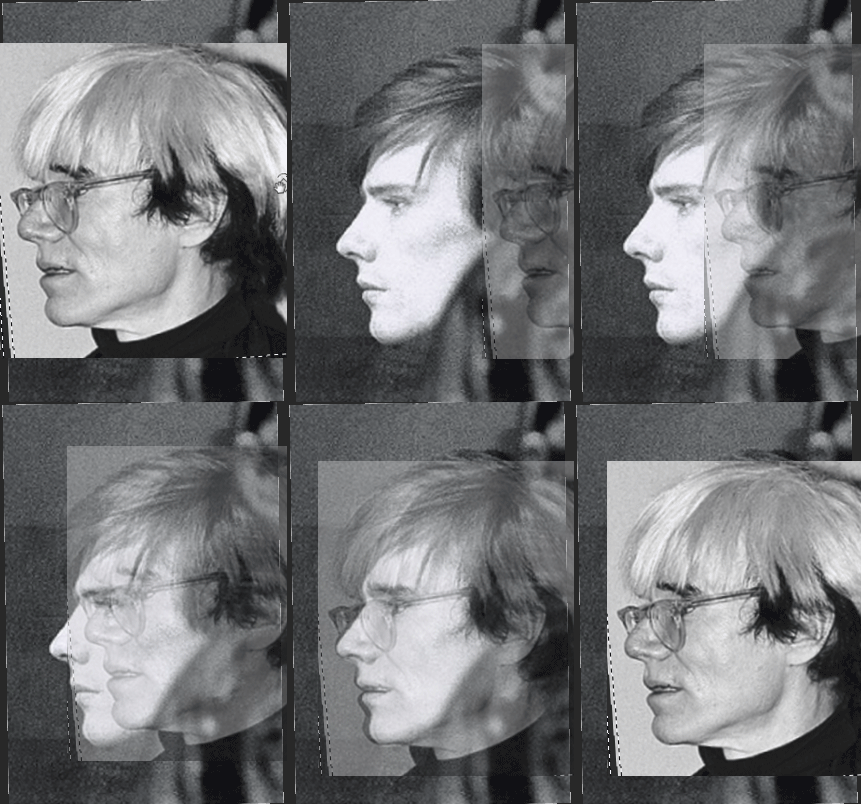
I see very good alignment of features. However, in the right profile of Sutcliffe, his ear is not available. Here are two profiles from the right:


Here Warhol’s ear is visible. And here is a gif leading to an overlay of the two images:
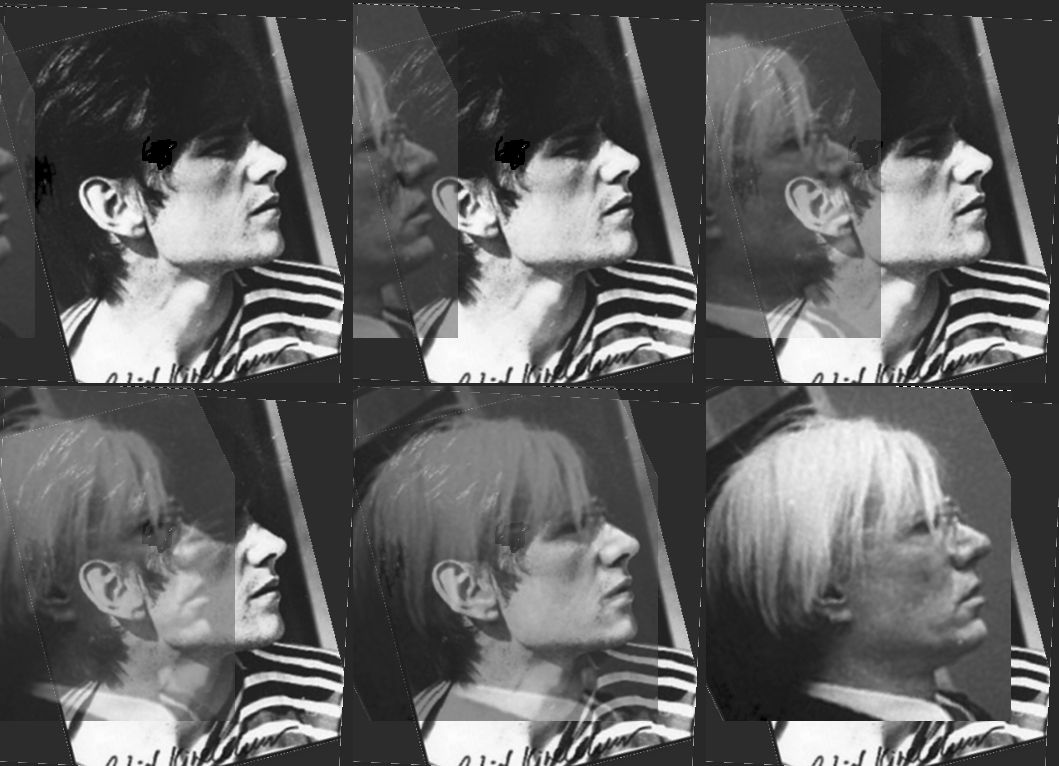
As you can see, the ears line up.
Finally, a full frontal view of “both” men.


And a gif overlay …
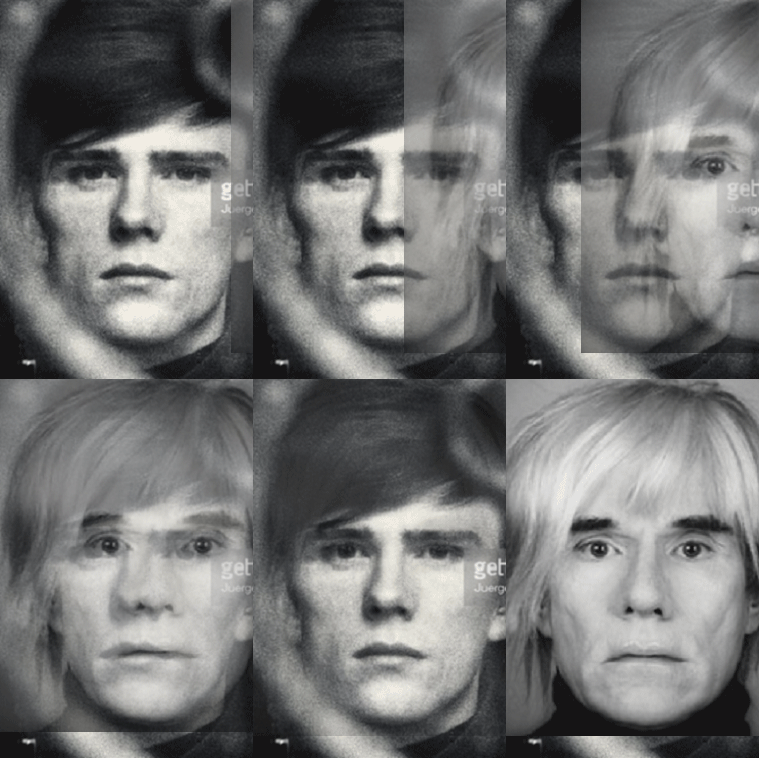
The two men appear to me to be one and the same at different ages.
I maintain that Stu Sutcliffe faked his death and took on the persona of “Andy Warhol,” an invented name with an invented biography, as part of a larger CIA project to rob art of meaningful content, a project alive to this day.
_______________
Finally, some odds and ends:
Was Stu Sutcliffe gay? It is rumored, and Beatles buffs will tell you that he and John were lovers. Warhol was gay, admitted by all. I bring up this subject because of this photograph:
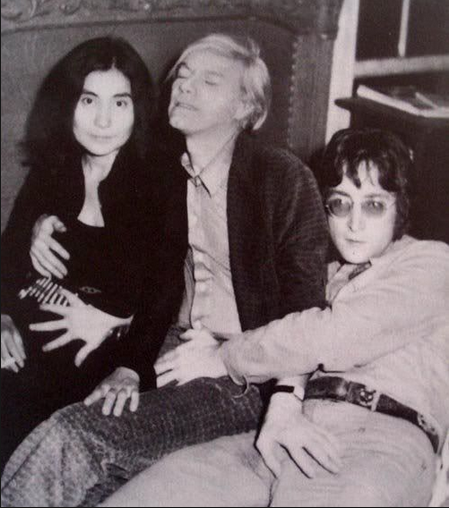
Sutcliffe and John Lennon knew each other, supposedly since art school in London. In this photo, at least, there seems to be an attraction between the men, Warhol, openly gay, groping both Lennon and Ono while Lennon gropes Warhol. My working premise is that Yoko Ono was/is a beard*. (This does not mean that they could not have a child.)
In Wikipedia we learn the following about Warhol:
“On June 3, 1968, radical feminist writer Valerie Solanas shot Warhol and Mario Amaya, art critic and curator, at Warhol’s studio.[37] Before the shooting, Solanas had been a marginal figure in the Factory scene. She authored in 1967 the S.C.U.M. Manifesto,[38] a separatist feminist tract that advocated the elimination of men; and appeared in the 1968 Warhol film I, a Man. Earlier on the day of the attack, Solanas had been turned away from the Factory after asking for the return of a script she had given to Warhol. The script had apparently been misplaced.[39]”
I will leave footnotes and dates to the numerologists, but suggest without further research that this event was probably staged, and that Warhol was not harmed. What better way to bring a mediocre artist with Intelligence ties to the national forefront than an attempted murder? It looks more like a rollout.
We also learn from Wikipedia that …
[Warhol] began exhibiting his work during the 1950s. He held exhibitions at the Hugo Gallery[26] and the Bodley Gallery[27] in New York City; in California, his first West Coast gallery exhibition[28][29]
This, of course, would mess up the timeline if indeed Warhol was featured in these now-defunct art galleries. Without photographs of the exhibits, I would suggest that the same people who substituted fake photos of the youthful Warhol might also be able to plant information like this in Wikipedia, a controlled source anyway. Both galleries were for modern art at a time when Intelligence was pushing this kind of art into the mainstream. I would suggest that the supposed exhibits, like Warhol himself, were fake, mere insertions in Wikipedia for sake of assisting the hoax.
Warhol died in Manhattan, at 6:32 am, on February 22, 1987. According to news reports, he had been making good recovery from gallbladder surgery at New York Hospital before dying in his sleep from a sudden post-operative cardiac arrhythmia.[52] Prior to his diagnosis and operation, Warhol delayed having his recurring gallbladder problems checked, as he was afraid to enter hospitals and see doctors.[47] His family sued the hospital for inadequate care, saying that the arrhythmia was caused by improper care and water intoxication.[53] The malpractice case was quickly settled out of court; Warhol’s family received an undisclosed sum of money.[54]
I find with fake deaths that “out of court” settlements of lawsuits (probably fake too) are common, and that “undisclosed” sums of money are not uncommon. In 1987 Warhol would have been 47 years old, if Sutcliffe’s date of birth is accurate, or 58 if “Warhol’s” is the accurate date. Most likely neither is reliable, and anyway, this event was probably the second fake death in the ongoing life of this man, Sutcliffe or whatever his real name was. Fake death at a later age usually means retirement, his assignment over, job well done. Stu/Andy is probably still with us, maybe living in Liverpool, maybe in Brazil.
______________
*Paul McCartney, the one we know now anyway, told Howard Stern in a Sirius interview that he thought John Lennon and Brian Epstein had a fling.













As to girls loving the Beatles, I’m not so sure. Of course at first and then, when our parents found them not too bad, we moved on to the Stones.
A familiar story arc Belyi, I’m sure that many lasses of that time took a similar view. The Beatles were “nice”, the Stones far more “rebellious”
The irony is that BOTH bands were intelligence projects. See here, page 10
https://mileswmathis.com/dylan.
“It gets even better when we discover that the Rolling Stones came out of the LSE. As it turns out, Mick wrote a grant proposal for the Stones while in school, and the LSE provided the band’s first funding. Wow. ”
LSE is of course a Fabian institution. All Labour “leaders” have been Fabians, every last one, including the current incumbent Sir Quier
The whole article is worth a look, it deconstructs Bob Dylan and more
https://mileswmathis.com/dylan.pdf
One above didn’t work for some reason
Oh I agree, Pete. The Stones are downright satanic, but we didn’t look at the nuances in those far-off days.
Brian Jones assembled/recruited the Stones and was the genius who created their style and reputation. When he quit the band and tried to set up as an independent, he unfortunately died. The main media never mentions he had already left the band when he died. More subtle music before Brian Jones left body language shows Jagger couldn’t stand him! – https://www.youtube.com/watch?v=IzcLdHBFfYU&list=RDIzcLdHBFfYU&start_radio=1
‘…he unfortunately died’. Hmm, I would say he was unfortunately murdered.