Exploring Biodigital Convergence: What happens when biology and digital technology merge
Thu 9:52 pm +00:00, 12 Feb 2026
Biodigital convergence may profoundly impact our economy, our ecosystems, and our society. Being prepared to support it, while managing its risks with care and sensitivity, will shape the way we navigate social and ethical considerations, as well as guide policy and governance conversations.
Guided by its mandate, Policy Horizons Canada (Policy Horizons) intends to start an informed and meaningful dialogue about plausible futures for biodigital convergence and the policy questions that may arise. In this initial paper, we define and explore biodigital convergence – why it is important to explore now, its characteristics, what new capabilities could arise from it, and some initial policy implications. We want to engage with a broad spectrum of partners and stakeholders on what our biodigital future might look like, how this convergence might affect sectors and industries, and how our relationships with technology, nature, and even life itself could evolve.
We welcome your comments and participation, and look forward to diving more deeply into the questions raised in this paper.
Kristel Van der Elst
Director General
Policy Horizons Canada
Summary
In the late 1970s and early 1980s, Canadians and policy makers began to understand that the digital age was upon us. Early movers seized opportunities, grappled with challenges, and initiated deft policies that have provided benefits for decades. We continue to see the powerful effects of digitization, and more are surely to come. But we may be on the cusp of another disruption of similar magnitude. Digital technologies and biological systems are beginning to combine and merge in ways that could be profoundly disruptive to our assumptions about society, the economy, and our bodies. We call this the biodigital convergence.
This paper sets out an initial framing to guide Policy Horizons’ upcoming foresight work.
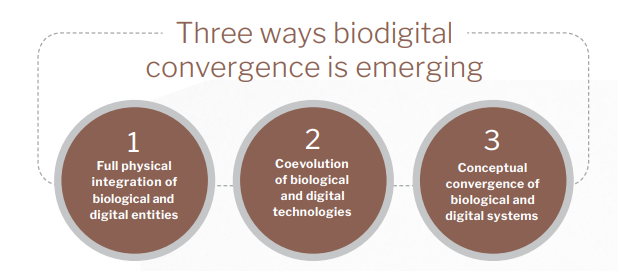
Three ways biodigital convergence is emerging
Three ways biodigital convergence is emerging – Text version
Biodigital convergence is opening up striking new ways to:
- Change human beings – our bodies, minds, and behaviours
- Change or create other organisms
- Alter ecosystems
- Sense, store, process, and transmit information
- Manage biological innovation
- Structure and manage production and supply chains
Possible characteristics of the biodigital system
- Democratization
- Decentralization
- Geographic diffusion
- Scalability
- Customization
- Reliance on data
Initial policy-relevant questions
- Economic
-
- Could traditional resource-based competitive advantages fade
- Would education and training systems need to be adapted to address potential skills gaps
- What could data protection and intellectual property frameworks look like in the biodigital era
- How can policy foster a competitive business environment in a biodigital world
- Social
-
- Could social attitudes shift towards health and lifestyle
- What policies could help address health inequality
- What policies could foster trust among partners and stakeholders
- Environmental
-
- What changes could occur in land use and the natural environment
- Geopolitical
-
- What policies are necessary to compete in a global biodigital world
- What is needed to protect citizens’ security in the biodigital world
- Governance
-
- How can regulation and policy making take social concerns about biodigital advances into account
- Is the current tax framework suited for the biodigital world
- Do public finance systems need to be reassessed to be sustainable in the biodigital world
What is biodigital convergence?
Biodigital convergence is the interactive combination, sometimes to the point of merging, of digital and biological technologies and systems. Policy Horizons is examining three ways in which this convergence is happening.
Full physical integration of biological and digital entities
Digital technology can be embedded in organisms, and biological components can exist as parts of digital technologies. The physical meshing, manipulating, and merging of the biological and digital are creating new hybrid forms of life and technology, each functioning in the tangible world, often with heightened capabilities.
Robots with biological brainsFootnote1 and biological bodies with digital brainsFootnote2 already exist, as do human-computer and brain-machine interfacesFootnote3. The medical use of digital devices in humansFootnote4, as well as digitally manipulated insects such as drone dragonfliesFootnote5 and surveillance locustsFootnote6, are examples of digital technology being combined with biological entities. By tapping into the nervous system and manipulating neurons, tech can be added to an organism to alter its function and purpose. New human bodies and new senses of identityFootnote7 could arise as the convergence continues.
Coevolution of biological and digital technologies
This type of biodigital convergence emerges when advances in one domain generate major advances in the other. The coevolution of biological and digital sciences and technologies enables progress in each domain that would be impossible otherwise. This could lead to biological and digital technologies that are developed as integrated or complementary systems.
Complex living systems – bacteria, fungi, plants, and animal life including humans – are increasingly subject to examination and understanding by digital tools and applications such as machine learning. This deeper understanding, enabled by digital technologies, means that biology is subject to influence and manipulation that was not possible a few years ago.
For example, gene sequencing combined with artificial intelligence (AI) leads to understanding genetic expression, which is then used to alter existing organisms to create organic compounds in new waysFootnote8 or even entirely synthetic organismsFootnote9. The CRISPR/Cas9 approach and other new gene editing techniques would have been impossible without the evolution of digital technology and bioinformatics. Advances in digital technologies have helped the advancement of the biodigitalFootnote10.
We also see a greater understanding of biology, which is fueling progress in the field of biological computing. Neural nets – computer systems that are designed based on biological brains – are an example of how biological understanding is shaping digital technology.
There is also a blurring between what is considered natural or organic and what is digital, engineered, or synthetic. For example, biosynthetic vanilla is created using ferulic acid, eugenol, and glucose as substrates, and bacteria, fungi, and yeasts as microbial production hosts. Although it does not come from a vanilla plant, under both U.S. and EU food legislation, its production from “microbial transformations of natural precursors” allows it to be labelled as a “natural flavoring”Footnote11.
Conceptual convergence of biological and digital systems
A third form of biodigital convergence involves a shift in perspective that could reshape our framing and approach to biological and digital realms, facilitating the blending of the two.
As we continue to better understand and control the mechanisms that underlie biology, we could see a shift away from vitalism – the idea that living and nonliving organisms are fundamentally different because they are thought to be governed by different principlesFootnote12. Instead, the idea of biology as having predictable and digitally manageable characteristics may become increasingly common as a result of living in a biodigital age. Any student of biology today will have grown up in a digital world and may consciously or subconsciously apply that frame of reference to bioinformatics and biology generally.
From a digital perspective, we see a potential shift in the opposite direction. Computing began as a means of producing predictable, replicable, and relatively simple outcomes. As digital technology became more complex and connected, the system began to mimic the characteristics of the biological world, leading to the notion of technological ecosystems. Biological models are also being used to develop digital tools, such as AI based on neural nets.
Three ways biodigital convergence is emerging
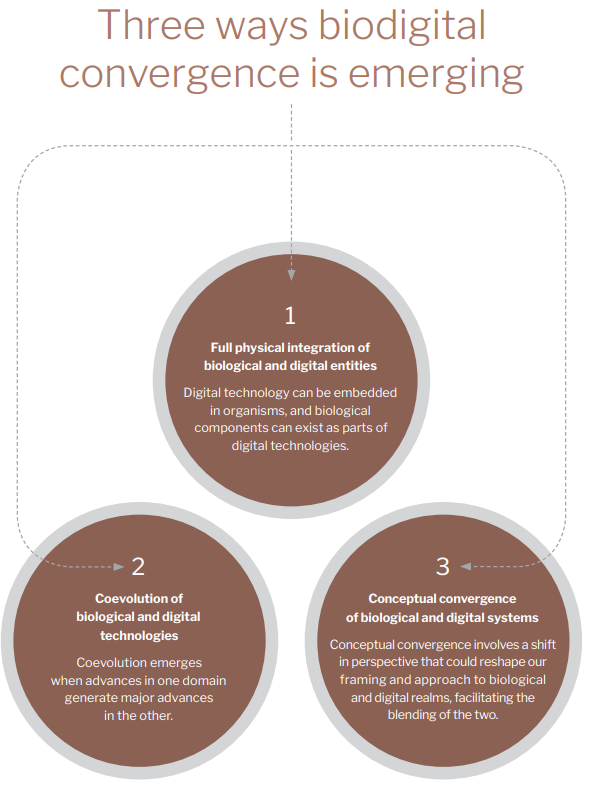
Three ways biodigital convergence is emerging – Text version
Why explore biodigital convergence now?
There are enough signals to give shape to potential biodigital futures. These signals suggest that biosciences and biotechnology may be at the cusp of a period of rapid expansion—possibly analogous to digital computing circa 1985.
That year, Microsoft introduced Windows 1.0, Atari released the Atari ST home computer, and the first domain name, symbolics.com, was registered. Computing was entering the mass market, creating value across many more types of organizations and contexts than it had during the decades of giant mainframes.
Biodigital convergence is showing signs of a similar trajectory—moving away from the centralized models of pharmaceutical and industrial biotech toward widespread commercial and consumer use. These range from bioprinters that create organic tissue, to synthetic biology machines that can be programmed to create entirely new organisms. For example, Printeria is an all-in-one bioengineering device that automates the process of printing genetic circuits in bacteria. It is intended to be as easy to use as a domestic desktop printer and is projected to cost $1,500Footnote13.
Rapid progress in biological technologies has benefited from the low-cost, broad availability, and increasing capabilities of digital processing, storage, and communication.
However, the biological realm’s own unique and special attributes are simultaneously influencing digital systems. New forms of biological capabilities are being built into digital networks as well as AI applications and computation, making them more efficient and creating new opportunities.
Biodigital convergence involves a rethinking of biology as providing both the raw materials and a mechanism for developing innovative processes to create new products, services, and ways of being.
Today’s rapid rate of change and innovation compels us to reassess our understanding and expectations about biological and digital systems. The convergence of these domains could cause systemic change across sectors and have policy implications. Governments can expect to be called upon to help manage the risks and seize the opportunities that could arise.
Good morning, biodigital
Many factors could affect how biodigital convergence technologies could impact different societies, countries, cultures, environments, and people around the globe. The following is one of many possible narratives depicting some of the innovations in a future biodigital world.
I wake up to the sunlight and salty coastal air of the Adriatic sea. I don’t live anywhere near the Mediterranean, but my AI, which is also my health advisor, has prescribed a specific air quality, scent, and solar intensity to manage my energy levels in the morning, and has programmed my bedroom to mimic this climate.
The fresh bed sheets grown in my building from regenerating fungi are better than I imagined; I feel rested and ready for the day. I need to check a few things before I get up. I send a brain message to open the app that controls my insulin levels and make sure my pancreas is optimally supported. I can’t imagine having to inject myself with needles like my mother did when she was a child. Now it’s a microbe transplant that auto adjusts and reports on my levels.
Everything looks all right, so I check my brain’s digital interface to read the dream data that was recorded and processed in real time last night. My therapy app analyzes the emotional responses I expressed while I slept. It suggests I take time to be in nature this week to reflect on my recurring trapped-in-a-box dream and enhance helpful subconscious neural activity. My AI recommends a “forest day”. I think “okay”, and my AI and neural implant do the rest.
The summary of my bugbot surveillance footage shows that my apartment was safe from intruders (including other bugbots) last night, but it does notify me that my herd of little cyber-dragonflies are hungry. They’ve been working hard collecting data and monitoring the outside environment all night, but the number of mosquitoes and lyme-carrying ticks they normally hunt to replenish their energy was smaller than expected. With a thought, I order some nutrient support for them.
My feet hit the regenerative carpet and I grab a bathrobe, although I don’t need it for warmth. My apartment is gradually warming up to a comfortable 22 degrees, as it cycles through a constantly shifting daily routine that keeps me in balance with the time of day and season. Building codes and home energy infrastructure are synchronized, and require all homes be autoregulated for efficiency. Because houses and buildings are biomimetic and incorporate living systems for climate control wherever possible, they are continuously filtering the air and capturing carbon. I check my carbon offset measure to see how much credit I will receive for my home’s contribution to the government’s climate change mitigation program.
As I head to the bathroom, I pause at the window to check the accelerated growth of the neighbouring building. Biological architecture has reached new heights and the synthetic tree compounds are growing taller each day. To ensure that the building can withstand even the strongest winds – and to reduce swaying for residences on the top floors – a robotic 3D printer is clambering around the emerging structure and adding carbon-reinforced biopolymer, strengthening critical stress points identified by its AI-supported sensor array. I am glad they decided to tree the roof of this building with fire-resistant, genetically modified red cedar, since urban forest fires have become a concern.
While I’m brushing my teeth, Jamie, my personal AI, asks if I’d like a delivery drone to come pick up my daughter’s baby tooth, which fell out two days ago. The epigenetic markers in children’s teeth have to be analysed and catalogued on our family genetic blockchain in order to qualify for the open health rebate, so I need that done today.
I replace the smart sticker that monitors my blood chemistry, lymphatic system, and organ function in real time. It’s hard to imagine the costs and suffering that people must have endured before personalized preventative medicine became common.
Also, I’ll admit that it sounds gross, but it’s a good thing the municipality samples our fecal matter from the sewage pipes. It’s part of the platform to analyze data on nutritional diversity, gut bacteria, and antibiotic use, to aid with public health screening and fight antibiotic-resistant strains of bacterial infections.
Supposedly, the next download for my smart sink will allow me to choose a personalized biotic mix for my dechlorinated drinking water.
Today’s microbiome breakdown is displayed on the front of my fridge as I enter the kitchen. It’s tracking a steady shift as I approach middle age: today it suggests miso soup as part of my breakfast, because my biome needs more diversity as a result of recent stress and not eating well last night.
The buildings in my neighbourhood share a vertical farm, so I get carbon credits by eating miso made from soybeans produced on my roof and fermented by my fridge.
My fridge schedules the production of more miso and some kimchi in preparation for the coming week. It also adds immune-boosting ingredients to my grocery order because we’re approaching flu season, and a strain that I’m likely to be susceptible to has been detected only a few blocks away.
I take my smart supplement, which just popped out of my bioprinter. The supplement adjusts the additional nutrients and microbes I need, and sends data about my body back to my bioprinter to adjust tomorrow’s supplement. The feedback loop between me and my bioprinter also cloud-stores daily data for future preventive health metrics. The real-time monitoring of my triglycerides is important, given my genetic markers.
As my coffee pours, I check my daughter’s latest school project, which has been growing on the counter for the past week. She’s growing a liver for a local puppy in need as part of her empathy initiative at school. More stem cells are on the way to start a kidney too, because she wants to help more animals. I grab my coffee, brewed with a new certified carbon-negative bean variety, and sit on the couch for a minute.
It appears the nutrient treatment I had painted on the surface of the couch and chairs has allowed them to rejuvenate. I’ll have to try the treatment on my bioprinted running shoes, as they’re starting to wear out.
Oh wow – is that the time? I have only 10 minutes before my first virtual meeting. I tighten the belt on my skeleto-muscular strength chair, lean back, and log into my workspace. First I get the debrief from colleagues finishing their work day on the other side of the world. I shiver momentarily as I think about how intimately we’re all connected in this digital biosphere – then it passes. Let the day begin.
This story may sound far-fetched, however all the technologies mentioned exist in some form today. While they are not yet commercially available in the form presented here, a world where we take the interaction between biological and digital technologies for granted is already starting to emerge.
While this is a representation of technologies that could be part of a biodigital world, it does not represent the only plausible future. Rather, it is an imaginative vignette outlining the radical shifts that could take place within an optimistic biodigital future. Varying levels of access, adoption, and alternative realities could exist.
What new capabilities arise from biodigital convergence?
We are already experiencing the combination of digital and biological systems through new products, platforms, services, and industries.
Biodigital convergence is opening up strikingly new ways to:
- change human beings – our bodies, minds, and behaviours
- change or create other organisms
- alter ecosystems
- sense, store, process, and transmit information
- manage biological innovation
- structure and manage production and supply chains
New capabilities produced by the convergence of digital and biological systems
New ways to change human beings – our bodies, minds, and behaviours
-
1. Altering the human genome – our core biological attributes and characteristics
-
2. Monitoring, altering and manipulating human thoughts and behaviours
-
3. New ways to monitor, manage, and influence bodily functions, as well as predict, diagnose, and treat disease
-
4. Creating new organs and enhancing human functionality
-
5. New ways to experience and interact with the world
-
6. Creating new organs and enhancing human functionality
New ways to change or create other organisms
-
1. Changing the type or amount of inputs that organisms need to grow
-
2. Creating entirely new organisms with tailored characteristics
-
3. Changing what and how organisms produce substances
New ways to alter ecosystems
-
1. Changing and eradicating entire species
-
2. Altering the natural environment at scale
-
3. Predicting and managing the spread of organisms
New ways to sense, store, process, and transmit information
-
1. New ways to store information using biological systems
-
2. Turning organisms into biocomputers
-
3. Creating biomimetic materials
New ways to manage biological innovation, production, and supply chains
-
1. More efficient and scalable research and production approaches
-
2. Increasingly open and efficient supply chain management
-
3. Open collaboration on cell lines and genomes to support research
What are possible characteristics of the biodigital system?
Based on initial signals, the characteristics of the biodigital system could include:
The following outlines each potential characteristic of the biodigital and their potential impact.
- Democratization
- Until recently, cell biology and biotechnology were generally developed and produced in sterile labs and specialized factories, using expensive equipment and expertise.
Now, advances in software and hardware are removing these restrictions on biosciences and biotech production. The ability to control systems remotely and transmit instruction sets in digital form, as well as higher levels of automation, are shifting biology-based production closer to consumers.
For example, mail-order bioengineering or CRISPR kits allow biohackers to purchase and practice genetic alteration at home. A range of relatively affordable online consumer options include a 30 USD “Genetic Design Starter Kit” allowing a novice to insert a gene into a jellyfish to make it glow from the comfort of their kitchen tableFootnote50. Another CRISPR kit allows purchasers to make genome edits in bacteria that can reproduce for 159 USDFootnote51. A third “molecular biology and genetic engineering” starter kit costs less than 170 USDFootnote52.
The decreasing cost of genome sequencing is another example of biotech becoming more broadly available. The first whole genome sequencing (reading all 3 billion base pairs) in 2003 took 13 years and cost more than 3 billion USD. By 2016, the price had dropped to approximately 1000 USD. In July 2019, it cost 599 USD, and personal genetics company Veritas Genetics predicts that it will drop to below 200 USD by 2022Footnote53. As a result, a consumer market for genotyping (which sequences less than 1% of the genome) has emerged to support people interested in their heritage or uncovering targeted health information, typified by services such as 23andme.com.
- Decentralization
- We may see more decentralized production as the capabilities of synthetic biology increase. Products that needed to be created or extracted in a specific geographical location could be produced more widely as humans get better at assembling – or growing – organic and nonorganic compounds through faster, cheaper, and customized chemical and biological processes.
This includes the ability to create food and engineer meat without the need for arable landFootnote54. Lab-grown meat—cells that develop to produce muscle cells and cultured meat in a monitored environment—could be a game changer in decentralizing multiple industries from farming to shipping.
The Japanese biotech company Spiber has developed a genetically modified protein called Brewed ProteinFootnote55 that can be used as a textile in the fashion industry, or as a robust material in the construction and automobile industries. And biomass produced locally by algae-based bioreactorsFootnote56 capturing carbon dioxide could be transformed into products such as fuels, plastics, and cosmetics.
- Geographic diffusion
- Decentralization could allow economies lacking in natural resources to compete with resource-rich nations for the production of goods, using biodigital technologies to produce materials that previously needed to be imported.
Increasing interest in open-source and publicly available research could allow rapid geographic diffusion. More generally, diffusion of biodigital knowledge could proceed rapidly if there is a willingness to share information. Some researchers are allowing access to all of their data. For example, pioneering bioengineers at the University of Washington are commercializing recent breakthroughs in 3D organs. Through their company, Volumetric, they have made all the source data from their experiments on 3D-printed vascular networks freely availableFootnote57.
- Scalability
- Rapid scaling may be possible in both the digital and biological worlds. Data can be copied quickly, and simple biological organisms can generally replicate easily. This means an additional unit of production in both domains may be created quickly and easily.
In other words, the biodigital economy could be characterized by very low marginal production costs. Provided there is competition among providers, this characteristic could significantly reduce the cost of many biodigital goods or services for consumers.
Low marginal production costs and ease of replication also mean that innovations in the biodigital convergence economy could be highly scalable.
- Customization
- Biological systems are simultaneously simple and complex. As dynamic systems, they can respond in unanticipated ways, or cause multiple impacts that cannot be easily disentangled. This complexity is a feature of biological systems rather than a bug, as it means systems can be highly adaptable and varied. This suggests that there may be many pathways to obtaining desired outputs and consequently the potential for high degrees of customization.
Production approaches and devices could leverage this complexity to produce multiple customized biological outputs from single systems. For example, economies of scope allow companies developing synthetic biology to produce hundreds of different organisms and outputs with similar processesFootnote58.
In a healthcare context, one example of biological complexity is reflected in our expanding understanding of the human microbiome – the trillions of non-human bacteria living in and on our bodies, estimated to equal or outnumber our own human cells. Our microbiome influences many different aspects of our lives, from digestion to mood to body odour. Biodigital therapies targeted at microbiomes, personalized for maximum efficiency, may emerge first.
- Reliance on data
- The technologies and applications featuring biodigital convergence will not be able to operate without a lot of data. For example, the field of bioinformatics uses digital tools and data analysis to understand biological systemsFootnote59, including deploying deep learning algorithms to analyze images of cells to detect patterns that humans would find impossible to discernFootnote60. Techniques such as next-generation gene sequencing are hugely data intense, creating new challenges with sharing, archiving, integrating, and analyzing this dataFootnote61.
The global bioinformatics market is projected to grow from 7.73 billion USD in 2018 to 13.50 billion USD in 2023, at a compound annual growth rate of 14.5%Footnote62. The rate of data growth to fuel this expansion could exceed this.
The data required is highly varied. Upstream of the production processes, data may also be an important asset in the form of genomes, phenotypes, and environmental contexts of a diverse set of humans and a wide range of unique organisms. Bioprospecting is already an important aspect of drug development, and may rise in importance – and provoke greater controversy in healthcareFootnote63.
The full potential of biodigital convergence may therefore require a constant flow of data. Capturing, managing, sharing, and governing this data could become a resource-intensive process and a more highly developed industry in itself.
What are some initial policy questions?
The dynamics of the biodigital world described above – democratization, decentralization, geographic diffusion, scalability, customization, and data reliance – may require individuals, governments, organisations, and industry to change the way they operate.
Policy Horizons will explore potential implications of the biodigital convergence in an upcoming in-depth foresight study. The following section highlights some initial policy-relevant questions concerning the economic, social, ecological, geopolitical, and governance domains.
Policy-related questions arising from biodigital convergence
- Economic
- Could traditional resource-based competitive advantages fade
- Would education and training systems need to be adapted to address potential skills gaps
- What could data ownership and intellectual property frameworks look like in the biodigital era
- How can policy foster a competitive business environment in a biodigital world
- Social
- What policies could foster trust between stakeholders
- What policies could help avoid potential rising health inequality
- Could there be a shift in social attitudes towards health and lifestyle
- Environmental
- What changes could occur in land use and the natural environment
- Geopolitical
- What policies are necessary to compete in a global biodigital world
- What is needed to protect citizens’ security in the biodigital world
- Governance
- How can regulation and policy making take social concerns regarding biodigital advances into account
- Is the current tax framework suited for the biodigital world
- Do public finance systems need to be reassessed to be sustainable in the biodigital world
Economic
-
Could traditional resource-based competitive advantages fade?
-
Would education and training systems need to be adapted to address potential skills gaps?
-
What could data protection and intellectual property frameworks look like in the biodigital era?
-
How can policy foster a competitive business environment in a biodigital world?
Social
-
Could social attitudes shift towards health and lifestyle?
-
What policies could help address health inequality?
-
What policies could foster trust among partners and stakeholders?
Environmental
-
What changes could occur in land use and the natural environment?
Geopolitical
-
What policies are necessary to compete in a global biodigital world?
-
What is needed to protect citizens’ security in the biodigital world?
Governance
-
How can regulation and policy making take social concerns about biodigital advances into account?
-
Is the current tax framework suited for the biodigital world?
-
Do public finance systems need to be reassessed to be sustainable in the biodigital world?
“The future ain’t what it used to be”
The biodigital could unfold in numerous ways, and a future where the biodigital is part of human existence could be quite different. The following narratives, although hypothetical, describe scenarios that could emerge as biological and digital systems converge.
Radical life extension: Following a decade of simulating human biochemistry using machine learning, an Asia-based company becomes the first to develop and patent a radical life-extension therapy. Based on altering the human genome in cells throughout the body, the therapy dramatically slows cellular deterioration, adding up to 15 years of healthy life to users, but effective only for people under the age of 40. The treatment is marketed worldwide at 10 million USD per course. More than 5,000 patients register for treatment within the first month of the announcement, including a reported 120 Canadians.
Inspired by: Barclays Beyond 100 report on LongevityFootnote77
Food customized to your unique digestive system: One of the fastest-growing companies in the food sector uses microbiome analysis to create personalised and dynamic nutrition plans. By designing food precisely for your body – and the trillions of non-human organisms that make up are part of your microbiome – MyBestBiome promises that you will have more energy and will feel better. Furthermore, 90% of the animal protein is sustainably sourced from specially engineered insects. The catch? You have to grant the company access and data rights to your entire biome to receive the product and its purported health benefits.
Inspired by: Diets should be personally tailored to your gut microbiome, study says, Food Design To Feed the Human Gut MicrobiotaFootnote78
Neurotech nightmare: A leading Canadian supermarket is having a bad year. It’s been embroiled in a scandal over several features of its loyalty program. The “Your Choice” program offers special discounts and preemptive ordering if you allow it full access to your “digital twin” – essentially giving it full access to your life and activity. A leaked internal report suggests that this data is being used in conjunction with intrusive neurotechnologies to encourage members into consuming more. At the centre of the scandal is the fact that the supermarket is essentially selling access to the minds of “Your Choice” members, outsourcing targeted consumer manipulation on a massive scale.
Inspired by: Towards new human rights in the age of neuroscience and neurotechnologyFootnote79
Conclusion
We could be on the cusp of a long-term biodigital transformation of our economy, society, institutions, and environment. This biodigital convergence could disrupt the way we produce and consume goods and services, relate to one another, maintain and augment our bodies, acquire and process data, make decisions, and manage our place in ecosystems.
In the late 1970s and early 1980s, Canadians and policy makers began to understand that the digital age was upon them. Early movers seized opportunities, perceived challenges, and initiated deft policies that have provided benefits for decades. Now could be the time to make similar investments and make thoughtful decisions to guide Canada through the beginning of a biodigital convergence.
Policy Horizons looks forward to collaborating with partners and stakeholders to develop policy-relevant foresight in this area.
Acknowledgements
Policy Horizons is spearheading an area of foresight called the biodigital convergence. This scoping paper is the initial framework for a forthcoming in-depth foresight study. As this new domain emerges, we will continue to examine plausible futures for biodigital convergence and the policy questions that may arise.
Exploring Biodigital Convergence project team
- Marcus Ballinger, Manager
- Steffen Christensen, Senior Foresight Analyst
- Nicholas Davis, SWIFT Partners Sàrl
- Kristel Van der Elst, Director General
- Pierre-Olivier DesMarchais, Foresight Analyst
- Avalyne Diotte, Foresight Analyst
- Eric Ward, Senior Director
Communications
- Maryam Alam, Communications Advisor
- Nelly Leonidis, Manager
- Alain Piquette, Graphic Designer
- Nadia Zwierzchowska, Editor
We would like to thank our colleagues Imran Arshad, Pascale Louis, and Claudia Meneses for their support on this project.
We look forward to collaborating with partners and stakeholders on the study of biodigital convergence.
© Her Majesty the Queen in Right of Canada, 2019
For information regarding reproduction rights: Contact Policy Horizons
Cat. No.: PH4-185/2019E-PDF
ISBN: 978-0-660-33015-0