
Did Bank of Japan crash the dollar? United States is among the most vulnerable to Japanese contagion
Thu 5:42 pm +00:00, 29 Jan 2026 2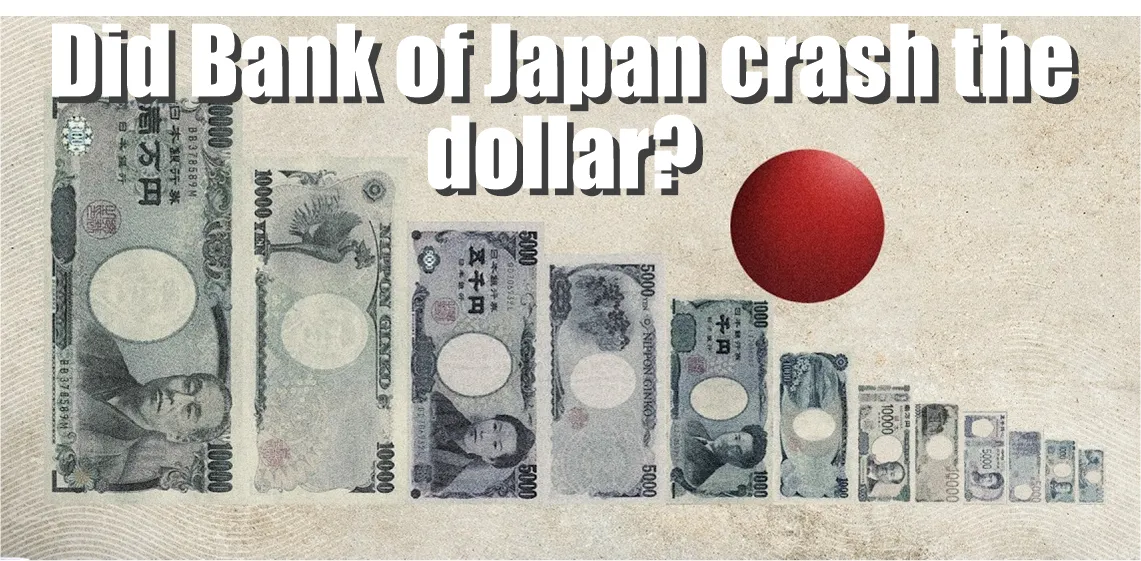
Source: https://alexkrainer.substack.com/p/did-bank-of-japan-crash-the-dollar
Over the last nine days, the US dollar index collapsed: on 19 January, the index closed at 99.16. Today it is trading below 96 – a 3.2% decline! This may not sound like much, but as far as foreign currency markets are concerned, it’s a very substantial move:

The culprit may have been the Bank of Japan. Over the last 26 years, Japan has been the world’s key exporter of financial capital. The Bank of Japan (BOJ) made money free in 1999 (setting interest rates at zero) and pioneered quantitative easing (QE) in 2001. With interest rates at or near zero and vast quantities of liquidity generated out of its printing presses, the BOJ became the world’s largest owner of Japanese Government Bonds (JGBs) as well as U.S. Treasuries.
Bank of Japan owns some 52% of all JGBs outstanding and around $1.2 trillion in U.S. treasuries (as of October 2025). In effect, the BOJ has been monetizing government debt. In the process, Japan has accumulated the highest ratio of public debt to GDP of any developed country: a whopping 260%. In other words, Japan’s public debt is now 2.6 times the size of the annual output of her entire economy.
The “carry trade” unwind tsunami
Japan has also been the source of the so-called carry trade: Japanese and foreign investors borrowed funds in Japan at very low interest rates, and invested them elsewhere around the world where return on capital was considerably higher. By today, Japan’s $7 trillion JGBs market has been the ultimate source of the colossal carry trade exposure that could cause unprecedented market turmoil. U.S. markets could be among the most vulnerable. According to Bloomberg, U.S. carry trade exposure totals some 342 trillion yen, corresponding to about 2.25 trillion U.S. dollars.

There’s no means of avoiding the final collapse
All these balances accumulated during the “good old days” of zero interest rates when market participants didn’t have a care in the world about the bulging debts: it was all free money, going around in nearly unlimited amounts. But as Ludwig von Mises correctly pointed out,
There is no means of avoiding the final collapse of a boom brought about by credit expansion. The alternative is only whether the crisis should come sooner as a result of voluntary abandonment of further credit expansion, or later as a final and total catastrophe of the currency system involved.
Today, the reversal of Japan’s zero interest rates policy and all that it entailed, is accelerating. This month, the yield on 10-year JGB hit over 2.3%, the highest level since 1997. Now, the cost of servicing Japan’s public debts consumes around 25% of the government’s budget. Rather than providing economic stimulus, the Bank of Japan has reversed its QE policy and has begun aggressively reducing its colossal balance sheet.
One of the unintended outcomes of BOJ’s aggressive QE policy has been the steady depreciation of the yen, in spite of rising interest rates. Now, to defend the yen and to keep their bonds markets from collapsing, the BOJ and other Japanese financial institutions must scramble to repatriate their foreign investments, including stocks, bonds, ETFs and ultimately even US government treasuries, since they represent the largest and most liquid foreign asset Japan owns. In a crisis, Japan will be forced to liquidate their US Treasury investments.
Western nations will follow Japan’s policies
This is an inevitability, as Ludwig von Mises predicted. The ultimate consequences of this crisis would be difficult to forecast, but given the magnitude of imbalances that are now present in global markets thanks to 26 years of Japan’s massive QE, the contagion from Japan could hit the whole global economy like a tsunami. In response, the governments of other Western nations might have to resort to the same policies as the BOJ.
When Japan yanks liquidity from under their markets, their central banks will have to ramp up their own printing presses that much more. Ultimately, this process leads to an acceleration of inflation and/or hyperinflation. And by now, every overindebted government will welcome inflation as it will enable them to get rid of their debts with a worthless currency.











As the dollar fell,silver surged. They’ve stopped the surge for now using massive control techniques, but make no mistake, silver will go again when the dollar falls again. This has been predicted for decades, but is starting to actually happen now.
Interesting
Yes decades, I stopped being a Jeremiah about this collapse some time back. I couldn’t see how it could be avoided, it felt inevitable, but it never happened so I gave up predicting. I still don’t understand how they avoided it for so long