Fuel shortages in Russia – why are gasoline-starved Russians complaining?
Wed 1:57 pm +00:00, 22 Oct 2025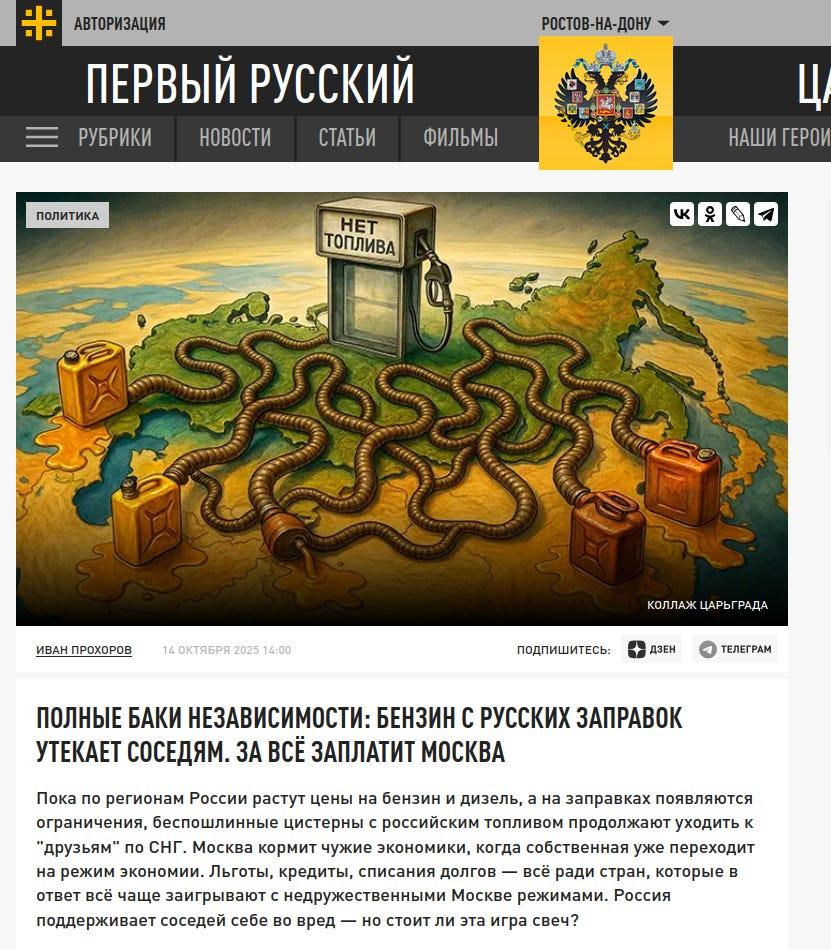
Fuel shortages in Russia is the price Moscow pays to remain the world’s moral superpower
It’s a well-known fact that Moscow has a moral duty to supply subsidized energy to countries openly hostile to Russia, so why are gasoline-starved Russians complaining?
So great is the Kremlin’s limitless kindness and alms-giving that its virtuous deeds, which almost never actually benefit the Russian people, are sometimes misinterpreted as state-sponsored treachery.
Indeed, even among Russia’s conservative Christians, there is a growing feeling that the Kremlin’s no-strings-attached altruism should in some small way provide discernible advantages to ordinary Russians, and not just Tajik oligarchs. (However, this is debatable.)
Last week, Tsargrad, a popular conservative-patriotic-Christian outlet in Russia that serves as a semi-official platform for adherents of the “Good Tsar, Bad Boyars” worldview, published a remarkable analysis of the Kremlin’s unparalleled generosity amid ongoing fuel shortages in the country.
Before I share with you an English translation of this article, I would like to provide some brief background on Russia’s fuel crisis.
Simply put, Russia currently lacks the refining capabilities to meet domestic fuel needs in some parts of the country. This unexpected turn of events has been blamed in large part on Ukraine’s aerial attacks on Russia’s energy infrastructure.
An October 18 report from Novosibirsk media does a good job of conveying at the local level what is happening in multiple regions across Russia:
The situation with gasoline in Russia has ceased to be an ordinary problem of individual gas stations and turned into a systemic one … The Novosibirsk region has also felt the consequences of the Russia-wide imbalance.
A correspondent of NGS.RU visited several gas stations in different parts of the city to personally verify the scale of the deficit. At the Teboil gas station, as well as at the Otti gas station, there was neither AI-95 nor AI-92 gasoline available. Readers on social media confirmed a worrying trend, reporting a lack of fuel at other gas stations in the city.
The situation has reached such intensity that one of the largest local chains—the Prime gas station, which has 27 stations—was forced to officially announce the suspension of sales of AI-92 for private car owners, leaving fuel only for the city’s life support enterprises.
Crimea has been hit the hardest. A large number of gas stations have been forced to suspend operations, and the republic introduced a 20-liter limit on fuel purchases starting in October. The limit was increased to 30 liters on Monday.
Even in regions where gasoline still flows like the Don, fuel prices have increased sharply.
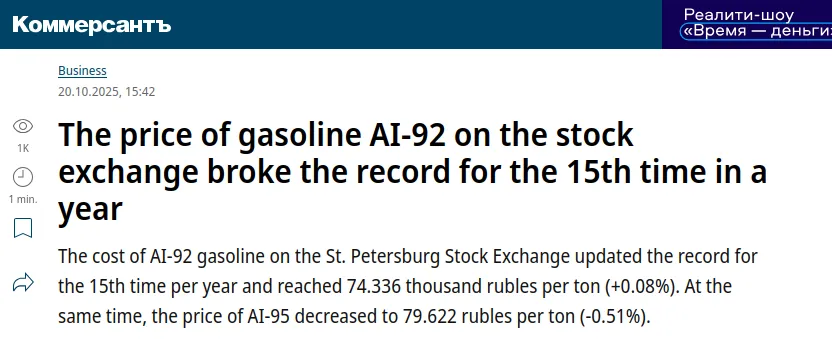
The federal government has responded to this crisis by banning gasoline exports through the end of the year. But this temporary prohibition does not include restrictions on the flow of heavily discounted crude and natural gas to Moscow’s esteemed regional partners.
As a result, Russians now exist in an upside-down world where they are paying exorbitant prices for Russian gasoline (assuming it’s available), while Moscow’s neighbors—almost all of them seeking closer ties with the West and NATO—reap the benefits of generously subsidized Russian energy.
Let us now turn our attention to Tsargrad’s report on this curious state of affairs.
Full tanks of independence: Gasoline from Russian gas stations is flowing to neighboring countries. Moscow will pay for everything
By Ivan Prokhorov
While gasoline and diesel prices are rising in Russia’s regions, and there are restrictions at gas stations, duty-free tankers of Russian fuel continue to flow to “friends” in the Commonwealth of Independent States (CIS). Moscow is feeding other countries’ economies while its own economy is already in a state of austerity. Benefits, loans, and debt forgiveness are all provided to countries that are increasingly aligning with regimes that are hostile to Moscow. Russia is supporting its neighbors to its own detriment—but is it worth the cost?
Russia as a fuel sponsor to post-Soviet regimes
After the collapse of the USSR, Moscow assumed the unofficial role of “generous big brother”, guaranteeing the energy stability of the former Soviet republics. Initially this was justified by a shared past, and then by economic interests and obligations to allies. However, Russia has been using its own resources to support the political regimes of its neighbors for decades, through the provision of oil and fuel at zero tariffs, debt forgiveness, and artificially low prices.
Kyrgyzstan receives up to 1.2 million tons of petroleum products from Russia every year without export duties. This is enshrined in an intergovernmental agreement signed in 2016. On this basis, Kyrgyzstan stabilizes its fuel and lubricant market, maintains domestic prices, and avoids fuel crises of its own. In return, Russia loses export revenue, which it compensates for with budget “damper” subsidies.
Tajikistan has also had a preferential import regime for Russian fuel since 2013, with no export duties. These supplies have been extended until 2025, effectively subsidizing the regime of Emomali Rahmon, whose domestic market relies heavily on Russian supplies. Moscow not only turns a blind eye to re-exports but also regularly forgives debts, such as the cancellation of approximately $300 million in debt owed by the Sangtuda Hydroelectric Power Plant in exchange for Russian companies’ involvement in its management.
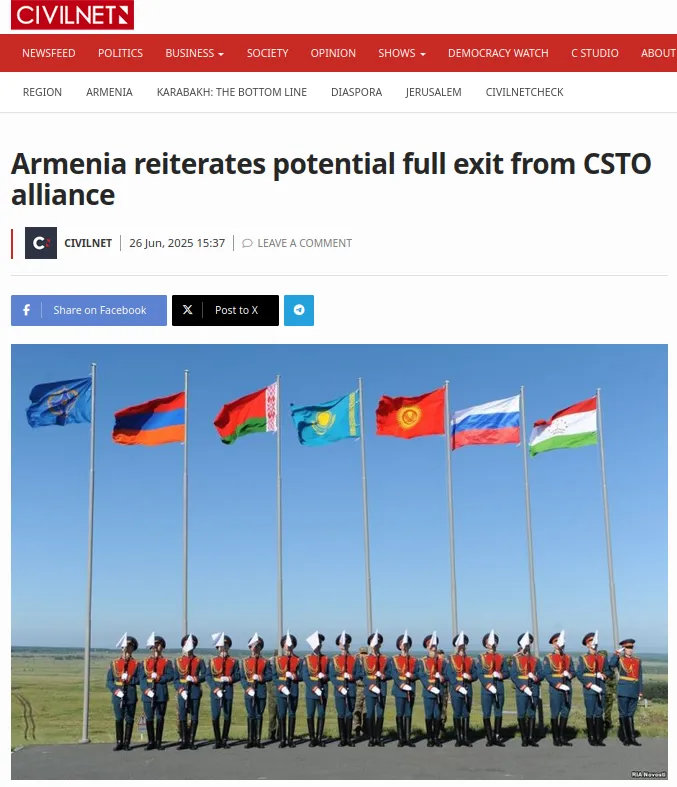
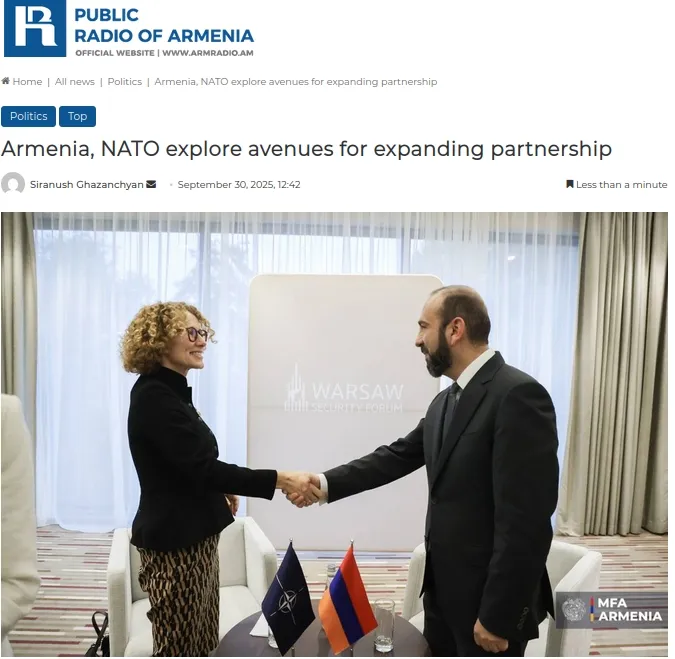
Armenia was given access to discounted Russian gas and petroleum in exchange for joining the Eurasian Economic Union [in 2015]. In fact, this is an energy subsidy that supports the republic’s budget and industry, but it does not guarantee strategic loyalty. Yerevan continues to shift its policy towards the West, taking advantage of Russian fuel.
While Moscow is busy, Armenia is quietly drifting towards the West.
Kyrgyzstan and Tajikistan previously had significant debts to Russia, amounting to hundreds of millions of dollars, which were completely written off in the 2010s. In return, Russia received only symbolic promises of “friendship forever” and the participation of these countries in the Eurasian Economic Union (EAEU) and the Collective Security Treaty Organization (CSTO). Similar write-offs have occurred in other cases, with Moscow forgiving tens of billions of dollars in debts to countries in the CIS and Africa, thereby financing their budgets instead of its own.
Against this backdrop, Russia continues to experience a shortage of fuel on the domestic market. At the same time, “friends” from the post-Soviet space are not only well-supplied, but often have lower gasoline prices than Russia due to their tax laws. Kazakhstan sells AI-92 for around $0.45 per liter, while Belarus sells it for $0.76, compared to Russia’s $0.78. Even in Kyrgyzstan and Armenia, where prices are higher, there is no shortage due to the import of fuel from Russia.
These examples show that Russia is actually acting as a donor of energy stability for its neighbors. It provides them with fuel, benefits, and loans, ensuring their social stability and budgetary balance. In return, there are no investments, no control, and no guaranteed support on the international stage. These policies only succeed in ensuring these regimes that they can rely on Russian resources.
Moscow remains the main supplier of vital energy for the post-Soviet states, but it is receiving less and less political or economic return from role.
What does Russia get in return, what is the pay-off?
At first glance, Russia maintains its influence in the post-Soviet space through preferential oil and gas supplies. However, if we examine the economic and political outcomes of this system, it becomes clear that the cost of this “friendship” is disproportionate to its benefits.
From an economic point of view, the scheme of supporting neighbors results in direct losses. After export duties on oil and petroleum products were abolished in 2019, the Russian budget lost a stable and clear source of income. Duty-free supplies to allies mean that Russia is effectively supplying them with fuel at domestic prices, and exporters have no incentive to keep their products on the domestic market. The reduction of payments to oil companies and the decline in export revenues create a hole that is being plugged with domestic taxes.
The political return on these sacrifices is also questionable. The recipients of Russian benefits do not demonstrate stable loyalty. Armenia, which receives heavily discounted gas, is simultaneously turning towards the West and limiting its cooperation within the CSTO. Kyrgyzstan and Tajikistan vote neutrally in the UN, avoiding open support for Moscow. Kazakhstan, a formal ally, is balancing between Russia, China, and Turkey. The subsidies do not translate into political capital, as supposed allies receive resources that aren’t tied to any obligations.
Even the economic dependence of its neighbors does not translate into loyalty towards Moscow. Russia supplies them with oil, but local oligarchs control the refining, trade, and distribution. In Kyrgyzstan and Tajikistan, subsidies are lost in intermediary schemes and do not reach the consumer. In fact, Moscow subsidizes the social stability of foreign countries, while the ruling elite benefits from political influence.
Russia supplies fuel to countries that have Turkish and Chinese investments, and even Western military programs. This creates a paradox: Russian fuel and loans are fueling the stability of regimes that are turning towards other centers of power.
The bottom line is clear: Russia pays to be feared, but it is not listened to. Allies take advantage of its generosity while maintaining political autonomy and forming parallel alliances. Duty-free imports, debt forgiveness, and energy incentives only reinforce Russia’s role as a regional sponsor, spending resources to mimic influence.
We feed the CIS, but we have nothing in our own pockets
For years, Russia has built its relations with its post-Soviet neighbors by keeping the flock at the trough with generous handouts. But the days of cheap fuel and bought friendship are over. No matter how much you feed a wolf, it still looks to the forest, and former “brothers” are naturally drawn to those who offer not discounts but a comprehensive strategy.
The problem is not even Moscow’s generosity—if there was a higher goal, it would make sense. However, let’s face it: Russia has yet to articulate its mission, and it vacillates between the West and the East, trying to be friends with everyone at once—with the same result as trying to sit on two chairs.
The internal emptiness of Russian politics makes its generosity fruitless. Moscow subsidizes its neighbors without explaining why. It balances between the West and the East, between liberal rhetoric and state conservatism, without deciding where its home is or why it should build an alliance around it. As a result, Russia spends billions without creating an ideological field, which means no one is gravitating towards it.
So what?
Until there is a clear mission—cultural, civilizational, or political—all the benefits that Russia provides to its allies at the expense of its own people will remain a waste of money. Alliances without ideas are only based on benefit, and those seeking only benefit are always looking for alternatives. Russia should not buy loyalty; it should make people want to be with it. This will only be possible when Russia has a clear direction of its own.
The main lesson is simple: energy without a purpose becomes a drain. Russia can and should support its neighbors, but on new principles of partnership, calculation, and a common mission. Otherwise, all the duty-free supplies and forgiven debts will remain nothing more than payment for oblivion.
Published October 14, 2025
Closing thoughts from Edward: Again, the above article was published by a media outlet with an editorial line geared towards Russia’s conservative Christians. Unsurprisingly, it proceeds from the assumption that Moscow is a victim of its own generosity. Even the author’s more direct criticisms of the Kremlin—that it has failed to “articulate a mission” for Russia, leading to rudderless policy-making—rules out the possibility that the Russian government has articulated a mission, and that its seemingly directionless policy decisions, which often treat the interests of the Russian people as a secondary consideration, reflect this mission.
This is another example of the limitations of heuristic-based thinking. Common sense would dictate that the Russian government works to advance the interests of the Russian people. Ergo, if these interests are being neglected, it’s likely for completely innocent reasons: Cynical, self-serving neighbors are taking advantage of the Kremlin’s boundless generosity, while its search for a clear mission is burdened by its own naivety and desire to help others.
To presume otherwise would defy common sense and lead to unpleasant thoughts.
So it’s not surprising that the author of this Tsargrad article uses cognitive shortcuts to explain what might motivate Moscow to provide subsidized energy to countries that aggressively pursue anti-Russia policies. The article works from the common sense assumption that Moscow is using its vast energy resources to seek influence and secure allies in the region, but has failed to achieve the intended results.
This could be because the author believes in his heart that the Kremlin means well but has lost its way. It could also be because departing from the state-approved Overton Window (“The Russian government is very generous, but perhaps it’s too generous?”) could land you in hot water with the authorities. It’s known to happen, now and then.
Even if he bases his reasoning on the least painful possibility, it would be wrong to accuse the author of hopelessly wishful thinking. The article does not hide the fact that subsidies supplied by Russia “are lost in intermediary schemes” of “local oligarchs”. While energy supplies maintain “social stability in foreign countries”, they primarily benefit their ruling elite, who are actively pursuing closer ties to the West. This is confusing. The author even admits that “Moscow subsidizes its neighbors without explaining why”.
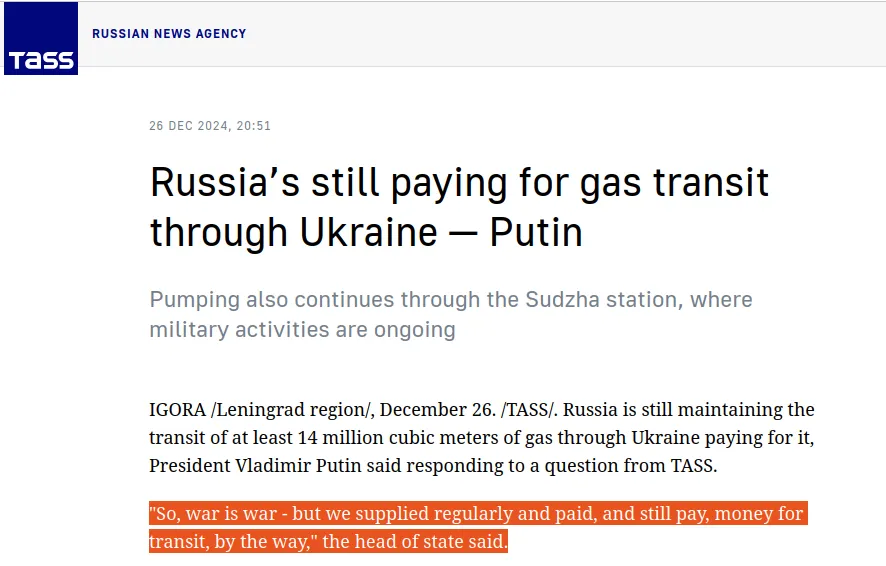
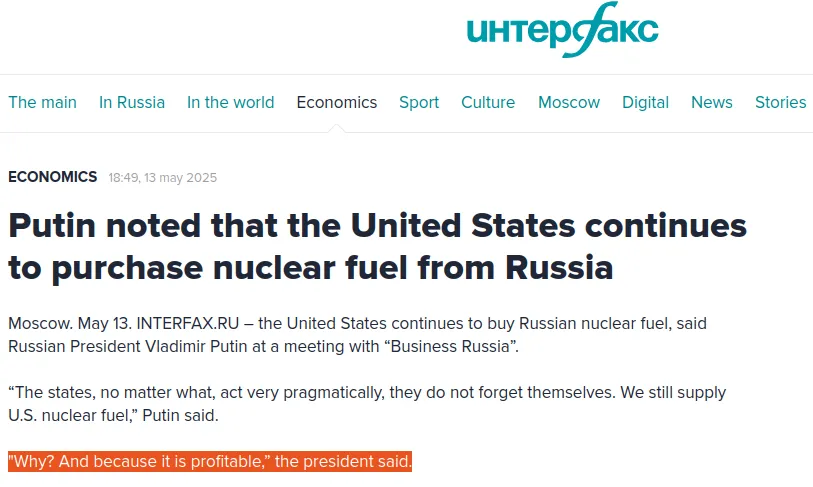
We cannot rule out the possibility that the Russian people have been double-crossed by Bad Boyars. Then again, the Tsar has also advocated for profit-driven pragmatism when seeking mutually beneficial cooperation with foreign states that are killing Russians on Russian soil.
We mustn’t be too quick to judge. It’s not easy being the world’s only moral superpower.