
Deliberate demolition of Germany’s and Europe’s economy
Tue 3:42 pm +00:00, 17 Dec 2024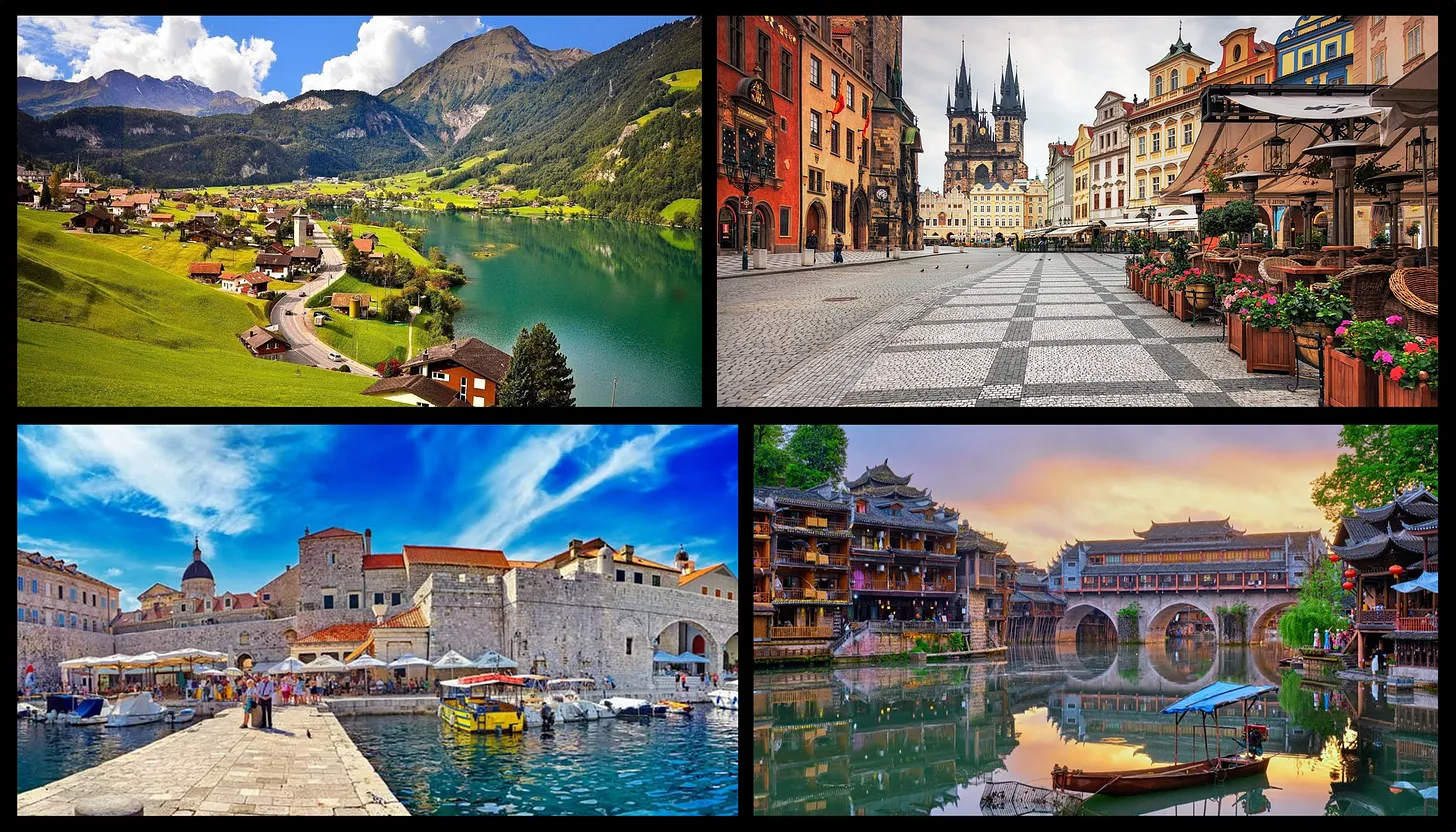
Why shouldn’t everywhere we live be beautiful?
Source: https://alexkrainer.substack.com/p/the-magic-essence-of-economic-development
The magical essence of economic development
That magic is us (+ credit)

The ongoing decline of Germany is gradually reversing one of the world’s most remarkable economic success stories. The standard explanations of this sad development usually include criticism of the incompetent government, pursuit of net zero policies and sustaining collateral damage in the empire’s war against Russia. All these explanations contain an element of truth, but what’s usually missing from such discussions are the secrets of Germany’s success.
Up until about ten years ago, Germany was the world’s No. 1 exporting superpower. But contrary to what one might assume, most of Germany’s exports were not products of known and recognized brands like Bosch, Mercedes or BMW. More than 50% of German exports were products and services developed by her (once) burgeoning small and medium-sized enterprises, most of them companies you may have never heard of. But such businesses were the engine of German industrial dynamism.
Home of the hidden champions
In a YouTube video titled, “Conversation with Professor Richard Werner,” Dr. Werner explains the phenomenon. Germany was the home base of the world’s largest number of hidden “champions” – market leaders that occupied either first, second or third spot in terms of the global market share of whatever product or service they produced. Some 1,500 German firms qualified as market champions.
For perspective, the distant second in terms of number of market champions was the U.S.A. which has about 300 such companies. So, how did Germany create fully 1,500 market champions? We always heard stories about the excellence of German engineering and the well educated and disciplined workforce, etc. But those are children’s tales that miss the mark and explain nothing.
Banking as a public utility
Rather, as Werner explained it, the secret of Germany’s success, which has had a 200-year continuity in spite of suffering through biblical crises over this period, is in her banking system which Werner said was the best in the world. American economist Michael Hudson also wrote extensively about German industrial banking. Germany had the largest number of banks in Europe: about 1,500 small, local banks.
Fully 70% of these banks were non-profit community banking institutions. Their core business was funding local small and medium-sized enterprises. They tended to have close relationships with their clients and actively participated in their business development, helping them fund and organize their operations and finances, break into new markets and network with other, similar businesses. It was not uncommon in Germany for local banking institutions to extend 100-year loans to their clients.
The magic is us (+ credit)
I think I’m not alone when I say that I must have witnessed dozens, perhaps hundreds of enthusiastic conversations among friends about this or that business idea – something that would make sense and be successful; something they knew they could do if they had the money to get it off the ground… Sadly, all too often that entrepreneurial spark is extinguished for the lack of funding.

But with ample credit at favorable terms, family businesses could develop their products and services and find markets for them. The family’s second and third generations, educated with advanced degrees in engineering, design, chemistry or biotechnology could refine and perfect the company’s offerings and thus gain a competitive advantage over their worldwide rivals who did not benefit from such a fertile and beneficial environment and could not confidently make long-term commitments to the development of their business.
Ultimately, creating a favorable environment for the development of small banking institutions and incentivizing them to provide long-term funding for the development of SMEs in their own regions is what policy makers could and should do to kick-start the engine of economic development. It amounts to simply empowering the individuals with the will to do and a soul to dare with the support they need to get started.
This is actually a fairly well understood concept and should be pursued by any sovereign democracy. This principle is consistent across the world. In a 2019 article, Eric Peters of One River Asset Management recounted a discussion with a Japanese colleague and a former central banker. He said that, “The dynamism in Japan’s economy is not to be found in the conglomerates. To find the really interesting companies you must look at the small and mid-sized firms that supply the large players – they’re the ones where you find the creativity, the risk takers, the innovators.”
The world over, based on the data from some 70 different nations, it emerges that SMEs are the main job creators: up to 80% of all jobs are created by SMEs. They also create the right kind of economic dynamism because, unlike large systems, SMEs create the needed, productive jobs and foster efficiency, innovation and competitive advantage. Collectively, they generate a nation’s wealth. By contrast, the large, zombified corporations tend to generate state dependency, kill innovation and dynamism and create what David Graeber called, “bullshit jobs.”

Having a large number of successful SMEs also gives an economy a certain resilience through economic or financial crises: even in tough times, commitment at family owned SMEs remains high, downsizing limited and cohesion strong. Family-owned SMEs don’t slave to quarterly earnings statements and they won’t move their operations to another nation as readily as large corporations will. Regional rootedness of SMEs also creates the local wealth effect.
Their owners and workers tend to have roots in their own communities; they eat food and drink water locally; travel on local roads, send their children to local schools, sports clubs and cultural centers, use local doctors and local dentists and frequent local social events. This all fortifies a community spirit and the commitment to creating safe and beautiful living spaces and continuously improving the life of that community
This could have a real and durable effect, as opposed to hollow corporate virtue signalling for PR-purposes while every other consideration is subordinated to the tyranny of quarterly income statements (and therefore not a penny can be spent on anything that could reduce the corporation’s profits and clip its share price).
Given that we actually know all this (not that it is being widely discussed), and that we know that our developed economies are phenomenally productive, it becomes harder to explain why Germany should now be in an economic decline. Indeed, why should any nation be in economic decline? The answers point to the global economic predator class, the moneylending oligarchy controlling the GSIBs, or Global Systemically Important Banks.
Sovietization of Europe’s banking industry
In the case of Germany, beyond the current government’s misadventure with Project Ukraine and their commitment to Global Goals and net zero policies, the foundations of German economic success have been under a deliberate and sustained attack by the European Central Bank which has been on a mission of consolidating the banking industry and destroying small local and regional banks.
Across the EU, the ECB has thus far culled some 6,000 small banks, in many cases depriving Europe’s SME’s of their financial lifeline. We might also ask why the IMF’s structural adjustments consistently move their client economies farther away from sustainable economic development and prosperity.
These are not accidents of incompetent leadership. The principles I summarized above are well understood by top level policy makers – or they should be. What we are experiencing is a deliberate demolition of Germany’s and Europe’s economy. Our next question should be, why? To what end? Unfortunately, because they won’t tell us, we have to try to deduct an explanation ourselves. The conversation continues…